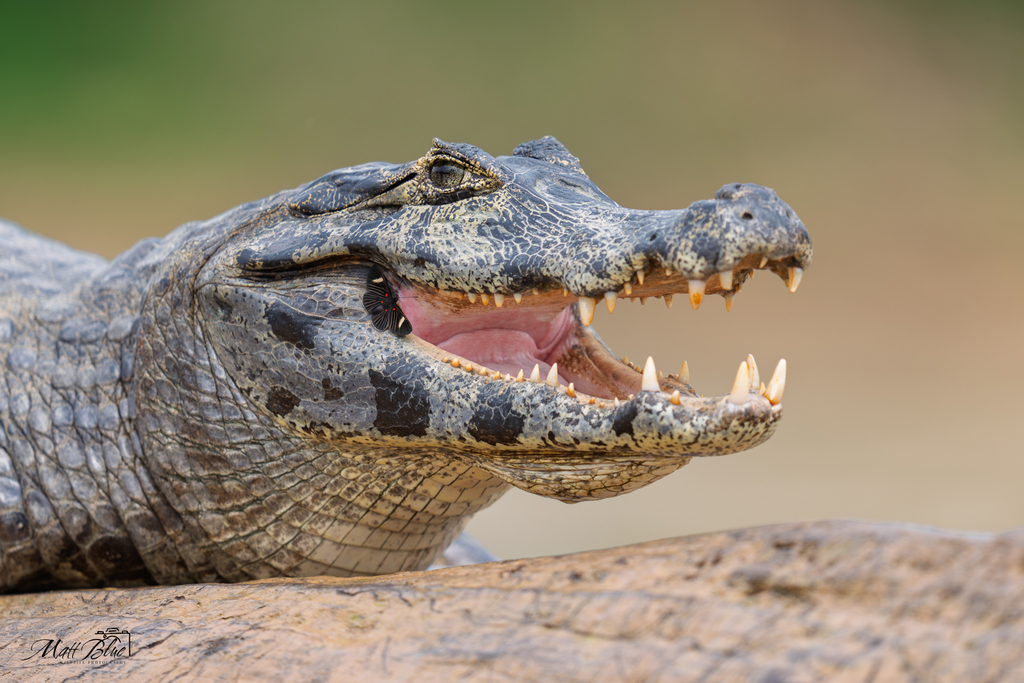
Yacare Caiman
Caiman yacare
The yacare caiman (Caiman yacare), also known commonly as the jacare caiman, Paraguayan caiman, piranha caiman, red caiman, and southern spectacled caiman, is a species of caiman, a crocodilian in the family Alligatoridae. The species is indigenous to Argentina, Bolivia, Brazil, and Paraguay. Brown in color and covered with dark blotches, males grow to a total length (including tail) of 2–3 m (6 ft 7 in – 9 ft 10 in) and weigh around 40–50 kg (88–110 lb); while females grow to 1.4 m (4 ft 7 in) long and about 15–20 kg (33–44 lb). Typical habitats of this caiman include lakes, rivers, and wetlands. Its diet primarily consists of aquatic animals, such as snails, and occasionally land vertebrates. Mating occurs in the rainy season and eggs hatch in March, with young fending for themselves as soon as they hatch. The yacare caiman was hunted heavily for its skin to use for leather in the 1980s, which caused its population to decrease significantly. However, trading restrictions placed since have caused its population to increase. Its population in the Pantanal is about 10 million, and it is listed as least concern on the IUCN Red List.
From the article Yacare caiman on Wikipedia (CC BY-SA), quoted section by section
Description
C. yacare is a medium-sized caiman, brown in color. Male specimens grow to 2–3 m (6 ft 7 in – 9 ft 10 in) in total length (including tail) and up to 58 kg (128 lb) in weight. Females are much smaller, with an adult total length of 1.4 m (4 ft 7 in) and weight of 14–23 kg (31–51 lb). The average snout–vent length (SVL) of hatchlings is 12.49 cm (4.92 in) for females and 12.84 cm (5.06 in) for males. Based on a study of the growth of multiple specimens in the Pantanal from 1987 to 2013, both sexes are about 50 cm (20 in) SVL at age five. By age 15, they have mostly finished growth, with females being about 80 cm (31 in) SVL and males over 100 cm (39 in) SVL. The study also showed that individuals have significant variation in their growth rates.
Dark marks are distributed across the body; most noticeably, its lower jaw is covered with three to five blotches. It has a smooth snout, which is medium in length and broad. It has lumps on its eyelids and a curved ridge between its eyes. It has osteoderms on its scales, a feature also present in the spectacled caiman. It has an average of 74 teeth, with 5 pre-maxillary, 14–15 maxillary, and 17–21 mandibular. Some of the teeth on its lower jaw can poke through holes in its upper jaw. This feature makes its teeth more prominent and has been compared to piranhas, which has established the common name "piranha caiman".
Range & habitat
The range of the yacare caiman includes Argentina (north), Bolivia, Brazil (south), and Paraguay. It is one of three species of genus Caiman in South America, the others being the broad-snouted caiman (C. latirostris) and the spectacled caiman (C. crocodilus), with more easterly and northerly ranges, respectively. The yacare caiman is one of the most common species of caiman on its continent.
Wikipedia: “Distribution”
What it does
The yacare caiman is ecologically similar to the spectacled caiman. It lives in semi-aquatic habitats, including lakes, rivers, and wetlands, but is able to adapt to a variety of habitats. Individuals sometimes move to different locations in groups if their habitat is disturbed. The species' diet consists of aquatic animals, such as snails and fish, and occasionally snakes. It has also been known to eat capybaras. When hunting for snails, this caiman looks within vegetation floating in water and uses its jaws to break the shells of the snails. In July 1986, the stomach of a specimen in Bolivia was observed to be full of mud, along with small parts of eggshells that likely belonged to a caiman. In general, crocodilians can eat the eggshells of their own young subsequent to the young hatching.
Wikipedia: “Ecology”
In human culture
Its specific name, “yacare” (also written “jacare”) entered English primarily through Portuguese, which had adopted the indigenous Tupi-Guarani term jakare to refer to certain caimans and similar reptiles from South America. The adoption of this word into Portuguese (jacaré) and Spanish (yacaré) is due to contact between the Guarani people and the conquistadors during the colonial period and subsequent centuries of linguistic coexistence.
Wikipedia: “Etymology”
Where it lives
Recorded sightings
—
geo-referenced records in GBIF, from museums, herbaria and field observers.
Drag the globe to turn it. Dots are where records exist, not a range map; darker means more records.
In the stacks
Searching the stacks…
Every page naming Caiman yacare in the Biodiversity Heritage Library →
This page is assembled live from iNaturalist, GBIF, Wikipedia, the Source Library and the Internet Archive. It is not yet part of the hand-edited codex. iNaturalist taxon 116570.