On eBird ↗
Brown Eared-Pheasant
Live sightings near you, the range map, bar charts of when it is seen, and Macaulay Library photos and recordings.
Brown Eared-Pheasant
Crossoptilon mantchuricum
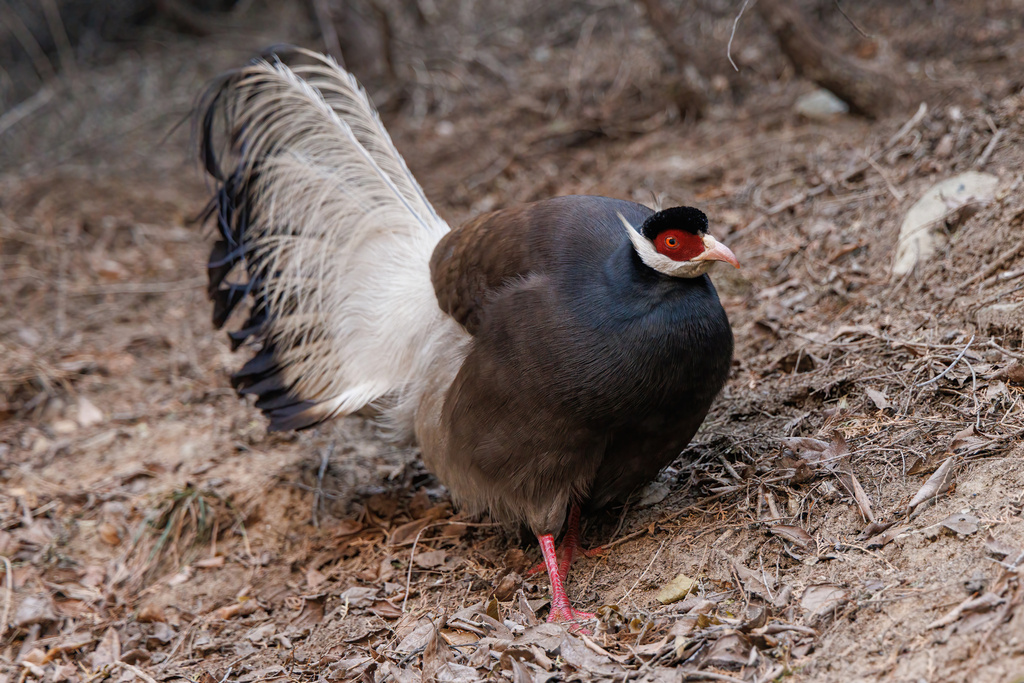
The brown eared pheasant (Crossoptilon mantchuricum) is a large pheasant, 83–110 cm in length. The body is dark brown overall, with the head and neck black and bare bright red facial skin. Long, stiff white ear tufts emerge from the sides of the head, forming a bundle. Both sexes are similar in colouration. The species is endemic to the mountain forests of northern China.
It is similar to the blue eared pheasant (Crossoptilon auritum), but differs in having dark brown (rather than blue) body overall and white lower back and tail.
From the article Brown eared pheasant on Wikipedia (CC BY-SA), quoted section by section
Range & habitat
The brown eared pheasant is distributed in the Xiaowutai Mountains in northwestern Hebei, and in the northwestern Shanxi and Lüliang Mountains regions of China. It primarily inhabits low mountains and hilly areas below 2,500 meters above sea level. During summer and autumn, it prefers secondary mixed forests of conifers and broad-leaved trees or coniferous forests, while in winter it occupies lower-elevation broad-leaved farmland, forest edges, and shrublands. It is mainly terrestrial, favouring open spaces within forests or grasslands along forest edges, and roosts at night on pine or palm trees. It is endemic to China.
Wikipedia: “Habitat and Distribution”
What it does
Outside the breeding season, individuals form flocks beginning in early July, with populations reaching 20 to 60 birds by late September. Flocks have a clear hierarchy, led by a dominant, large male, with another fit bird acting as a sentinel. They spend most of the day foraging, with rest and dust bathing around midday, and generally follow fixed routes to feeding sites in loosely organized lines. When startled, the flock may disperse; the leader then regroups juveniles with adults, females with males, solitary birds with groups, and small groups into larger flocks. When fleeing, birds run uphill and only take flight upon reaching ridge tops, gliding down to valleys or opposite slopes.
Vocalizations. The brown-eared pheasant produces a variety of calls rather than true songs. Its common call is transcribed as "gu-ji" or "gu-gu", used for communication between individuals, including between parents and chicks. The alarm call is a repeated "ji-ji", while a rhythmic "gua-gua-gua" call is produced during courtship displays.
Diet. The brown eared pheasant feeds primarily on various plant materials, but also consumes a small amount of animal food, with its diet changing seasonally based on food availability.
Reproduction. The breeding season of the brown eared pheasant lasts from April to June, with pair formation beginning in mid-March. …
Wikipedia: “Behaviour”
Listen
Looking for field recordings…
Where it lives
Recorded sightings
—
geo-referenced records in GBIF, from museums, herbaria and field observers.
Drag the globe to turn it. Dots are where records exist, not a range map; darker means more records.
In the stacks
Searching the stacks…
Every page naming Crossoptilon mantchuricum in the Biodiversity Heritage Library →
This page is assembled live from iNaturalist, GBIF, Wikipedia, the Source Library and the Internet Archive. It is not yet part of the hand-edited codex. iNaturalist taxon 1167.