- Animals
- ›Chordates
- ›Vertebrates
- ›Birds
- ›Perching Birds
- ›Ovenbirds and Woodcreepers
- ›Typical Ovenbirds
- ›Leptasthenura
On eBird ↗
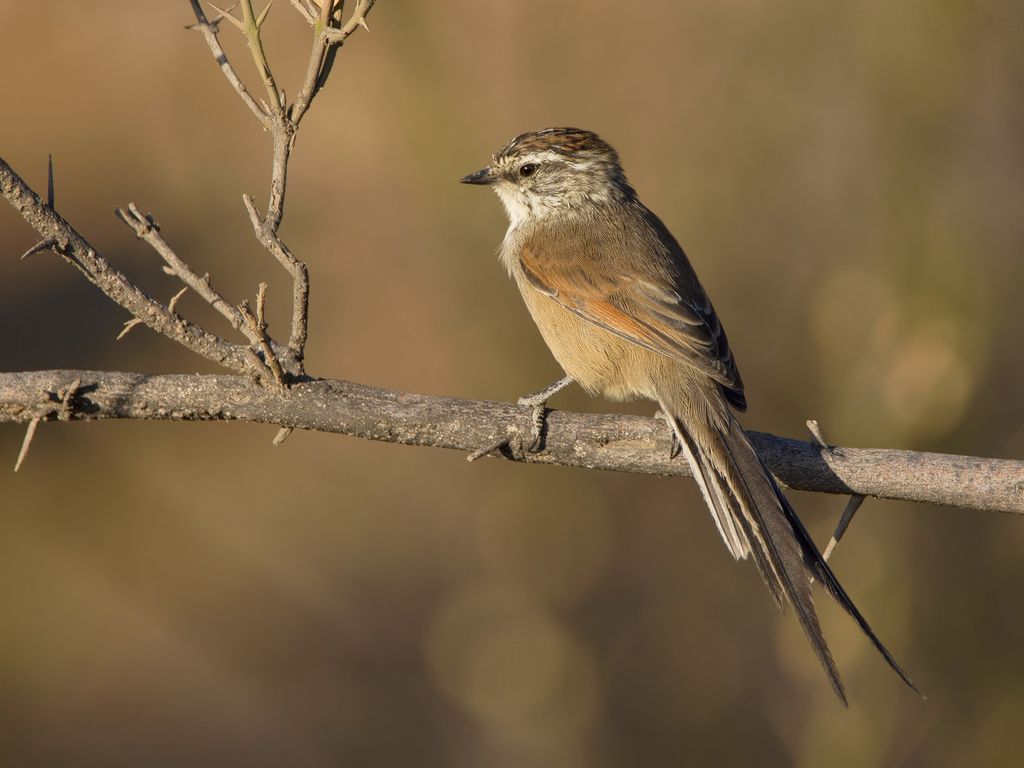
Plain-mantled Tit-Spinetail
Live sightings near you, the range map, bar charts of when it is seen, and Macaulay Library photos and recordings.
Plain-mantled Tit-Spinetail
Leptasthenura aegithaloides
The plain-mantled tit-spinetail (Leptasthenura aegithaloides) is a small passerine bird of South America belonging to the ovenbird family, Furnariidae. It is a common bird across much of Chile, southern and eastern Argentina, southern Peru and western Bolivia. It occurs from 0 to 4,300 metres above sea level in a variety of habitats including arid country, open woodland, forest edge, scrub, grassland, parks and gardens. It forages among leaves and branches, searching for insects.
From the article Plain-mantled tit-spinetail on Wikipedia (CC BY-SA), quoted section by section
Description
The plain-mantled tit-spinetail is 15 to 17 cm (5.9 to 6.7 in) long and weighs 7.5 to 11 g (0.26 to 0.39 oz). It is a small, slender, long-tailed furnariid with a short bill. The sexes have the same plumage. Adults of the nominate subspecies L. a. aegithaloides have a white supercilium on an otherwise dark brownish, whitish streaked, face. Their crown is dark brown with wide golden-tawny streaks, their hindneck dark brown with grayish-white streaks, and their back, rump, and uppertail coverts dull brownish. Their upperwing coverts are dull brownish with rufous edges and their flight feathers dull fuscous with dark rufous bases. Also, their tail feathers are dark fuscous brown with paler edges; the tail is graduated and appears forked due to the central feathers having reduced inner webs. Their throat is whitish with some dark feather edges that increase onto the upper breast. The rest of their breast is dull grayish brown and the rest of their underparts are slightly paler. Their iris is brown, their maxilla blackish to dark gray-brown, their mandible dark horn to greenish gray, and their legs and feet gray to blackish. Juveniles have indistinct crown and throat markings, a lightly spotted back, and rounded tail feathers. Subspecies L. a. …
Range & habitat
The nominate subspecies of the plain-mantled tit-spinetail is found in central Chile between the Coquimbo and Aysén regions. Subspecies L. a. grisescens is the northernmost; it is found coastally from Peru's Department of Arequipa south into northern Chile as far as the Atacama Region. L. a. berlepschi is found in the Andes of southern Peru, northern Chile, western Bolivia, and northwestern Argentina. L. a. pallida is found from northern Argentina and southern Chile south onto Tierra del Fuego. The subspecies of the plain-mantled tit-spinetail inhabit different landscapes. The nominate subspecies and L. a. grisescens occur in arid scrublands (both lowland and montane), open forests, and in the natural vegetation in human-modified areas like agricultural fields, parks, and oases. In elevation, it ranges from near sea level to 2,500 m (8,200 ft) in Chile and up to 2,000 m (6,600 ft) in Peru. Subspecies L. a. berlepschi inhabits puna grasslands and scrublands of the Altiplano. In elevation, it ranges from about 3,500 to 4,300 m (11,500 to 14,100 ft) in Peru and 2,000 to 4,200 m (6,600 to 13,800 ft) in Chile and Argentina. L. a. pallida inhabits scrublands and woodlands at the transition between the lower elevation forest and higher steppe; it also occurs on salt flats and in arid thorny woods. In elevation, it ranges from sea level to 700 m (2,300 ft).
Wikipedia: “Distribution and habitat”
What it does
The plain-mantled tit-spinetail feeds on arthropods. It typically forages in pairs or in small groups that may be families; in the non-breeding season, it forages in flocks of up to about 40 individuals. It regularly joins mixed species feeding flocks. It feeds from the forest's understorey to its canopy, though in some areas it stays quite low and even on the ground. It usually forages by gleaning its prey from foliage, flower clusters, twigs, and branches. It sometimes hangs upside down to reach prey.
Wikipedia: “Feeding”
Listen
Looking for field recordings…
Where it lives
Recorded sightings
—
geo-referenced records in GBIF, from museums, herbaria and field observers.
Drag the globe to turn it. Dots are where records exist, not a range map; darker means more records.
In the stacks
Searching the stacks…
Every page naming Leptasthenura aegithaloides in the Biodiversity Heritage Library →
This page is assembled live from iNaturalist, GBIF, Wikipedia, the Source Library and the Internet Archive. It is not yet part of the hand-edited codex. iNaturalist taxon 11672.