On eBird ↗
Jocotoco Antpitta
Live sightings near you, the range map, bar charts of when it is seen, and Macaulay Library photos and recordings.
Jocotoco Antpitta
Grallaria ridgelyi
The jocotoco antpitta (Grallaria ridgelyi) is an endangered antpitta, a bird from Ecuador and Peru. It was discovered in 1997, and scientifically described in 1999.
From the article Jocotoco antpitta on Wikipedia (CC BY-SA), quoted section by section
Description
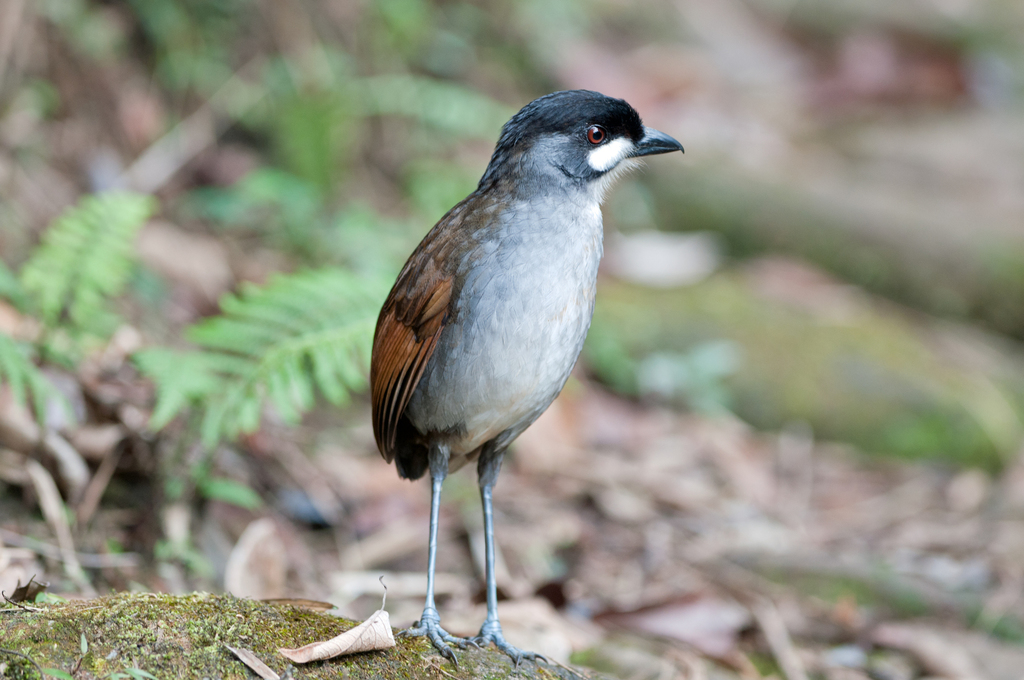
Grallaria antpittas are a "wonderful group of plump and round antbirds whose feathers are often fluffed up...they have stout bills [and] very short tails". The jocotoco antpitta is the largest member of its family. It is 20 to 24 cm (7.9 to 9.4 in) long and weighs about 150 to 200 g (5.3 to 7.1 oz). The sexes have the same plumage. Adults have a black crown and brownish olive nape. They have a large, somewhat shaggy, fan-shaped white patch from the bill to below the eye. Their ear coverts are gray. Their upperparts are brownish olive with a black wash that lessens from the mantle to the rump. Their tail is reddish brown. Their flight feathers have blackish inner webs and cinnamon outer webs, and their upperwing coverts are brownish olive with a black band. Their throat is snowy white. Their underparts are mostly light gray that is darker on the flanks which also have a brownish olive wash. Their undertail coverts are brownish olive with fine black bars. Both sexes have a dark red to crimson reddish brown iris, a black bill, and blue-gray legs and feet. Juveniles are similar to adults but more muted and with a chestnut crown.
Range & habitat
The jocotoco antpitta is known only from a very small number of locations in southeastern Ecuador and adjacent Peru. It was originally believed to be limited to the upper Chinchipe River drainage in Zamora-Chinchipe, Ecuador, but in 2006 a population was discovered in Cordillera del Cóndor in Cajamarca, Peru. It inhabits steep slopes within wet, dense, mossy forest with Chusquea bamboo stands and silvery-leaved Cecropia trees. In Ecuador it occurs between 2,300 and 2,650 m (7,500 and 8,700 ft). The observations in Peru were made at about 2,250 m (7,400 ft).
Wikipedia: “Distribution and habitat”
What it does
The jocotoco antpitta is one of several antpittas that regularly come to feeding stations set up to view them. There they are fed earthworms, which are thought to also be a large part of their natural diet. In the wild they also feed on arthropods and other invertebrates. They are almost entirely terrestrial, seeking prey by probing leaf litter with their bill and flipping it with their bill and feet. They occasionally follow army ant swarms to capture prey disturbed by the ants.
Wikipedia: “Feeding”
Listen
Looking for field recordings…
Where it lives
Recorded sightings
—
geo-referenced records in GBIF, from museums, herbaria and field observers.
Drag the globe to turn it. Dots are where records exist, not a range map; darker means more records.
In the stacks
Searching the stacks…
Every page naming Grallaria ridgelyi in the Biodiversity Heritage Library →
This page is assembled live from iNaturalist, GBIF, Wikipedia, the Source Library and the Internet Archive. It is not yet part of the hand-edited codex. iNaturalist taxon 116778.