- Animals
- ›Chordates
- ›Vertebrates
- ›Birds
- ›Perching Birds
- ›Ovenbirds and Woodcreepers
- ›Typical Ovenbirds
- ›Leptasthenura
On eBird ↗
White-browed Tit-Spinetail
Live sightings near you, the range map, bar charts of when it is seen, and Macaulay Library photos and recordings.
White-browed Tit-Spinetail
Leptasthenura xenothorax
The white-browed tit-spinetail (Leptasthenura xenothorax) is a Near Threatened species of bird in the Furnariinae subfamily of the ovenbird family Furnariidae. It is endemic to Peru.
From the article White-browed tit-spinetail on Wikipedia (CC BY-SA), quoted section by section
Description
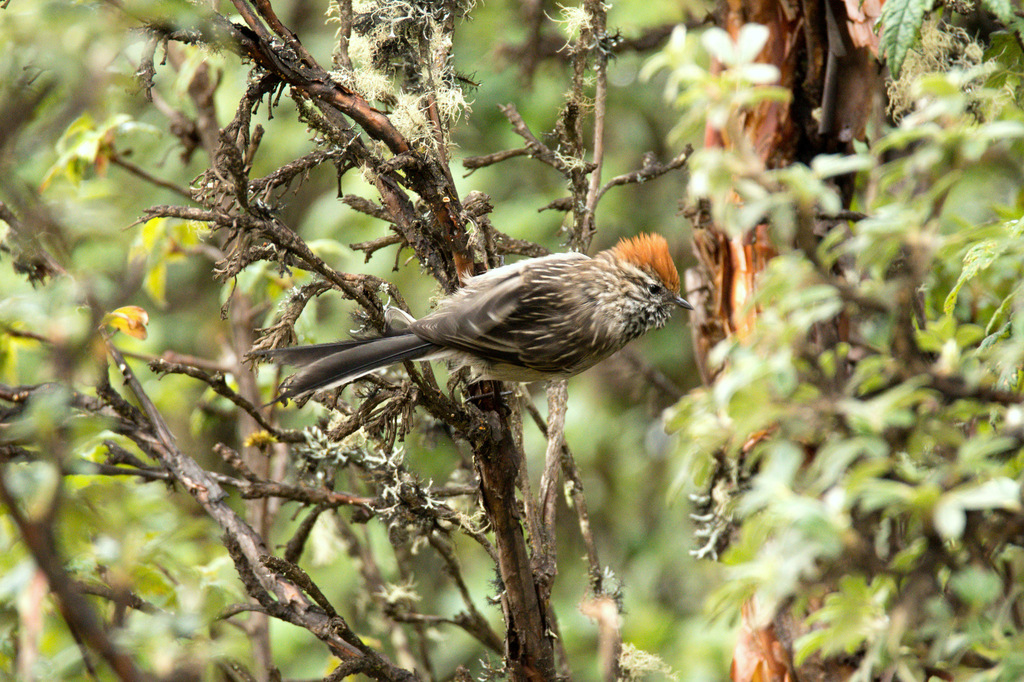
The white-browed tit-spinetail is 16 to 18 cm (6.3 to 7.1 in) long and weighs about 13 g (0.46 oz). It is a small-bodied, long-tailed furnariid with a short bill. The sexes have the same plumage. Adults have a white supercilium with a narrow black border above it on an otherwise blackish and whitish streaked face. Their crown is bright rufous. Their upperparts are dull grayish brown, with narrow black-outlined white streaks that become more prominent on the lower back, then fainter on the rump, and become more obvious but still pale on the uppertail coverts. Their wings are dark fuscous with dull rufescent edges on the coverts and a pale tawny patch across the flight feathers. Their tail is mostly dark fuscous to black; the feathers have bare shafts on their tips giving a spiny appearance. Their throat and upper breast are whitish with coarse black mottling and the rest of their underparts are unmarked pale gray-brown. Their iris is brown to blackish gray, their bill black with a pinkish base to the mandible, and their legs and feet black.
Range & habitat
The white-browed tit-spinetail is found only in the Peruvian Andes. It is only known from a few locations in the departments of Cuzco and Apurímac. It primarily inhabits Polylepis woodlands but occasionally occurs in montane scrublands. It favors large areas of primary forest but will forage in smaller patches. In elevation it occurs between 3,700 and 4,550 m (12,100 and 14,900 ft) but is most common in the lower part of that range.
Wikipedia: “Distribution and habitat”
What it does
The white-browed tit-spinetail feeds on arthropods but its diet is not known in detail. It forages in pairs or small family groups and regularly joins mixed-species foraging flocks. It typically forages acrobatically in dense foliage near the top and on the outermost branches of Polylepis trees, where it gleans the foliage for prey.
Wikipedia: “Feeding”
Listen
Looking for field recordings…
Where it lives
Recorded sightings
—
geo-referenced records in GBIF, from museums, herbaria and field observers.
Drag the globe to turn it. Dots are where records exist, not a range map; darker means more records.
In the stacks
Searching the stacks…
Every page naming Leptasthenura xenothorax in the Biodiversity Heritage Library →
This page is assembled live from iNaturalist, GBIF, Wikipedia, the Source Library and the Internet Archive. It is not yet part of the hand-edited codex. iNaturalist taxon 11681.