On eBird ↗
Lapland Longspur
Live sightings near you, the range map, bar charts of when it is seen, and Macaulay Library photos and recordings.
Lapland Longspur
Calcarius lapponicus
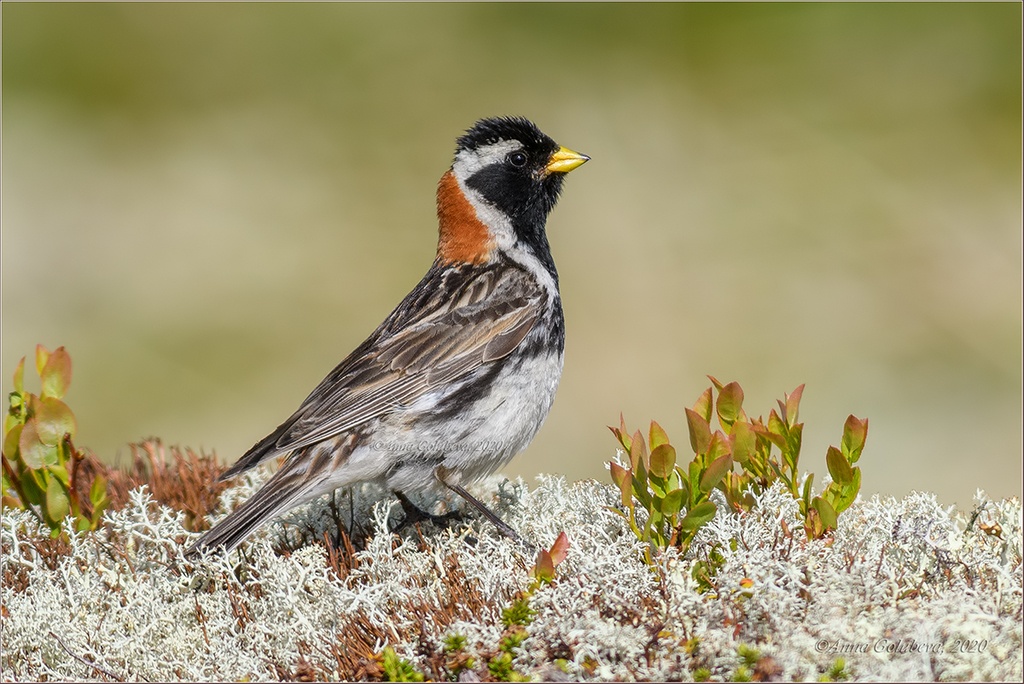
The Lapland longspur (Calcarius lapponicus), also known as the Lapland bunting, is a passerine bird in the longspur family Calcariidae. It is a circumpolar arctic breeder and the only member of the genus Calcarius present in Eurasia.
From the article Lapland longspur on Wikipedia (CC BY-SA), quoted section by section
Description
The Lapland longspur is a robust bird, with a thick yellow seed-eater's bill. The summer male has a black head and throat, white eyestripe, chestnut nape, white underparts, and a heavily streaked black-grey back. Other plumages have a plainer orange-brown head, a browner back and chestnut nape and wing panels. Measurements:
Length: 5.9–6.3 in (15–16 cm) Weight: 0.8–1.2 oz (22.3–33.1 g) Wingspan: 8.7–11.4 in (22–29 cm)
Range & habitat
It breeds across Arctic Europe and the Palearctic and in Canada and the northernmost United States. It is migratory, wintering in the Russian steppes, the southern United States, Northern Scandinavian arctic areas and down to coastal Southern Sweden, Denmark and Great Britain. This is the only Asian species of the longspur buntings, and while it probably did not evolve there, it has been present in Eastern Europe for at least about 30,000 years.
Wikipedia: “Distribution and habitat”
At the table
The food habits of the Lapland longspur are quite simple: mostly seeds in winter and arthropods in the summer, when they are in activity. During the winter, the longspur feeds on seeds. They pick them on the ground, rarely feeding directly on plants. They will forage around the same area for a period varying between a few minutes and an hour, then fly away looking for a new foraging area. Their seed diet is composed mainly of seeds from grass, foxtail, cultivated millet, crabgrass and wheat. During the breeding season, the birds migrate to the north, where their diet switches to arthropods. Nestlings are only fed arthropods, which also constitute the diet of the parents at that time of the year (June to July). The birds often catch insects in mid-air, but do forage through vegetation when climatic conditions prevent the insects from flying. Longspurs can consume between 3000 and 10,000 prey items (insects or seeds) per day, depending on their energy needs; they may need to increase this number by 3000 when feeding the young. Dipteran larvae and adults form the major part of their insectivorous diet.
Wikipedia: “Food habits”
Listen
Looking for field recordings…
Where it lives
Recorded sightings
—
geo-referenced records in GBIF, from museums, herbaria and field observers.
Drag the globe to turn it. Dots are where records exist, not a range map; darker means more records.
In the stacks
Searching the stacks…
Every page naming Calcarius lapponicus in the Biodiversity Heritage Library →
This page is assembled live from iNaturalist, GBIF, Wikipedia, the Source Library and the Internet Archive. It is not yet part of the hand-edited codex. iNaturalist taxon 116840.