On eBird ↗
Cetti's Warbler
Live sightings near you, the range map, bar charts of when it is seen, and Macaulay Library photos and recordings.
Cetti's Warbler
Cettia cetti
Cetti's warbler /ˈtʃɛti/, Cettia cetti, is an Old World warbler. It is a small, brown bush-warbler which breeds in southern and central Europe, north-west Africa and east southern temperate Asia as far as Afghanistan and north-west Pakistan. The bird is named after the 18th century Italian zoologist, Francesco Cetti. This species is very difficult to see because of its skulking habits.
From the article Cetti's warbler on Wikipedia (CC BY-SA), quoted section by section
Description
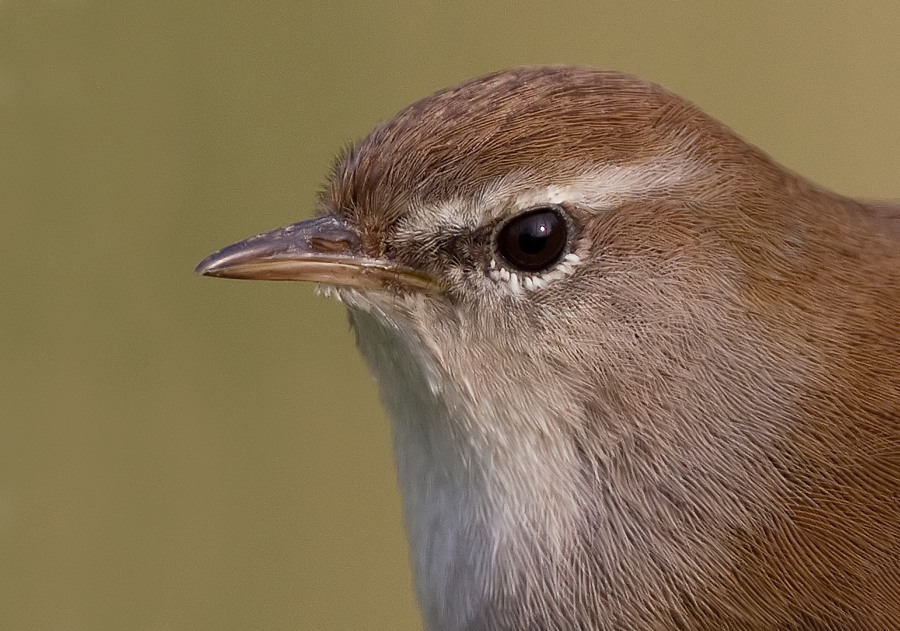
Cetti's warbler is approximately 13–14 cm (5.1–5.5 in) from bill to tail. The male weighs 15 g (0.53 oz) and the female 12 g (0.42 oz). Cetti's warbler has a rounded head with a narrow pale grey stripe arching over conspicuous black eyes, and short, rounded wings. The upperparts are a rich chestnut or dark reddish-brown; the throat and breast are pale grey-brown. The tail is longer and broader than many other warblers. The sexes have similar plumage, but males are 26% to 32% heavier than females with a wing-length 11.2% to 13% longer. The male has a wing longer than 60 mm; the female has a wing shorter than 55 mm. The birds can be aged by their plumage; juveniles look similar to adults but have fresh plumage and two dark or dark grey spots on the tongue. Cetti's warbler is unusual among passerine birds in having ten tail feathers (rectrices) rather than the usual twelve. Cetti's warblers signal their presence with loud song. Their song is distinct, comes in loud bursts, and has a unique structure that allows the birds to avoid mating with other species.
Range & habitat
Cetti's warbler usually inhabits thick shrubby vegetation in damp areas close to (but not in) ponds, lakes, marshes and rivers. The number of Cetti's warblers has greatly increased across Europe since 1990. The current population of Cetti's warblers in Europe is estimated to be about 600,000-1,600,000 breeding pairs. The populations in Italy and Turkey are known to be stable or increasing. The exception to the general positive European population trend is in Greece, where the population decreased slightly between 1990 and 2000. However, overall, Cetti's warblers are evaluated as secure. Cetti's warbler was first recorded in the United Kingdom in 1961, with the first breeding in 1972–73. Population growth was rapid at first, then fell by over a third between 1984 and 1986 following the severe 1985–86 winter, but rebounded again rapidly thereafter. UK populations continue to grow; by 2016 there were 3,450 territorial males, distributed throughout most of England and Wales, with the first breeding in Scotland in 2023. It was first recorded in Ireland in 2013, with the first breeding in 2022.
Wikipedia: “Distribution and habitat”
What it does
Cetti's warbler is insectivorous, preying on arthropods such as small, soft-bodied insects and larvae. Cetti's warblers prefer tiny insects because they can digest them faster.
Wikipedia: “Feeding”
Listen
Looking for field recordings…
Where it lives
Recorded sightings
—
geo-referenced records in GBIF, from museums, herbaria and field observers.
Drag the globe to turn it. Dots are where records exist, not a range map; darker means more records.
In the stacks
Searching the stacks…
Every page naming Cettia cetti in the Biodiversity Heritage Library →
This page is assembled live from iNaturalist, GBIF, Wikipedia, the Source Library and the Internet Archive. It is not yet part of the hand-edited codex. iNaturalist taxon 116858.