On eBird ↗
White-throated Antpitta
Live sightings near you, the range map, bar charts of when it is seen, and Macaulay Library photos and recordings.
White-throated Antpitta
Grallaria albigula
The white-throated antpitta (Grallaria albigula) is a species of bird in the Grallariidae family. It is found in Argentina, Bolivia, and Peru.
From the article White-throated antpitta on Wikipedia (CC BY-SA), quoted section by section
Description
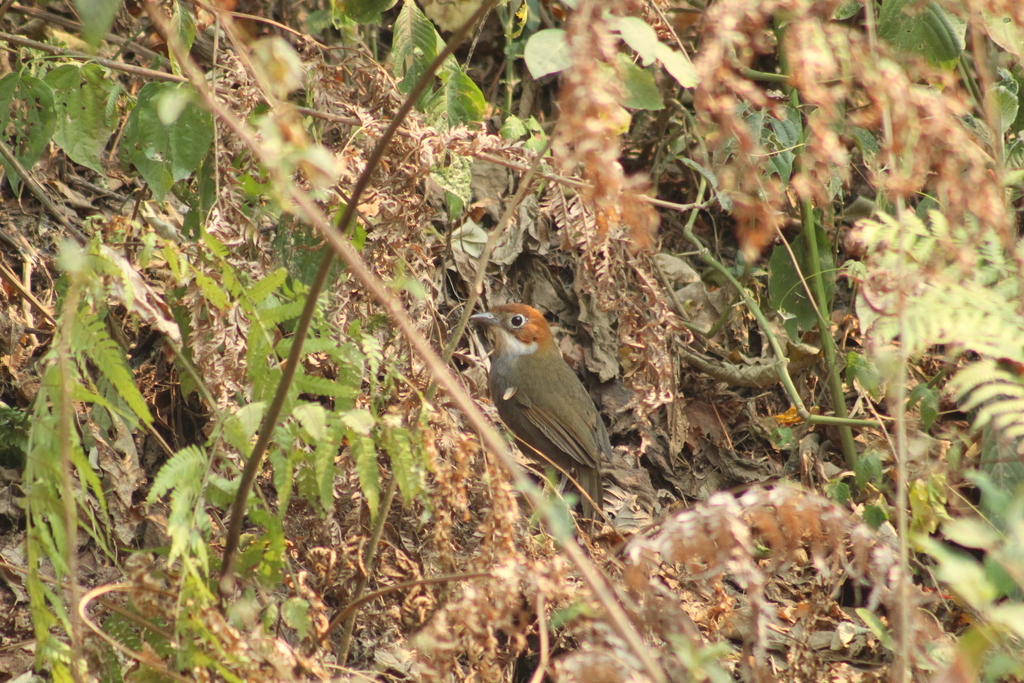
Grallaria antpittas are a "wonderful group of plump and round antbirds whose feathers are often fluffed up...they have stout bills [and] very short tails". The white-throated antpitta is 18.5 to 20 cm (7.3 to 7.9 in) long and weighs 84 to 95 g (3.0 to 3.4 oz). The sexes have the same plumage. Adults of the nominate subspecies have a bright chestnut-rufous crown, nape, and ear coverts. They have grayish lores and a ring of pale bluish white bare skin around their eye. Their upperparts are mostly olivaceous-brown with reddish brown uppertail coverts and tail. Their wings are mostly reddish brown with tawny-brown leading edges on the primaries and brownish olive upperwing coverts. Their throat is white that extends back under the ear coverts. Their breast and belly are pale gray to medium gray that is lighter on the central breast and belly; their flanks have an olive wash. Their undertail coverts are pale gray with an olive-brown wash. Subspecies G. a. cinereiventris has an entirely gray breast and belly and flanks washed with sepia-olive. Adults of both subspecies have a brown iris, a blackish gray maxilla, a blue-gray mandible, and blue-gray legs and feet.
Range & habitat
The white-throated antpitta has a disjunct distribution. One population of the nominate subspecies is found from the Department of Cuzco in southeastern Peru southeast slightly into northwestern Bolivia. The other is found from Cochabamba Department in central Bolivia south to about the Argentina border. Subspecies G. a. cinereiventris is found in the Argentinian provinces of Jujuy and Salta. The species primarily inhabits the understory of humid montane forest. In parts of Bolivia it also is found in semi-deciduous and deciduous woodlands, shrubby and scrubby areas, and patches of bamboo. In Argentina it mostly occurs in humid temperate semi-deciduous and deciduous forest. In Peru it ranges in elevation mostly between 1,150 and 2,100 m (3,800 and 6,900 ft) though overall it ranges between 600 and 2,700 m (2,000 and 8,900 ft).
Wikipedia: “Distribution and habitat”
What it does
The white-throated antpitta's diet has not been detailed but is known to include insects and spiders; it probably also eats earthworms like many other Grallaria antpittas. It is almost entirely terrestrial, foraging along the ground, usually in dense vegetation.
Wikipedia: “Feeding”
Listen
Looking for field recordings…
Where it lives
Recorded sightings
—
geo-referenced records in GBIF, from museums, herbaria and field observers.
Drag the globe to turn it. Dots are where records exist, not a range map; darker means more records.
In the stacks
Searching the stacks…
Every page naming Grallaria albigula in the Biodiversity Heritage Library →
This page is assembled live from iNaturalist, GBIF, Wikipedia, the Source Library and the Internet Archive. It is not yet part of the hand-edited codex. iNaturalist taxon 116889.