On eBird ↗
Bay Antpitta
Live sightings near you, the range map, bar charts of when it is seen, and Macaulay Library photos and recordings.
Bay Antpitta
Grallaria capitalis
The bay antpitta (Grallaria capitalis) is a species of bird in the Grallariidae family. It is endemic to Peru.
From the article Bay antpitta on Wikipedia (CC BY-SA), quoted section by section
Description
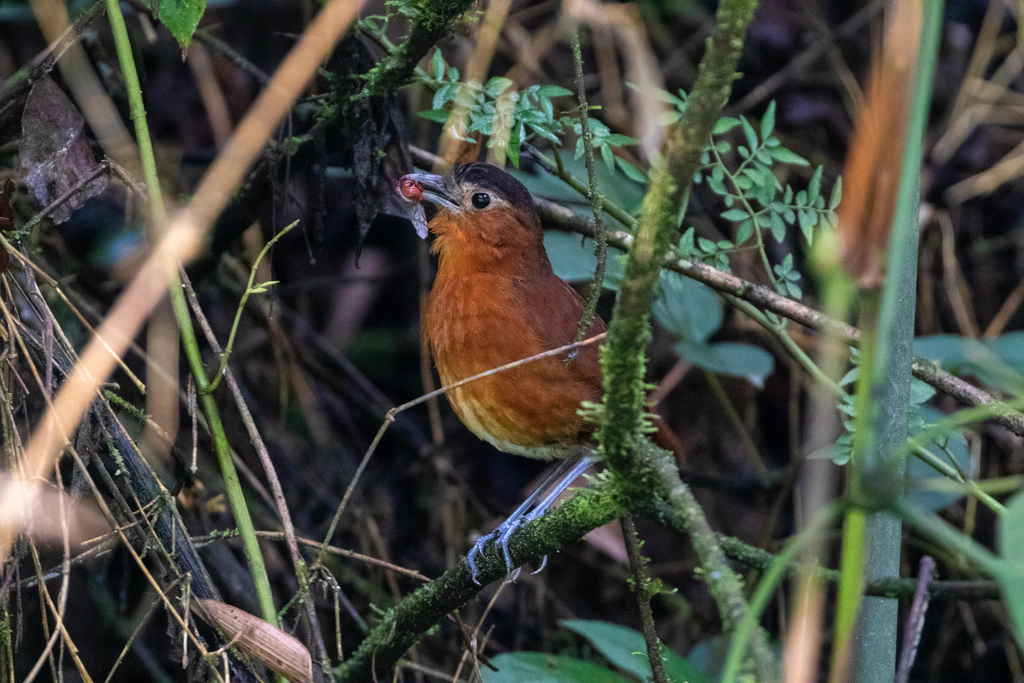
Grallaria antpittas are a "wonderful group of plump and round antbirds whose feathers are often fluffed up...they have stout bills [and] very short tails". The bay antpitta is 16 to 17 cm (6.3 to 6.7 in) long and weighs 65 to 77 g (2.3 to 2.7 oz). The sexes have the same plumage. Adults have a dusky brown or dark russet brown crown. They have a rufous or blackish lores. Their back, rump, wings, and tail are rufous chestnut. Their underparts are mostly rufous that is darker on the breast and paler on the belly; the center of their belly is whitish buff. Both sexes have a dark brown iris, a blue-gray bill, and blue-gray legs and feet.
Range & habitat
The bay antpitta is found on the east side of the Peruvian Andes in Huánuco, Pasco, and Junín departments. It inhabits the understory of humid montane forest, often in areas where thick vegetation is regrowing such as in landslide scars, the edges of secondary forest, and abandoned slash-and-burn fields. In elevation it mostly ranges between 1,800 and 3,000 m (5,900 and 9,800 ft) though locally as low as 1,500 m (4,900 ft).
Wikipedia: “Distribution and habitat”
What it does
The bay antpitta's diet and foraging behavior have not been detailed but it is known to feed on insects and small snails. It is almost entirely terrestrial, where it runs and hops along the ground, usually in dense vegetation.
Wikipedia: “Feeding”
Listen
Looking for field recordings…
Where it lives
Recorded sightings
—
geo-referenced records in GBIF, from museums, herbaria and field observers.
Drag the globe to turn it. Dots are where records exist, not a range map; darker means more records.
In the stacks
Searching the stacks…
Every page naming Grallaria capitalis in the Biodiversity Heritage Library →
This page is assembled live from iNaturalist, GBIF, Wikipedia, the Source Library and the Internet Archive. It is not yet part of the hand-edited codex. iNaturalist taxon 116891.