On eBird ↗
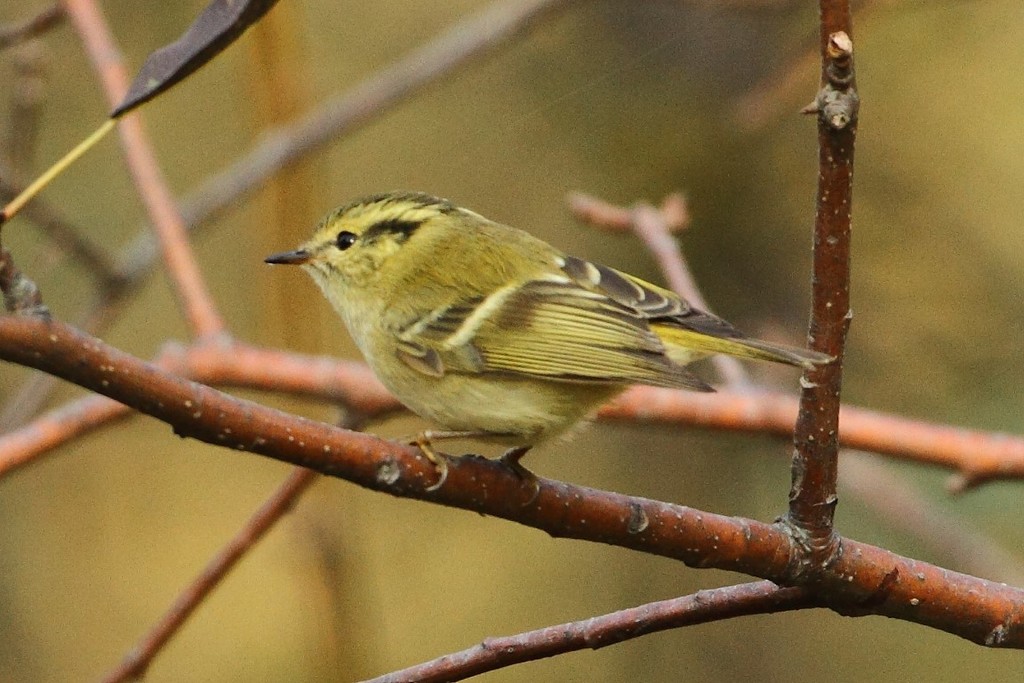
Lemon-rumped Warbler
Live sightings near you, the range map, bar charts of when it is seen, and Macaulay Library photos and recordings.
Lemon-rumped Warbler
Phylloscopus chloronotus
The Lemon-rumped Warbler (Phylloscopus chloronotus), also known as the Pale-rumped
Warbler, is a small species of Old World warbler in the family Phylloscopidae. It is native to the Himalayas, breeding in montane forests and wintering in the southern foothills and the Purvanchal Range. The species is structurally identical to the Sichuan Leaf Warbler (Phylloscopus forresti), but differs in vocalizations.
From the article Lemon-rumped warbler on Wikipedia (CC BY-SA), quoted section by section
Description
The Lemon-rumped Warbler is 9–10 cm long and weighs about 4.6–5.1 g. It has a whitish crown stripe bordered by darker olive-brown sides, a pale line above the eye, and a dark eyestripe that often curves downward. The upperparts are greenish-grey, and the rump is yellowish or whitish, which gives the species its name. The wings are grey-brown with green edging and usually show one or two pale wingbars. The underparts are whitish or buff with some grey along the breast sides. The bill is dark with a yellowish or orange base to the lower mandible, and the legs are dark grey. Males and females are similar, though females are slightly smaller. Juveniles resemble adults. Two subspecies are recognized: one in the central and eastern Himalayas and another in the west, which shows greener and more buff-toned plumage.
Range & habitat
The species breeds across the Himalayas from northern Pakistan through Nepal into India, Bhutan, and China. In winter, it descends to lower elevations, reaching Assam and occasionally Myanmar, though its presence in Afghanistan is uncertain. It inhabits montane forests between 2 200 and 4 200 meters above sea level. In Pakistan it is most frequent at elevations of 2 200–2 700 m, while in Nepal it ranges up to 4 000 m. Winter records occur from 300–2 700 m, generally above 1 000 m. Breeding habitat includes spruce and fir forests with rhododendron and broadleaf trees, as well as oak and lower-elevation broadleaf stands near the conifer zone.
Wikipedia: “Distribution and habitat”
What it does
Its diet consists mainly of insects and larvae. It forages alone or in pairs in winter but also joins mixed-species flocks. Foraging occurs in the canopy and understory, often involving short hovering or sallies to catch prey in the air—a behavior known as flycatching.
Wikipedia: “Feeding”
Listen
Looking for field recordings…
Where it lives
Recorded sightings
—
geo-referenced records in GBIF, from museums, herbaria and field observers.
Drag the globe to turn it. Dots are where records exist, not a range map; darker means more records.
In the stacks
Searching the stacks…
Every page naming Phylloscopus chloronotus in the Biodiversity Heritage Library →
This page is assembled live from iNaturalist, GBIF, Wikipedia, the Source Library and the Internet Archive. It is not yet part of the hand-edited codex. iNaturalist taxon 117014.