On eBird ↗
Chestnut Antpitta
Live sightings near you, the range map, bar charts of when it is seen, and Macaulay Library photos and recordings.
Chestnut Antpitta
Grallaria blakei
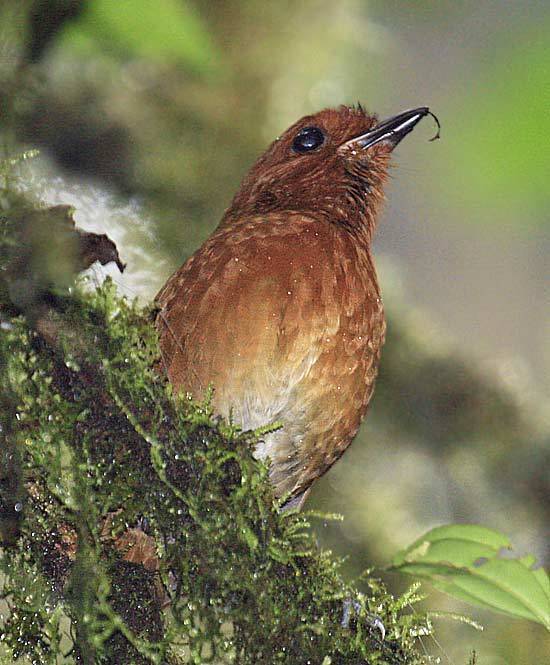
The chestnut antpitta (Grallaria blakei) is a species of bird in the Grallariidae family. It is endemic to Peru.
From the article Chestnut antpitta on Wikipedia (CC BY-SA), quoted section by section
Description
The chestnut antpitta is about 14.5 to 15 cm (5.7 to 5.9 in) long; six individuals weighed between 37 and 47 g (1.3 and 1.7 oz). The sexes have the same plumage. Adults have rufous brown upperparts. Their lores and most of their face are rufous. Their throat and breast are pale rufous, their belly whitish buff with obscure dusky barring, their flanks brown or olive brown, and their vent and undertail coverts tawny brown. They have a brown iris, a black bill, and slate, blue-gray, or silvery gray legs and feet.
Range & habitat
The chestnut antpitta is found intermittently on the eastern slope of the Peruvian Andes from the Cordillera de Colán in Amazonas Department south for an unknown distance but short of northern Huánuco Department. It inhabits humid montane forest and secondary forest where it favors stands of bamboo and other dense undergrowth.
Wikipedia: “Distribution and habitat”
What it does
The chestnut antpitta's diet and foraging behavior have not been detailed; it is assumed to eat arthropods and perhaps small vertebrates as do other members of genus Grallaria . It is known to forage on or very near the ground.
Wikipedia: “Feeding”
Listen
Looking for field recordings…
Where it lives
Recorded sightings
—
geo-referenced records in GBIF, from museums, herbaria and field observers.
Drag the globe to turn it. Dots are where records exist, not a range map; darker means more records.
In the stacks
Searching the stacks…
Every page naming Grallaria blakei in the Biodiversity Heritage Library →
This page is assembled live from iNaturalist, GBIF, Wikipedia, the Source Library and the Internet Archive. It is not yet part of the hand-edited codex. iNaturalist taxon 117158.