On eBird ↗
Nauru Reed Warbler
Live sightings near you, the range map, bar charts of when it is seen, and Macaulay Library photos and recordings.
Nauru Reed Warbler
Acrocephalus rehsei
The Nauru reed warbler (Nauruan: itsirir) (Acrocephalus rehsei) is a passerine bird endemic to the island of Nauru in the Pacific Ocean. It is one of only two native breeding land-birds on Nauru and it is the only passerine found on the island. It is related to other Micronesian reed warblers, all of which evolved from one of several radiations of the genus across the Pacific. Related warblers on nearby islands include the Caroline reed warbler, with which the Nauru species was initially confused, and the nightingale reed warbler, which was formerly sometimes considered the same species.
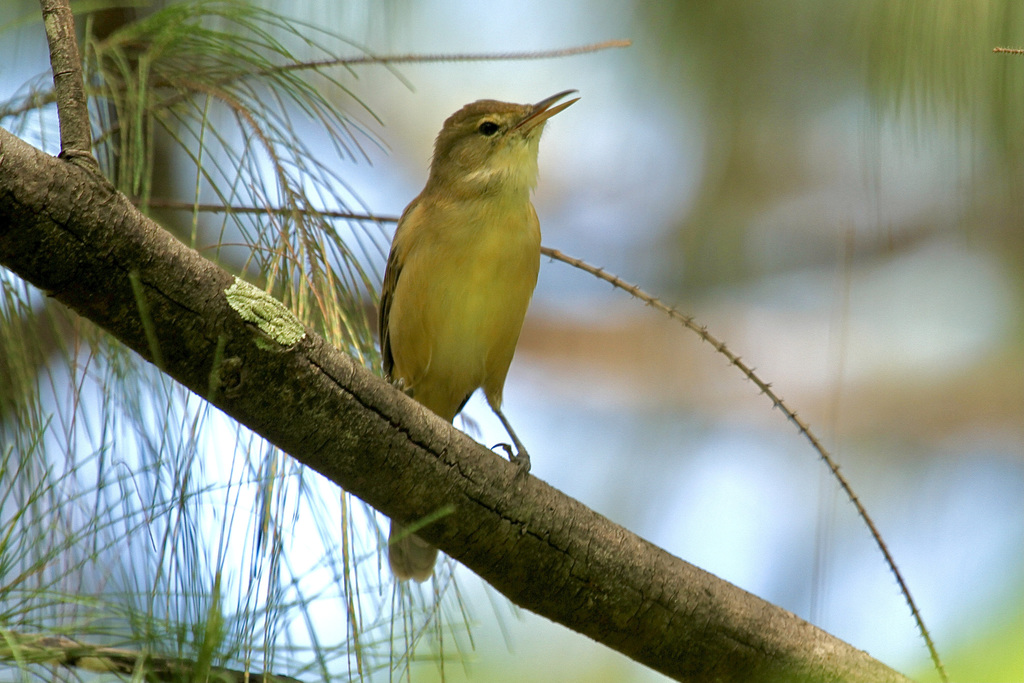
A medium-sized warbler, the Nauru reed warbler has dark brown upperparts, cream underparts and a long, thin beak. It makes a low, cup-shaped nest into which it lays two or three white eggs, and it feeds on insects. However, details about its behavior and ecology are little known. It is found throughout Nauru, which has changed substantially in recent decades due to phosphate mining. The Nauru reed warbler is potentially threatened by introduced predators and habitat loss, and its small range means that it could be vulnerable to chance occurrences, such as tropical cyclones. Reports of a similar warbler from nearby islands suggest that it might previously have been found elsewhere, but was driven to local extinction by introduced cats.
From the article Nauru reed warbler on Wikipedia (CC BY-SA), quoted section by section
Description
The Nauru reed warbler is a medium-sized and warmly coloured reed warbler, with a relatively light build. The entirety of the upperparts are dark brown, with the rump and uppertail coverts slightly brighter than the tail and mantle. When closed, the wing is the same colour as the mantle, short and rounded. The wing does not reach the start of the tail feathers, which enhances the appearance of a long tail. Close inspection of the wing reveals darker centres to both the greater coverts and tertial feathers. Its face shows little contrast, as the ear coverts, crown, nape, chin and throat are all a similar shade of pale brown. The lores are a dark brown, and there is a pale, creamy supercilium, or "eyebrow", extending from the beak to the ear coverts, which are a cinnamon-brown, darkening and merging with the nape. The beak is long, thin and straight. The underparts are much lighter, darkening towards the vent and undertail coverts. The chin is a dull cream, merging with the throat, which then browns towards the base. The centre of the breast is a dull brown-yellow, while the sides are a reddish brown. The upper mandible of the beak is dark grey with pink edges, while the lower mandible is pink, darkening towards to the tip. The legs and feet are dark grey. …
Range & habitat
The Nauru reed warbler is endemic to the island of Nauru, in the Pacific Ocean. It is one of only two indigenous land birds which breed on the island, the other being the Micronesian pigeon. The warbler can be found throughout the island, thriving in the scrubland in areas previously used for phosphate mining, as well as the remaining patches of forest on the island's central plateau. It is most common in the remains of forest found on the island's steep slopes. It is also readily observed in gardens and ruderal areas on the island's coast. In 1881, Finsch described the species as abundant, calling it "as common as the House-Sparrow in England." Biologist Donald Buden again found it widespread on the island in 2008. The species is sedentary, meaning that the birds do not naturally leave Nauru. Banaba is the nearest island, and despite being similar to Nauru, it lacks any warblers. However, it is possible that populations of the Nauru reed warbler existed on other islands until comparatively recently. On the Marshall Islands, traditional stories refer to a small bird, known in Marshallese as annañ, anang or annãng. This bird was considered the property of chieftains. Though no physical descriptions exist of the species, it has been described as butterfly-sized, pleasant-smelling and as living among rocks on the shores of north-western islands. …
Wikipedia: “Distribution and habitat”
What it does
Nauru reed warbler nests are cup-shaped and woven from grasses and twigs. They sometimes include Cassytha filiformis vine or Casuarina equisetifolia needles. The nests are bound to upright stems in a way typical of warblers. Buden reported that the warblers nest in trees and shrubs at a height of 2 to 8 m (6.6 to 26.2 ft). The species may also nest on the ground; the young in ground nests may be more vulnerable to predation by rats. Eggs have variously been reported in December and July, and ornithologist A. Pearson suggested that the species may nest all year round. The clutch size has been reported as two or three eggs. Incubation and fledgling periods are unknown. Pearson reported lower nesting than Buden, recording nests in bushes and undergrowth between 45 and 300 cm (18 and 118 in) from the ground, especially in forked branches of hibiscus and lime. Buden reported that the birds were more vocal in December than in March and April. The song has been described as similar to that of a song thrush, common blackbird, or willie wagtail, and it is delivered both day and night. Finsch described the warbler as insectivorous, feeding primarily on dragonflies. Six species of dragonfly have been observed on the island: Ischnura aurora, Anax guttatus, Diplacodes bipunctata, Pantala flavescens, Tholymis tillarga and Tramea transmarina. …
Wikipedia: “Behaviour and ecology”
Listen
Looking for field recordings…
Where it lives
Recorded sightings
—
geo-referenced records in GBIF, from museums, herbaria and field observers.
Drag the globe to turn it. Dots are where records exist, not a range map; darker means more records.
In the stacks
Searching the stacks…
Every page naming Acrocephalus rehsei in the Biodiversity Heritage Library →
This page is assembled live from iNaturalist, GBIF, Wikipedia, the Source Library and the Internet Archive. It is not yet part of the hand-edited codex. iNaturalist taxon 117182.