On eBird ↗
Santa Marta Antpitta
Live sightings near you, the range map, bar charts of when it is seen, and Macaulay Library photos and recordings.
Santa Marta Antpitta
Grallaria bangsi
The Santa Marta antpitta (Grallaria bangsi) is a species of bird in the Grallariidae family. It is endemic to Colombia. Its natural habitat is subtropical or tropical moist montane forests. It is threatened by habitat loss.
From the article Santa Marta antpitta on Wikipedia (CC BY-SA), quoted section by section
Description
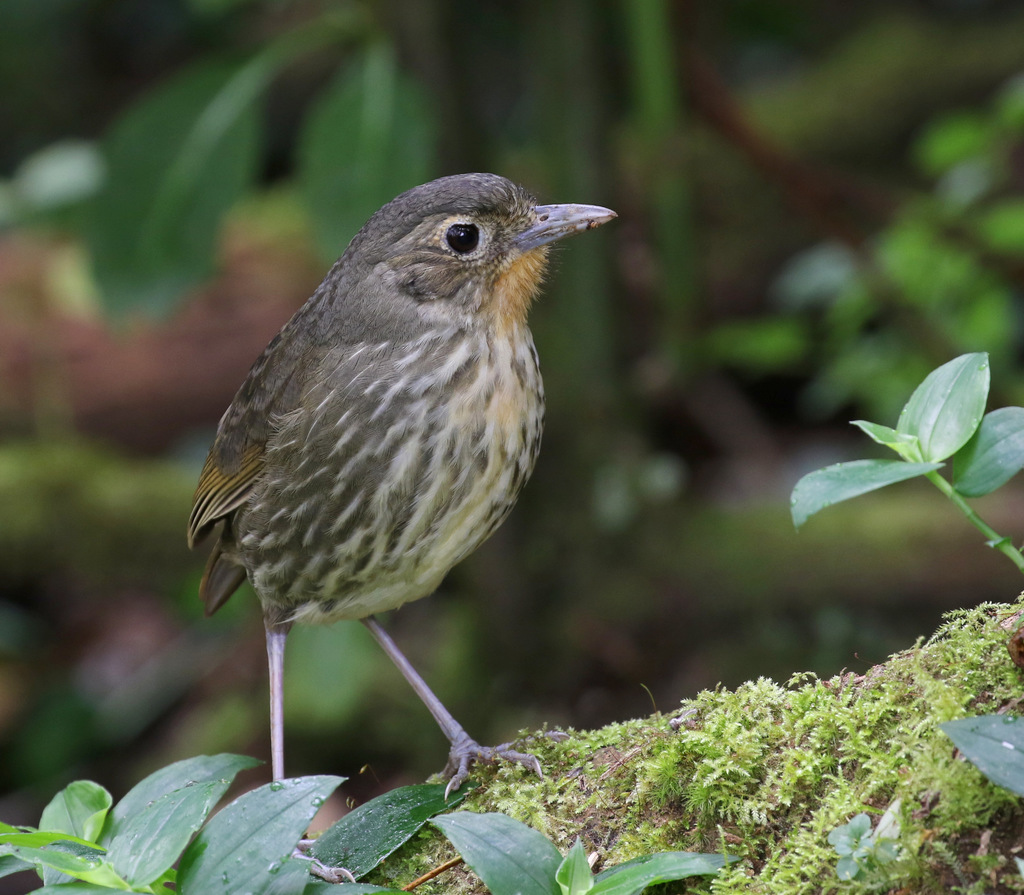
Grallaria antpittas are a "wonderful group of plump and round antbirds whose feathers are often fluffed up...they have stout bills [and] very short tails". The Santa Marta antpitta is 17 to 18 cm (6.7 to 7.1 in) long; one male weighed 62 g (2.2 oz). The sexes have the same plumage. Adults have a mostly dark olive-brown crown, nape, and upperparts. Their flight feathers and tail are brownish olive. They have buffy whitish lores and a narrow buffy ring around their eye on an otherwise white-streaked olive-brown face. Their throat is deep ochraceous buff. Their underparts are whitish with wide dusky olive-brown streaks. Both sexes have a dark brown iris, a bluish gray bill, and dark gray to bluish gray or leaden blue legs and feet.
Range & habitat
The Santa Marta antpitta is found only in the isolated Sierra Nevada de Santa Marta in northern Colombia's Magdalena Department. It inhabits the floor and understory in the interior and edges of humid cloudforest and mature secondary forest. It is frequently seen in clearings and along roadsides. In elevation it ranges from 1,200 to 2,500 m (3,900 to 8,200 ft) and perhaps somewhat higher. Most encounters are above 1,600 m (5,200 ft).
Wikipedia: “Distribution and habitat”
What it does
The Santa Marta antpitta is one of several antpittas that regularly come to feeding stations set up to allow viewing them. There they are fed earthworms and similar invertebrates, which are thought to also be a large part of their natural diet. In the wild they also feed on arthropods, seeds, and small vertebrates like frogs. They are almost entirely terrestrial, hopping on the ground to seek prey and only occasionally moving up to a low perch.
Wikipedia: “Feeding”
Listen
Looking for field recordings…
Where it lives
Recorded sightings
—
geo-referenced records in GBIF, from museums, herbaria and field observers.
Drag the globe to turn it. Dots are where records exist, not a range map; darker means more records.
In the stacks
Searching the stacks…
Every page naming Grallaria bangsi in the Biodiversity Heritage Library →
This page is assembled live from iNaturalist, GBIF, Wikipedia, the Source Library and the Internet Archive. It is not yet part of the hand-edited codex. iNaturalist taxon 117199.