On eBird ↗
Ijima's Leaf Warbler
Live sightings near you, the range map, bar charts of when it is seen, and Macaulay Library photos and recordings.
Ijima's Leaf Warbler
Phylloscopus ijimae
Ijima's leaf warbler (Phylloscopus ijimae) (also known as Izu leaf warbler, Ijima's willow warbler or Ijima's warbler) is a species of Old World warbler in the family Phylloscopidae. It is found in Japan, the Philippines, and Taiwan. Its natural habitats are subtropical or tropical dry forests, subtropical or tropical moist lowland forests, and subtropical or tropical moist shrubland. It is threatened by habitat loss, but is locally abundant in steep and densely wooded areas whose topography
From the article Ijima's leaf warbler on Wikipedia (CC BY-SA), quoted section by section
Description
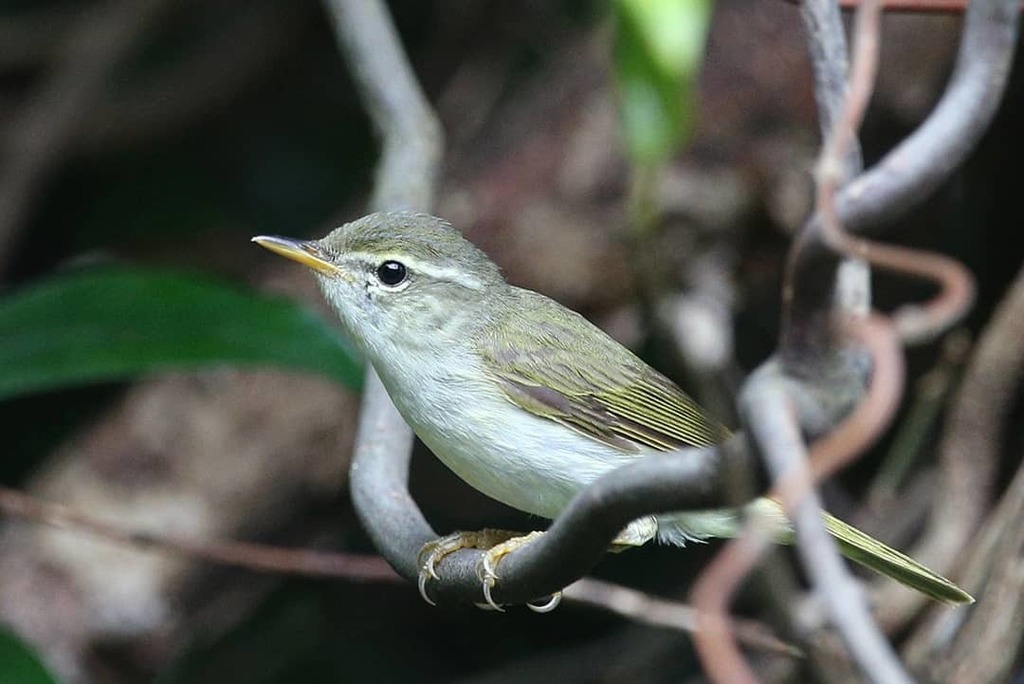
Ijima's leaf warbler is a small passerine with a total length of 11.5 cm (4.5 in) and weight of around 10 g (0.35 oz). The crown and nape are a greenish-grey, upperparts a bright olive green, flanks greyish, and underparts white. It has a long white or buffish-white supercilium, blackish eyestripe, and dark brown iris. The beak is relatively long and "broad-based", the upper mandible dark brown, the lower yellowish, and the legs and feet a pinkish brown. The warbler is similar in appearance to the eastern crowned warbler (Phylloscopus coronatus), from which it may be distinguished visually by the absence of a central stripe on its crown and by its paler yellow undertail coverts. Its song and calls, which include "swss, swss, swss", "swee-swee-swee-swee-swee", "shwee-it, shweet, shweet, shweet", and a soft "se-chui, se-chui, se-chui" and "phi-phi-phi", also differ from those of the eastern crowned warbler.
Range & habitat
Ijima's leaf warbler breeds in the summer in the Izu Islands, from Izu Ōshima to Aogashima, and also on Nakanoshima in the Tokara Islands. In the spring and autumn, there are records of its presence from Honshū (Shizuoka, Aichi, and Wakayama prefectures), Mizunoko-jima, Tanegashima, Yakushima, and Okinawa Island and the Yaeyama Islands in the Ryūkyūs. Its wintering grounds are poorly understood; a small number may overwinter in the Izu Islands (Miyake-jima and Hachijō-jima) and Ryūkyū Islands, while there are also records from Taiwan and Luzon in the northern Philippines. It inhabits the "lowland deciduous and mixed subtropical evergreen forest" and laurel forest, including the forest edge, stands of alder (Alnus) and bamboo, and shrubland.
Wikipedia: “Distribution and habitat”
What it does
Insects form the principal component of its diet — when written in kanji (飯島虫喰), the warbler's Japanese name reads as "Ijima's insect-eater" — which also includes seeds. For these it forages, singly or in small groups (sometimes including other species, in particular long-tailed tits (Aegithalos caudatus)), on lower branches, in the forest canopy, and on the ground, and it may also take prey in mid-air. The breeding season is from April to June or July. Nests are built some 0.5–2 m (1 ft 8 in – 6 ft 7 in) from the ground, on broad-leaved trees and in bamboo (this nesting behaviour differs from that of the eastern crowned warbler, which nests on the ground and in earthen banks). The clutch size ranges from two to four eggs, with three or four the most common.
Wikipedia: “Ecology”
Listen
Looking for field recordings…
Where it lives
Recorded sightings
—
geo-referenced records in GBIF, from museums, herbaria and field observers.
Drag the globe to turn it. Dots are where records exist, not a range map; darker means more records.
In the stacks
Searching the stacks…
Every page naming Phylloscopus ijimae in the Biodiversity Heritage Library →
This page is assembled live from iNaturalist, GBIF, Wikipedia, the Source Library and the Internet Archive. It is not yet part of the hand-edited codex. iNaturalist taxon 117212.