 NL·0669
Herbarium of the Nature Library
- Name
- Sagittarius serpentarius
- Family
- Sagittariidae
- Native to
- Sub-Saharan Africa, from Senegal and Sudan south to the Cape
- Habitat
- Savanna, Tropical grassland, Semi-desert scrub
On eBird ↗
Secretarybird
Live sightings near you, the range map, bar charts of when it is seen, and Macaulay Library photos and recordings.
Secretarybird
Sagittarius serpentarius
Also calledSekretarisvoël (Afrikaans) · Inxhanxhosi (Xhosa) · Intungunono (Zulu) · Messager sagittaire (French)
A raptor on stilts: an eagle-headed bird that hunts on foot across African grasslands, striding up to 20–30 km a day and killing snakes and rodents with precise, lightning-fast kicks. It is the sole living member of its family.
The secretarybird or secretary bird is a large bird of prey that is endemic to Africa. It is mostly terrestrial, spending most of its time on the ground, and is usually found in the open grasslands and savanna of the sub-Saharan region. John Frederick Miller described the species in 1779. A member of the order Accipitriformes, which also includes many other diurnal birds of prey such as eagles, hawks, kites, vultures, and harriers, it is placed in its own family, the Sagittariidae. Wikipedia
What it can do
- iKills prey by stamping; a measured kick delivered about five times the bird's body weight in roughly 15 milliseconds
- iiHunts almost entirely on foot, walking long transects through grass to flush prey
- iiiTakes venomous snakes, protected by heavily scaled lower legs and very fast strikes
- ivFlies strongly and soars, despite spending most of the day walking
In the field
Field marks
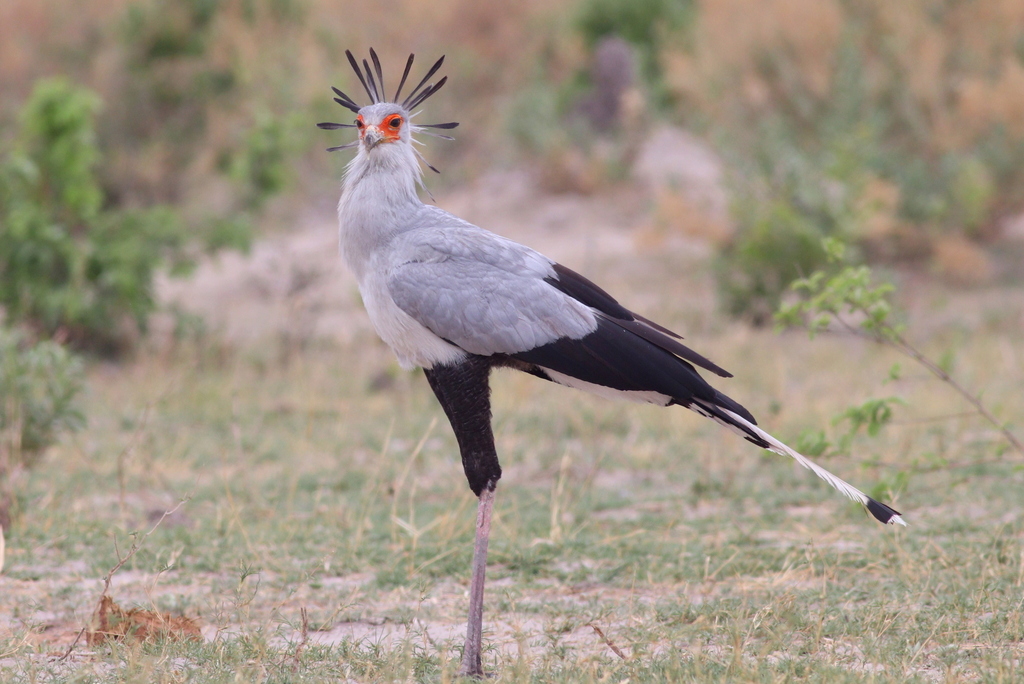
- aVery long legs with black 'shorts' (feathered thighs) and bare pinkish lower legs
- bPale grey body with black flight feathers
- cBare orange-red facial skin around the eye
- dLoose crest of long black-tipped quills at the back of the head
- eTwo very long central tail feathers projecting beyond the tail in flight
- Voice
- Usually silent; gives a deep, frog-like croak or groan, mainly in display or at the nest.
- Not to be confused with
- At distance it may be taken for a crane or stork walking in grass, but neither has the hooked raptor bill, orange face, black thigh feathering or quill crest. In flight the long legs and elongated central tail feathers both trail beyond the tail, a combination no eagle shows.
- Where to see it
- Open grasslands of Serengeti and Maasai Mara, Kruger's southern plains, Kgalagadi Transfrontier Park, Etosha and the Karoo
- When
- Resident year-round; pairs nest on flat-topped acacias in most months
Listen
Looking for field recordings…
Life & habits
- Diet
- Grasshoppers and other large insects, rodents, lizards, snakes, small birds and eggs
- Habitat
- Open grassland and lightly wooded savanna; avoids dense woodland
- Size
- About 1.2–1.5 m tall; wingspan about 2 m; 3–4 kg
- Lifespan
- Around 10–15 years in the wild; longer in captivity
Pairs patrol a territory side by side, stamping at tussocks to flush prey and then pinning it with repeated blows of the feet before swallowing it whole.
Where it lives
Recorded sightings
—
geo-referenced records in GBIF, from museums, herbaria and field observers.
Native range
Sub-Saharan Africa, from Senegal and Sudan south to the Cape
Drag the globe to turn it. Dots are where records exist, not a range map; darker means more records.
In the stacks
Searching the stacks…
Every page naming Sagittarius serpentarius in the Biodiversity Heritage Library →
Marginalia
The secretarybird appears on the coat of arms of South Africa adopted in 2000, its rising wings symbolising protection, and on the coat of arms of Sudan. Its English name is often linked to the quill-like crest resembling pens tucked behind a clerk's ear.
Curiosity
High-speed filming of a captive male showed each kick lasts about 15 milliseconds, shorter than a human blink, so the bird must aim before it strikes.
Kinship





Photographs: iNaturalist contributors under the licences shown. Records: GBIF.org. Historical plates: Source Library (CC BY-SA 4.0; originals public domain). Summary text: Nature Library editors and Wikipedia (CC BY-SA). Medicinal and edibility notes are historical and educational, not advice. iNaturalist taxon 117214.