- Animals
- ›Chordates
- ›Vertebrates
- ›Ray-finned Fishes
- ›Spiny-rayed fishes
- ›Perches, Scorpionfishes, Sticklebacks, and Allies
- ›Sculpins and Allies
- ›Fathead Sculpins
- ›Artedius
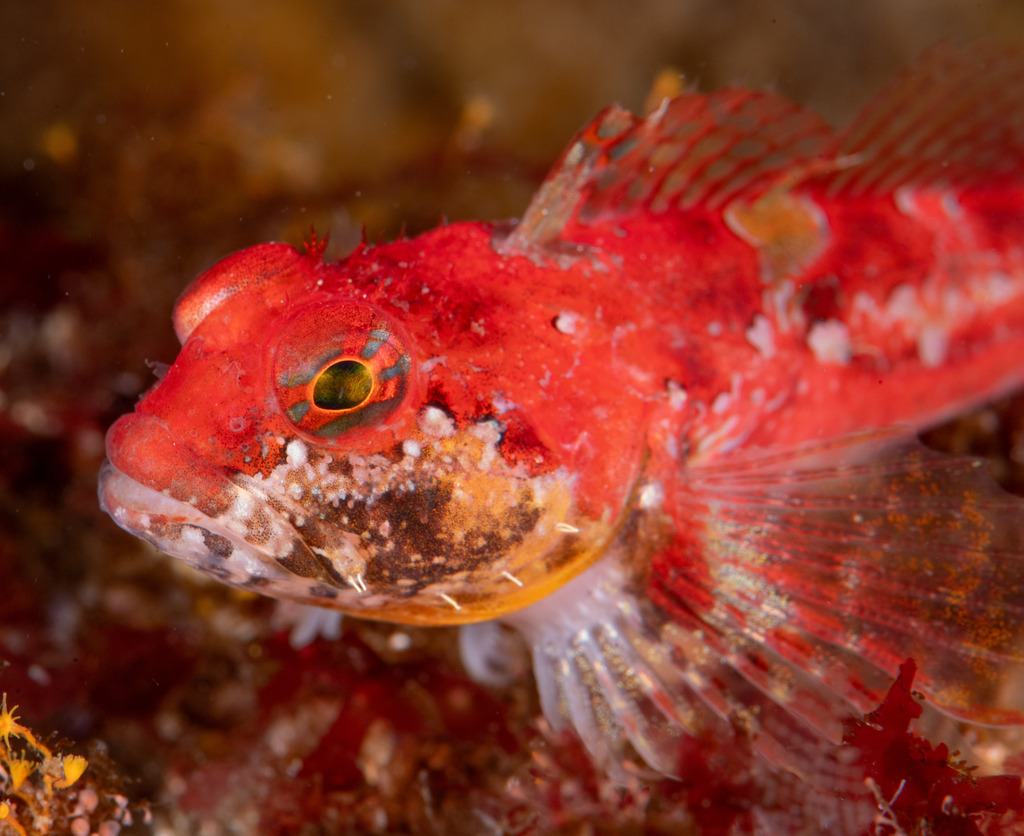
Scalyhead Sculpin
Artedius harringtoni
Artedius harringtoni, also known as the scalyhead sculpin or plumose sculpin, is a demersal species of marine ray-finned fish belonging to the family Cottidae, the typical sculpins. The species is native to the eastern Pacific Ocean.
From the article Artedius harringtoni on Wikipedia (CC BY-SA), quoted section by section
Description
Artedius harringtoni uses camouflage to blend into its surroundings. It can be identified by the orange linings of its gills and the orange or red lines running through its eyes. The species also has cirri above each eye. A. harringtoni is sexually dimorphic, with adult males reaching a maximum length of 10 centimeters.
Range & habitat
Artedius harringtoni is native to the eastern Pacific along the West Coast of the United States and the British Columbia Coast, with a range extending from Kodiak Island, Alaska, to San Miguel Island, California. The species is found in intertidal and sub-tidal rocky bottoms, commonly around pilings, to a depth of 21 meters.
Wikipedia: “Range and habitat”
What it does
The species reproduces through internal fertilization, with the males guarding the eggs until hatching. Males are highly territorial.
Wikipedia: “Reproduction and behavior”
In human culture
The genus Artedius is named after Peter Artedi, a naturalist, and A. harringtoni is named after Mark W. Harrington, president of the University of Washington from 1895 to 1897.
Wikipedia: “Etymology”
Where it lives
Recorded sightings
—
geo-referenced records in GBIF, from museums, herbaria and field observers.
Drag the globe to turn it. Dots are where records exist, not a range map; darker means more records.
In the stacks
Searching the stacks…
Every page naming Artedius harringtoni in the Biodiversity Heritage Library →
This page is assembled live from iNaturalist, GBIF, Wikipedia, the Source Library and the Internet Archive. It is not yet part of the hand-edited codex. iNaturalist taxon 117528.