- Animals
- ›Chordates
- ›Vertebrates
- ›Mammals
- ›Therians
- ›Placental Mammals
- ›Primates, Rodents, and Allies
- ›Rodents
- ›Mice, Rats, and Hamsters
- ›Muroids
- ›Hamsters, Voles, Lemmings, and Allies
- ›Voles, Lemmings, and Muskrats
- ›Eurasian Water Voles
- ›Arvicola
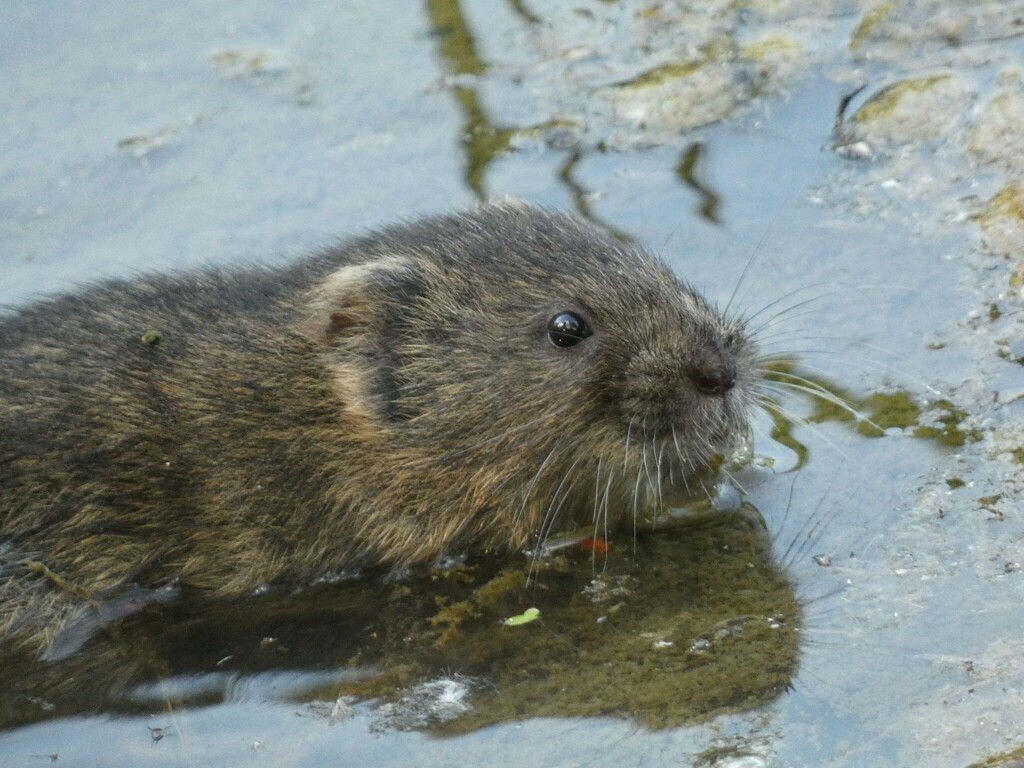
Italian Water Vole
Arvicola italicus
The European water vole (Arvicola amphibius) or northern water vole is a semi-aquatic rodent. It is often informally called the water rat, though it only superficially resembles a true rat. Water voles have rounder noses than rats, deep brown fur, chubby faces, and short fuzzy ears; unlike rats, their tails, paws, and ears are covered with hair.
In the wild, on average, water voles only live about five months. Maximum longevity in captivity is two and a half years.
From the article European water vole on Wikipedia (CC BY-SA), quoted section by section
Description
Water voles reach 14–22 centimetres (5.5–8.7 in) in length, plus a tail which is about half the length of the body. Weights reported for adults are variable. It is possible for large, optimal adults to weigh as much as 225 to 386 g (7.9 to 13.6 oz). However, these are peak weights. Elsewhere, the mean body mass has been reported as 60 to 140 g (2.1 to 4.9 oz), although this figure includes immature water voles. The minimum weight to successfully breed as well as to survive winter is reportedly 112 g (4.0 oz) in females and 115 g (4.1 oz) in males. As a species, the mean body mass is claimed as 140 g (4.9 oz). Overall, European water voles are a uniform dark brown colour, with slightly paler coloration on the underside. Their pelage is quite thick, and they are furred over their entire body, including their tail, unlike rats. Their dark colour allows them to blend in well in the densely vegetated areas they inhabit.
Wikipedia: “Appearance”
Range & habitat
The European water vole is found in most of Europe, Russia, West Asia and Kazakhstan.
Wikipedia: “Range”
What it does
Water voles mainly eat grass, sedges, rushes, herbs, and other vegetation near the water, but will also consume fruits, seeds, bulbs, twigs, buds, and roots when given the opportunity. In Europe, rich harvest periods can cause water vole "plagues" to take place, during which the voles eat ravenously, destroying entire fields of grass and leaving the fields full of burrows. Water voles in some parts of England have been shown to occasionally prey on water snails, freshwater mussels, other mollusks, frogs, and tadpoles; it has been speculated that this is to make up for a protein deficiency in the voles' diet. Food remains alone are not a reliable indicator of the presence of this species, as other smaller voles can also leave remains of large grasses and rushes.
Wikipedia: “Diet”
Listen
Looking for field recordings…
Where it lives
Recorded sightings
—
geo-referenced records in GBIF, from museums, herbaria and field observers.
Drag the globe to turn it. Dots are where records exist, not a range map; darker means more records.
In the stacks
Searching the stacks…
Every page naming Arvicola italicus in the Biodiversity Heritage Library →
This page is assembled live from iNaturalist, GBIF, Wikipedia, the Source Library and the Internet Archive. It is not yet part of the hand-edited codex. iNaturalist taxon 1177489.