Pygarrhichas
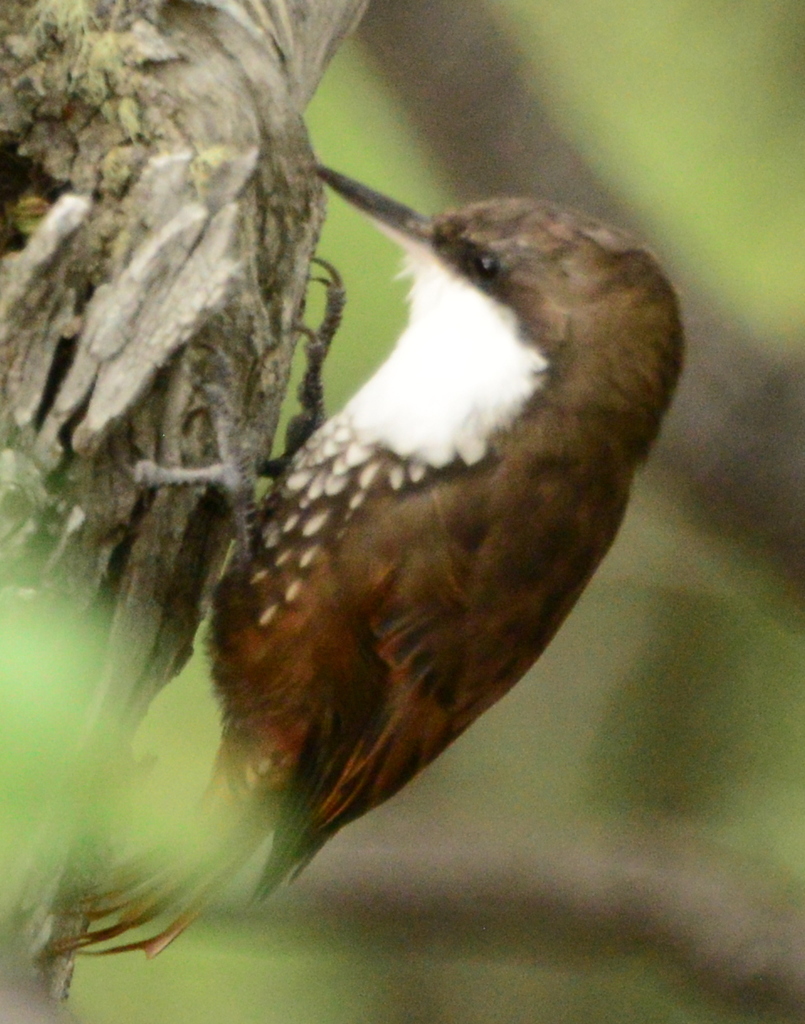
The white-throated treerunner (Pygarrhichas albogularis) is a species of bird in the family Furnariidae. It is the only species in the genus Pygarrhichas. The white-throated treerunner is about 15 cm (5.9 in) long, with a stiff and rounded tail. The upperparts are dark brown, turning red on the lower back and tail and contrasting sharply with the throat and chest of a bright white. The rest of the underparts are coarsely mottled with white. The bill is long, slightly curved upwards. The general appearance is reminiscent of a nuthatch (Sitta spp.), although they are not directly related. Like the Sittidae, Furnariidae tirelessly scours the trunks and branches of old trees for the small arthropods that make up its food, spiraling up the trunks, or sometimes moving head down. The white-throated treerunner consumes small invertebrates found on bark and nests in tree cavities. Outside of the breeding season, it may form mixed-species foraging flocks with other bird species.
The White-throated treerunner inhabits the southern tip of the American continent, in Chile and Argentina, from Santiago and Mendoza to Tierra del Fuego. It seeks out forests with large trees – the old trunks offer suitable nesting sites – whether they are lowland or highland, dense or open. It was described in 1831 by Phillip Parker King, a British explorer of Patagonia and Tierra del Fuego. Its systematic placement has remained unclear within its family, superficial similarities with other Furnariidae gleaning their food from the bark of trees seem to be the result of an evolutionary convergence.
1 branches of this genus, most-observed first · about 1 known species
See this branch on the Wheel of Life →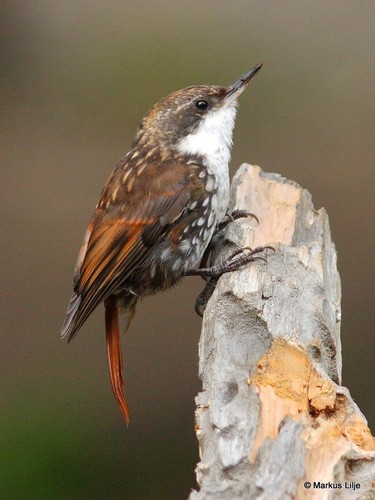
Where it lives
Recorded sightings
—
geo-referenced records in GBIF, from museums, herbaria and field observers.
Drag the globe to turn it. Dots are where records exist, not a range map; darker means more records.
In the stacks
Searching the stacks…
Every page naming Pygarrhichas in the Biodiversity Heritage Library →
This page is assembled live from iNaturalist, GBIF, Wikipedia, the Source Library and the Internet Archive. It is not yet part of the hand-edited codex. iNaturalist taxon 11818.