- Animals
- ›Chordates
- ›Vertebrates
- ›Birds
- ›Perching Birds
- ›Ovenbirds and Woodcreepers
- ›Typical Ovenbirds
- ›Ancistrops
On eBird ↗
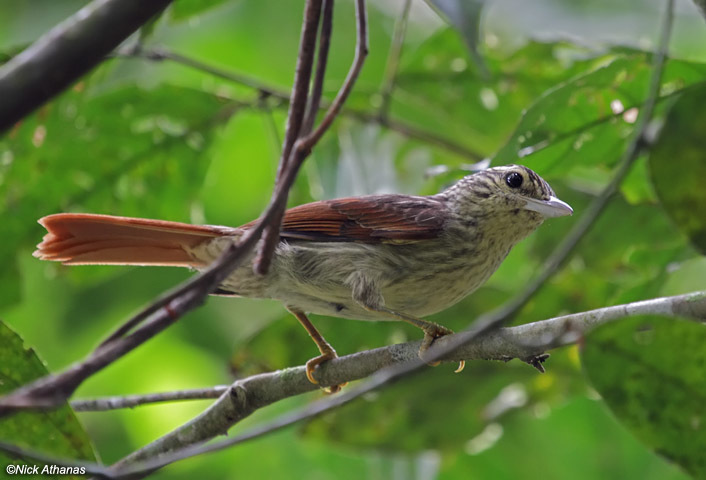
Chestnut-winged Hookbill
Live sightings near you, the range map, bar charts of when it is seen, and Macaulay Library photos and recordings.
Chestnut-winged Hookbill
Ancistrops strigilatus
The chestnut-winged hookbill (Ancistrops strigilatus) is a species of bird in the Furnariinae subfamily of the ovenbird family Furnariidae. It is found in Bolivia, Brazil, Colombia, Ecuador, and Peru.
From the article Chestnut-winged hookbill on Wikipedia (CC BY-SA), quoted section by section
Description
The chestnut-winged hookbill is 17 to 19 cm (6.7 to 7.5 in) long and weighs 30 to 39 g (1.1 to 1.4 oz). It is a largish furnariid with distinctive plumage, and a moderately hooked bill resembling those of Thamnophilus antshrikes. The sexes have the same plumage. Adults have a wide whitish to buff supercilium, grizzled brownish and buff lores, brown ear coverts with pale streaks, and yellowish buff malars. Their crown is very dark brown with obvious narrow gold-buff streaks. Their back is a paler, somewhat grayish olive, brown, with paler and less well defined streaks. Their rump and uppertail coverts are an even lighter brown with fainter streaks. Their wing coverts are dull chestnut with pale shafts; the flight feathers have dull chestnut outer webs and dark fuscous inner webs and tips. Their tail is bright rufous. Their throat is pale yellowish buff with faint dull brownish flecks, their breast dull yellowish buff with blurry browish streaks, their belly like the breast but only faintly streaked, their flanks dull brownish with yellowish buff streaks, and their undertail coverts mottled dull buff and light browish. Their iris is brown, their maxilla blackish to dark horn, their mandible blue-gray to bluish ivory, and their legs and feet yellowish brown to pale brownish olive. …
Range & habitat
The chestnut-winged hookbill is found in the Amazon Basin from southeastern Colombia south through eastern Ecuador and eastern Peru into northern Bolivia and east in Brazil to the Rio Tapajós. In Brazil it mostly occurs south of the Amazon but has been recorded north of it in Jaú National Park. It inhabits tropical lowland evergreen forest. It strongly favors terra firme forest but does occur locally in várzea. In elevation it mostly occurs below 500 m (1,600 ft) but can be found locally up to 900 m (3,000 ft).
Wikipedia: “Distribution and habitat”
What it does
The chestnut-winged hookbill feeds on arthropods. It typically forages singly or in pairs, and usually in mixed-species feeding flocks. It mostly forages between the forest's mid-storey and its canopy while moving slowly along branches and in vine tangles. It finds its prey by gleaning, often from dead leaves.
Wikipedia: “Feeding”
Listen
Looking for field recordings…
Where it lives
Recorded sightings
—
geo-referenced records in GBIF, from museums, herbaria and field observers.
Drag the globe to turn it. Dots are where records exist, not a range map; darker means more records.
In the stacks
Searching the stacks…
Every page naming Ancistrops strigilatus in the Biodiversity Heritage Library →
This page is assembled live from iNaturalist, GBIF, Wikipedia, the Source Library and the Internet Archive. It is not yet part of the hand-edited codex. iNaturalist taxon 11848.