- Animals
- ›Chordates
- ›Vertebrates
- ›Ray-finned Fishes
- ›Spiny-rayed fishes
- ›Cusk-eels
- ›Pearlfishes
- ›Fierasfers
- ›Carapus
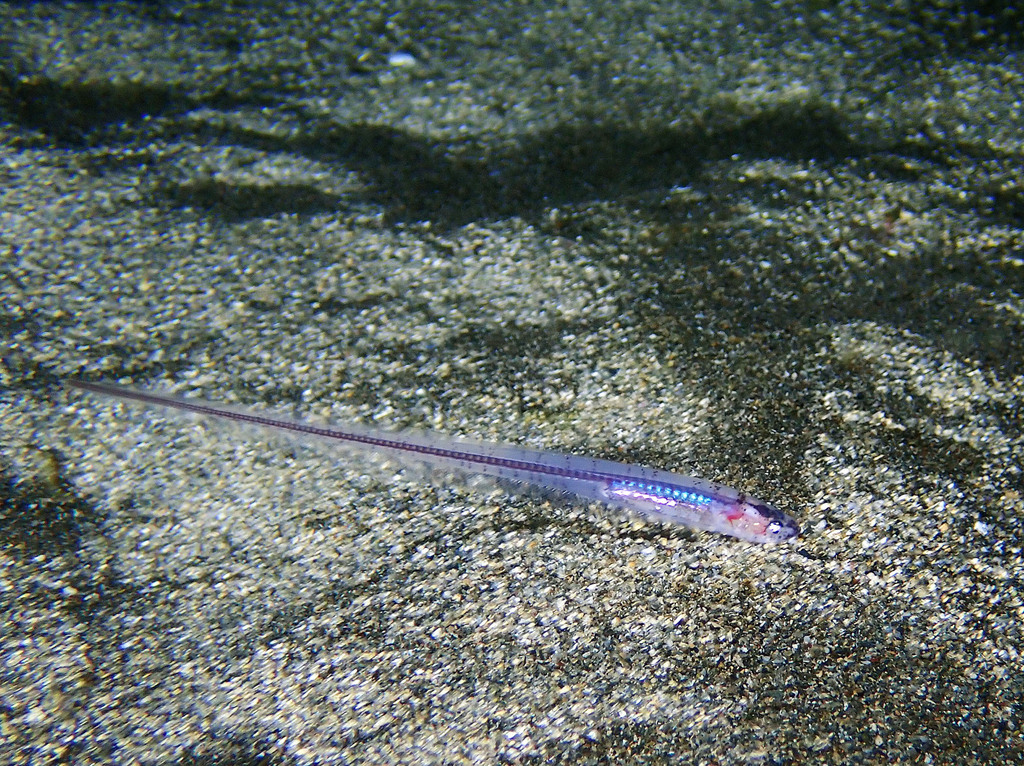
Pearl Fish
Carapus acus
Carapus acus is a species of bony fish in the family Carapidae, the pearlfishes, and is native to the Mediterranean Sea and the Atlantic Ocean. It lives as a commensal in association with a sea cucumber, spending the day inside its host and emerging at night to feed.
From the article Carapus acus on Wikipedia (CC BY-SA), quoted section by section
Description
Carapus acus is a laterally-compressed, elongated fish growing to a length of about 20 cm (8 in). The head measures about one eighth of the total length and there are 84 to 92 vertebrae, which gives the fish great flexibility. The continuous dorsal fin and the anal fin run the whole length of the body. There is no caudal fin and the tail ends with a point. The gut loops back and the anus is located just behind the head, in front of the pectoral fins. This fish is translucent, with a number of silvery or reddish-gold iridescent spots on the operculum and the thoracic region. The peritoneum lining the body cavity is an opaque silvery colour.
Range & habitat
Carapus acus is native to the Mediterranean Sea and eastern Atlantic Ocean; it is common in the western half and around the coasts of Spain, France, Italy, Sardinia and the Balearic Islands. It is less common in the Adriatic and Aegean Seas.
Wikipedia: “Distribution”
What it does
Carapus acus usually lives inside the respiratory tree or the body cavity of sea cucumbers. Neither the species nor the size of the host seem important in host choice, and the fish makes use of whatever sea cucumber it happens to encounter; the most common hosts are Parastichopus regalis and Holothuria tubulosa, while others include, H. poli, H. arguinensis, H. sanctori and H. mammata. The fish swims close to the seabed searching for a suitable host. When it finds one, it positions its head beside the sea cucumber's anus, from which a current of water is being expelled. Either it then bends its flexible tail around, inserts it in the sea cucumber's anus and works its way backwards inside, with the tail entering first, or less commonly, it thrusts its head into the orifice and enters with a sharp flick of its tail, turning round when inside the host. In either case, it positions itself with its head close to or protruding from the sea cucumber's anus. Because the fish's anus is located just behind its head, it is able to defecate into the open water without fouling its host. Pearlfishes are able to produce sounds by means of certain muscles connected to the swim bladder, with each species producing a sound unique to its species. …
Wikipedia: “Ecology”
Where it lives
Recorded sightings
—
geo-referenced records in GBIF, from museums, herbaria and field observers.
Drag the globe to turn it. Dots are where records exist, not a range map; darker means more records.
In the stacks
Searching the stacks…
Every page naming Carapus acus in the Biodiversity Heritage Library →
This page is assembled live from iNaturalist, GBIF, Wikipedia, the Source Library and the Internet Archive. It is not yet part of the hand-edited codex. iNaturalist taxon 118612.