- Animals
- ›Chordates
- ›Vertebrates
- ›Ray-finned Fishes
- ›Spiny-rayed fishes
- ›Perches, Scorpionfishes, Sticklebacks, and Allies
- ›Perches, groupers and allies
- ›Weeverfishes
- ›Trachinus
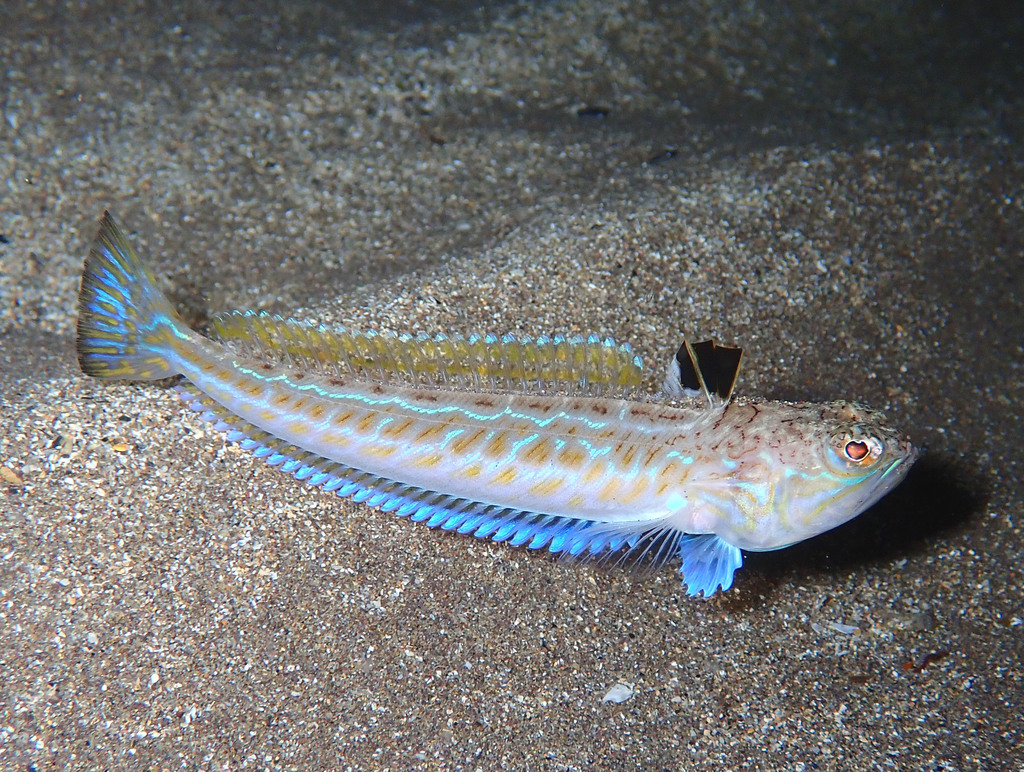
Greater Weever
Trachinus draco
The greater weever (Trachinus draco) is a species of marine ray-finned fish in the family Trachinidae. It is a benthic fish widely distributed along the eastern Atlantic coastline (from Norway to Morocco), extending to the Mediterranean, Aegean and Black Seas. The greater weever is mostly and notoriously known for its venomous spines, which can inflict serious injuries on humans through accidental stinging. Because of this, the greater weever is classified as one of the most venomous fishes in the Mediterranean.
From the article Greater weever on Wikipedia (CC BY-SA), quoted section by section
Description
The greater weever is an elongated and laterally flattened fish with a distinct superior mouth that is inclined upwards. The lower jaw is longer than the upper jaw. The head is compact flat and relatively big and the eyes sit almost on top of it. The upper rim of the eye has two to three small spines, in front of each eye. The five to seven spiny fin rays on its first dorsal fin and the thorns on each of the gill covers have venom glands at their basis.
Colouration. The greater weever is greenish brown with a varying count of dark marks on the upper side of the head. The flank is hued in a yellowish brown with bright blue and yellow discontinuous stripes that run crooked to the front of the fish. Additionally, oblique black stripes can be found laterally (this pattern is described as tiger-like by Müller).
Body dimensions. The body dimensions of Trachinus draco are described very differently by different authors and seem to differ based on the geographical location where the study has been carried out.
In the Eastern Black Sea, the length distribution of mature fishes ranges from 10 cm (3.9 in) up to a maximum of 25.8 cm (10.2 in) for females and from 9.5 to 22.5 cm (3.7 to 8.9 in) for males. …
What it does
The greater weever is an ambush predator that digs itself into fine sand during daytime, with only its eyes and the tip of the dorsal fin exposed. There it lurks until potential prey approaches, which it then attacks in a swift and sudden manner. At night, the greater weever is believed to swim around freely, even pelagically. This is supported by the finding that prey caught during daytime is already mostly digested by the night of the same day. As hinted above, the greater weever is a carnivore. According to catches in the Adriatic Sea suggests, it feeds mainly on smaller fish, decapods and opossum shrimps (also known as mysids); in general, these items make up to over 90% of the total relative importance (IRI). The diet contains also isopods, amphipods, cephalopods and bivalves. The most common prey that can be identified to the rank of species are Liocarcinus depurator, Galathea strigosa (both of which are decapods) and Anchialina agilis (a mysid). The compounds of the diet alters significantly with fish size. While the relatively small mysids are the most common prey for greater weevers under a size of 20 cm (7.9 in), their importance in the diet composition decreases with size, as does the importance of amphipods. On the other hand, the share of cephalopods and fishes increase with fsize. The feeding habit of T. …
Wikipedia: “Diet and feeding behaviour”
Toxicity
The venomous apparatus of T. draco consists of one spine on each operculum and five to eight dorsal spines. The spines on the operculum point towards the cauda, or tail, and are slightly bent downwards. The opercular spines arise from the upper edge of the operculum and are connected to the operculum with one third of their complete length. The other two thirds of their length lies free along the operculum. The total length of the opercular spines is approximately 27 mm. The spine itself is "covered by an integumentary sheath". If this sheath ruptures because there is force applied to the spine, it allows the venom to leak from the venom gland cells and to run through a deep groove along the spine and into the wound caused by the sting. Each of the dorsal spines is covered in an individual integumentary sheet. The spines are connected through a fine interspinous membrane. The spines have different length and are by that arranged in a curve like manner. The spines observed by Russel & Emery (1960) had minimum lengths of 5 mm and maximum lengths of 29 mm and were quite heterogeneous in their appearance on a microscopic level. The dorsal spines are all bent very slightly towards the tail of the fish. The mechanism of envenomation is quite similar to that of the opercular spines.
Wikipedia: “Venomous apparatus”
In human culture
The term "weever" is thought to originate from the Anglo-Saxon word "wivre", which translates to "viper".
Wikipedia: “Etymology”
Where it lives
Recorded sightings
—
geo-referenced records in GBIF, from museums, herbaria and field observers.
Drag the globe to turn it. Dots are where records exist, not a range map; darker means more records.
In the old herbals & bestiaries

In the stacks
Searching the stacks…
Every page naming Trachinus draco in the Biodiversity Heritage Library →
This page is assembled live from iNaturalist, GBIF, Wikipedia, the Source Library and the Internet Archive. It is not yet part of the hand-edited codex. iNaturalist taxon 118652.