On eBird ↗
Loggerhead Shrike
Live sightings near you, the range map, bar charts of when it is seen, and Macaulay Library photos and recordings.
Loggerhead Shrike
Lanius ludovicianus
The loggerhead shrike (Lanius ludovicianus) is a passerine bird in the family Laniidae. It is the only member of the shrike family endemic to North America; the related northern shrike (L. borealis) occurs north of its range; however, it is also found in Siberia. It is nicknamed the butcherbird after its carnivorous tendencies, as it consumes prey such as insects, amphibians, lizards, small mammals and small birds, and some prey end up displayed and stored at a site, for example in a tree. Due to its small size and weak talons, this predatory bird relies on impaling its prey upon thorns or barbed wire for facilitated consumption. The numbers of loggerhead shrike have significantly decreased in recent years, especially in Midwestern, New England and Mid-Atlantic areas.
From the article Loggerhead shrike on Wikipedia (CC BY-SA), quoted section by section
Description
The loggerhead shrike is a medium-sized passerine. "Loggerhead" refers to the relatively large size of the head as compared to the rest of the body. The wing and tail length are about 3.82 in (9.70 cm) and 3.87 in (9.83 cm) long, respectively. It weighs on average 1.8 oz (50 g), with a range of 1.6–2.1 oz (45–60 g) for a healthy adult shrike.
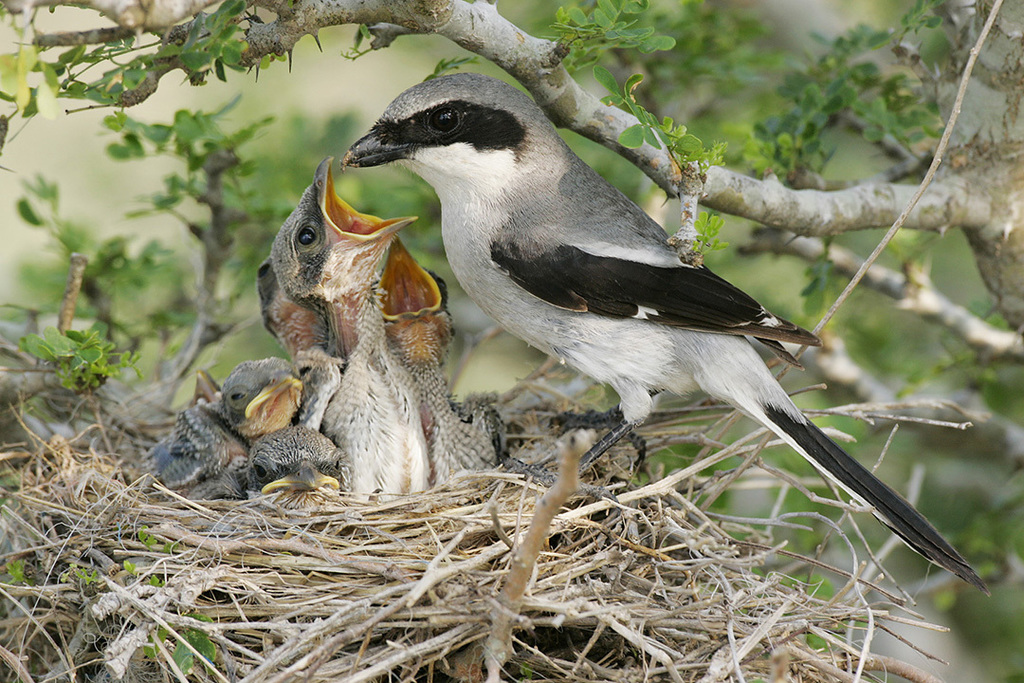
Measurement ranges Length: 7.9–9.1 in (20–23 cm) Weight: 1.2–1.8 oz (34–51 g) Wingspan: 11.0–12.6 in (27.9–32.0 cm) The adult plumage of the loggerhead shrike is grey above with a white to pale grey breast and black tarsi and feet. The bird possesses a black mask that extends across the eyes to its bill. The wings are black with a distinct white patch on the primaries. The tail is black edged with white and the irises are brown. The beak is short, black, and hooked, and contains a tomial tooth to help tear into prey. It is difficult to sex an adult loggerhead shrike in the field as they are sexually monochromatic. However, several studies have reported sexual dimorphism in plumage and size traits. Juveniles possess a paler gray plumage that is subtly vermiculated. The loggerhead shrike can be distinguished from the northern shrike by its smaller size, darker grey plumage, and larger black face mask that covers the eye completely. It also has a shorter bill with less prominent hook than the northern shrike. …
Range & habitat
Loggerhead shrikes were once widely distributed across southern Canada, the contiguous USA and Mexico. However, their populations have heavily declined since the 1960s. Four subspecies reside in southern coastal California: mearnsi, gambeli, grinnelli and anthonyi. L. l. mearnsi is only found on San Clemente Island in California, whereas L. l. gambeli breeds on the mainland and L. l. anthonyi breeds on the Channel Islands. L. l. excubitorides is found in central North America, whereas the non-migrating L. l. ludovicianus resides in southeastern North America. The distribution of L. l. migrans ranges from north to eastern North America; however, its range has been diminishing since the 1940s. The bird requires an open habitat with an area to forage, elevated perches, and nesting sites. They are often found in open pastures or grasslands and appear to prefer red-cedar and hawthorn trees for nesting. The hawthorn's thorns and the cedar's pin-like needles protect and conceal the shrike from predators. It may also nest in fence-rows or hedge-rows near open pastures and requires elevated perches as lookout points for hunting. Open pastures and grasslands with shorter vegetation are preferred by loggerhead shrikes, as they increase the bird's hunting efficiency. …
Wikipedia: “Distribution and habitat”
What it does
Loggerhead shrikes have been repeatedly observed killing prey larger than themselves by spearing the neck or head of the animal and twisting. The speed at which this occurs causes a whiplash injury to the animal. The neck strength of the shrikes compensates, making their talon weakness inconsequential. Although loggerhead shrikes are passerines, they are a predatory species that hunt during the day. They primarily eat insects, but also consume arachnids, reptiles, amphibians, rodents, bats and small birds. They have even eaten venomous snakes such as the water adder. The size of prey ranges from 0.001 g (3.5×10⁻⁵ oz) insects to 25 g (0.88 oz) mice or reptiles.
They are not true birds of prey, as they lack the large, strong talons used to catch and kill prey. Instead, they are sit-and-wait hunters that stalk prey by hawking and diving from elevated perches. By scanning their vicinity from a perch instead of flying, the shrike does not exhaust its energy during the search. Preferred perches are approximately 13 ft (4.0 m) off the ground, and are usually outer branches of trees or telephone wires. In winter, prey availability is low due to the shrike's preference for insects and poikilothermic prey; during this time, shrikes may be energetically stressed and underweight. …
Wikipedia: “Diet”
Listen
Looking for field recordings…
Where it lives
Recorded sightings
—
geo-referenced records in GBIF, from museums, herbaria and field observers.
Drag the globe to turn it. Dots are where records exist, not a range map; darker means more records.
In the stacks
Searching the stacks…
Every page naming Lanius ludovicianus in the Biodiversity Heritage Library →
This page is assembled live from iNaturalist, GBIF, Wikipedia, the Source Library and the Internet Archive. It is not yet part of the hand-edited codex. iNaturalist taxon 12024.