On eBird ↗
Lesser Gray Shrike
Live sightings near you, the range map, bar charts of when it is seen, and Macaulay Library photos and recordings.
Lesser Grey Shrike
Lanius minor
The lesser grey shrike (Lanius minor) is a passerine bird in the shrike family Laniidae. It breeds in South and Central Europe and western Asia and migrates to winter quarters in southern Africa in the early autumn, returning in spring. It is a scarce vagrant to western Europe, including Great Britain, usually as a spring or autumn erratic.
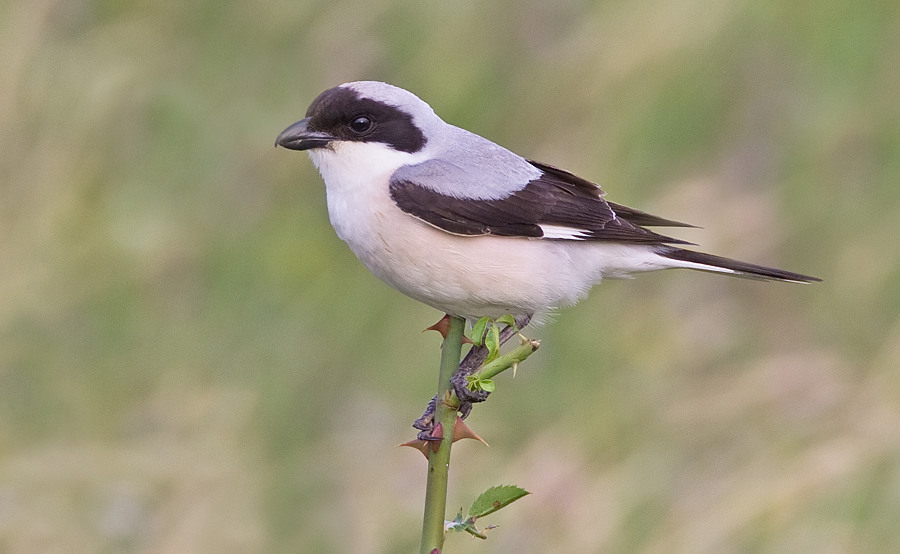
It is similar in appearance to the great grey shrike (Lanius excubitor) and the Iberian grey shrike (Lanius meridionalis); both sexes are predominantly black, white and grey, and males have pink-flushed underparts. It is slightly smaller than the great grey shrike, and has a black forehead and relatively longer wings. This species prefers dry open lowlands and is often seen on telephone wires.
From the article Lesser grey shrike on Wikipedia (CC BY-SA), quoted section by section
Description
The adult male lesser grey shrike has its nape, cheeks, ear and eye coverts and front part of the crown black. The hind part of the crown and the back is a pale bluish-grey and the rump is a similar but rather paler colour. The underparts are white with the lower breast and belly suffused with pink. The axillaries are greyish-white and the underwing coverts are brownish-black. The two central tail feathers are black with a white tip and base. The other pairs have increasing areas of white and less black. The primaries are black with a buff tip and white base. The secondaries are black with broader, paler tips but no white bases. The wing coverts are black with the lesser coverts being fringed with grey. The female has similar plumage but the head is dark grey rather than black, the ear coverts brownish-black, the upperparts a brownish-grey and the underparts less pink than the male. The juvenile is similar to the adults but is altogether more brown. It lacks the grey back and rump which are instead pale brown and faintly barred, and the underparts are white and cream without any pink. All birds have a brownish-black beak with a paler base to the lower mandible, brown irises and black legs and feet. Adult length is around 20 cm (7.9 in) with a wing length of 13 cm (5.1 in) and a tarsus length of 2.5 cm (1 in).
Range & habitat
The lesser grey shrike spends the summer in South and Central Europe and western Asia. It breeds in southern France, Switzerland, Austria, Hungary, Slovakia, Czech Republic, Italy, the former Yugoslavia, Albania, Greece, Romania, Bulgaria, Ukraine and southern Russia. In Asia it breeds in the Middle East, its range extending as far as eastern Turkey and Iran. It is a vagrant to more northerly parts of Europe, usually in spring or autumn. Countries where it has been seen include Sweden, Finland, Denmark, United Kingdom, Netherlands, Belgium and northern France. It is a migratory species and winters in a broad belt across tropical southern Africa. During the summer the lesser grey shrike inhabits open countryside, the edges of cultivated areas, heathland with scattered bushes and trees, gardens, coppices, woodland and roadside trees. In its winter quarters it is usually found in scrubland and among thorn trees.
Wikipedia: “Distribution and habitat”
What it does
The lesser grey shrike hunts from a strategic post, wire or branch and primarily feeds on insects which it catches in the air or on the ground. The diet includes beetles, moths and butterflies, large flies, grasshoppers, crickets and millipedes. Some fruits such as cherries and figs are eaten to a limited extent. The bird occasionally impales freshly caught prey on thorns for use later, but this is done to a much lesser extent than by some other shrike species. It has been shown experimentally that this species only creates a larder when it is satiated and that prey items are seldom plentiful enough for this to be the case. The male has been observed to feed the female before starting to create a food store. Repeated experimental exposure of birds to a food surplus significantly increases the rate at which they impale freshly caught prey. Other causal factors in the failure of this species to hoard may be a shortage of suitable caching sites and the fact that the bird lacks practice in storing food and this constrains its learning ability. The flight of the lesser grey shrike is low and somewhat undulating and it occasionally glides with extended wings. At the end of the flight it swoops upward to land on a new hunting perch. It then turns its head from side to side searching for prey. …
Wikipedia: “Behaviour”
Listen
Looking for field recordings…
Where it lives
Recorded sightings
—
geo-referenced records in GBIF, from museums, herbaria and field observers.
Drag the globe to turn it. Dots are where records exist, not a range map; darker means more records.
In the stacks
Searching the stacks…
Every page naming Lanius minor in the Biodiversity Heritage Library →
This page is assembled live from iNaturalist, GBIF, Wikipedia, the Source Library and the Internet Archive. It is not yet part of the hand-edited codex. iNaturalist taxon 12054.