On eBird ↗
Red-winged Fairywren
Live sightings near you, the range map, bar charts of when it is seen, and Macaulay Library photos and recordings.
Red-winged Fairywren
Malurus elegans
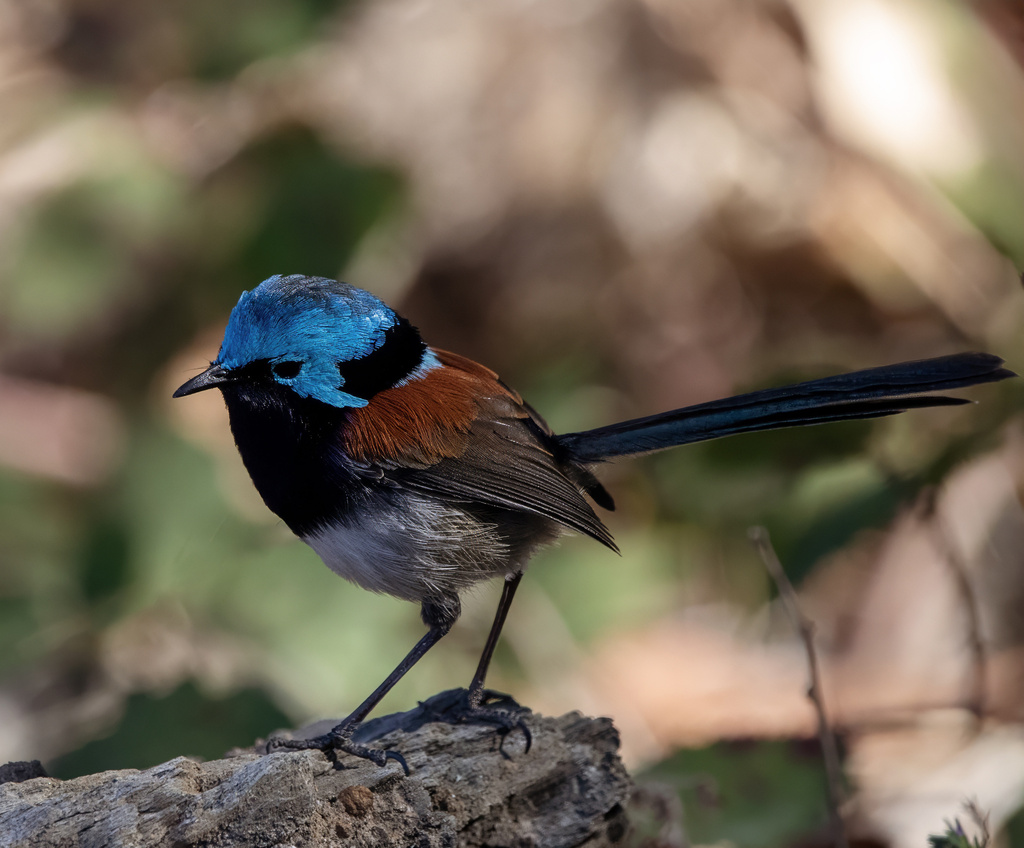
The red-winged fairywren (Malurus elegans) is a species of passerine bird in the Australasian wren family, Maluridae. It is non-migratory and endemic to the southwestern corner of Western Australia. Exhibiting a high degree of sexual dimorphism, the male adopts a brilliantly coloured breeding plumage, with an iridescent silvery-blue crown, ear coverts and upper back, red shoulders, contrasting with a black throat, grey-brown tail and wings and pale underparts. Non-breeding males, females and juveniles have predominantly grey-brown plumage, though males may bear isolated blue and black feathers. No separate subspecies are recognised. Similar in appearance and closely related to the variegated fairywren and the blue-breasted fairywren, it is regarded as a separate species as no intermediate forms have been recorded where their ranges overlap. Though the red-winged fairywren is locally common, there is evidence of a decline in numbers.
Bearing a narrow pointed bill adapted for probing and catching insects, the red-winged fairywren is primarily insectivorous; it forages and lives in the shelter of scrubby vegetation in temperate wetter forests dominated by karri trees, remaining close to cover to avoid predators. Like other fairywrens, it is a cooperative breeding species, with small groups of birds maintaining and defending small territories year-round. Groups consist of a socially monogamous pair with several helper birds who assist in raising the young. There is a higher proportion of female helpers recorded for this species than for other species of fairywren.
From the article Red-winged fairywren on Wikipedia (CC BY-SA), quoted section by section
Description
The red-winged fairywren is 15 cm (6 in) long and weighs 8–11 g (0.28–0.39 oz), making it the largest of the fairywrens. The average tail length is 7.5 cm (3.0 in), among the longest in the genus. Averaging 10 mm (0.4 in) in males and 9.3 mm (0.4 in) in females, the bill is relatively long, narrow and pointed, and wider at the base. Wider than it is deep, the bill is similar in shape to those of other birds that feed by probing for or by picking insects off of their environs.
Like other fairywrens, the red-winged fairywren is notable for its marked sexual dimorphism, males adopting a highly visible breeding plumage of brilliant iridescent blue and chestnut contrasting with black and grey-brown. The brightly coloured crown, ear tufts and upper back are prominently featured in breeding displays. The male in breeding plumage has a silvery blue crown, ear coverts and upper back, a black throat and nape, bright red-brown shoulders, a long grey-brown tail and wings, and a greyish-white belly. Non-breeding males, females and juveniles are predominantly grey-brown in colour, though males may retain traces of blue and black plumage. All males have a black bill and lores (eye-ring and bare skin between eyes and bill), while females have a black bill, rufous lores and pale grey eye-ring. …
Range & habitat
The red-winged fairywren occurs in the wetter, southwest corner of Western Australia, from Moore River north of Perth south through to the Margaret River region and east to Albany. It is common in parts of its range, though there is some evidence of decline from draining of swampland. It lives in the understorey of karri and jarrah. Older forests appear to be less favourable habitats, while birds appear to be attracted to disturbed areas after logging. Fire also results in populations disappearing, returning after a period of two years. Forestry plantations of pine and eucalypts are generally unsuitable as they lack sufficient undergrowth. Within the forest habitat, the red-winged fairywren prefers wetter gullies and riverside sword sedge. It borders the range of the variegated fairywren on the northern limit of its range, and the blue-breasted fairywren in the eastern limit, with those two species occupying dryer scrub while the red-winged fairywren is restricted to wetter forests. The lack of intermediate forms reinforces the status of all three taxa as separate species. Sites identified by BirdLife International as being important for red-winged fairywren conservation are Araluen-Wungong, Jalbarragup, Mundaring-Kalamunda, North Dandalup, the Stirling Range, Two Peoples Bay and Mount Manypeaks.
Wikipedia: “Distribution and habitat”
What it does
Hopping, with both feet leaving the ground and landing simultaneously, is the usual form of locomotion, though birds may run while performing the "rodent run display" detailed below. Its balance is assisted by a proportionally large tail, which is usually held upright and rarely still. The short, rounded wings provide good initial lift and are useful for short flights, though not for extended jaunts.
Courtship and breeding. The red-winged fairywren is a cooperative breeding species, with a pair or small group of birds maintaining and defending a territory year-round. These territories average around 0.4–2.4 hectares (1–6 acres) in optimal habitat of tall karri forest, although are smaller and restricted to dense riverbank undergrowth in less favourable habitats. The area maintained is large enough to support the group in poor years or to accommodate new members after a good breeding season. Groups range from two to nine members in size with an average of four birds, the largest for any fairywren studied to date. This is thought to be due to a very high annual survival and occupancy of suitable territory. Though reproduction rates are low, young birds still have few vacancies available for them to disperse into. Pairs are socially monogamous, with relationships ending for the most part when one partner dies. …
Wikipedia: “Behaviour and ecology”
In human culture
In his 1982 monograph, ornithologist Richard Schodde proposed a northern origin for the chestnut-shouldered fairywren group due to the variety of forms in the north and their absence in the southeast of the continent. Ancestral birds spread south and colonised the southwest during a warm and wetter period around 2 million years ago at the end of the Pliocene or beginning of the Pleistocene. Subsequent cooler and drier conditions resulted in the loss of habitat and fragmentation of populations. South-western birds gave rise to what is now the red-winged fairywren, while those in the northwest of the continent became the variegated fairywren. Further warmer, humid conditions again allowed birds to spread southwards; this group, occupying central southern Australia east to the Eyre Peninsula, became the blue-breasted fairywren. Cooler climate then resulted in this being isolated as well and evolving into a separate species. Finally, after the end of the last glacial period 12,000–13,000 years ago, the northern variegated forms again spread southwards. This has resulted in the ranges of all three species overlapping.
Wikipedia: “Evolutionary history”
Listen
Looking for field recordings…
Where it lives
Recorded sightings
—
geo-referenced records in GBIF, from museums, herbaria and field observers.
Drag the globe to turn it. Dots are where records exist, not a range map; darker means more records.
In the stacks
Searching the stacks…
Every page naming Malurus elegans in the Biodiversity Heritage Library →
This page is assembled live from iNaturalist, GBIF, Wikipedia, the Source Library and the Internet Archive. It is not yet part of the hand-edited codex. iNaturalist taxon 12063.