- Animals
- ›Chordates
- ›Vertebrates
- ›Ray-finned Fishes
- ›Dragonfishes and Allies
- ›Dragonfishes
- ›Chauliodontinae
- ›Chauliodus
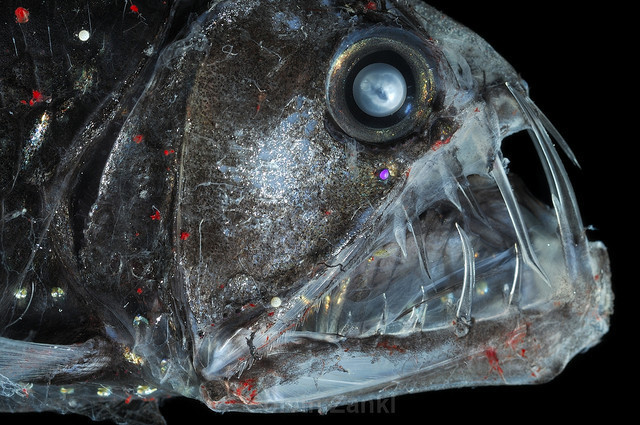
Sloane's Viperfish
Chauliodus sloani
Sloane's viperfish (Chauliodus sloani), is a predatory mesopelagic dragonfish found in waters across the world. The species was first described by German scientists Marcus Elieser Bloch and Johann Gottlob Schneider in their 1801 book Systema ichthyologiae: iconibus CX illustratum, volume 1. Female C. sloani reach maturity between 133 and 191 mm, while males likely reach maturity at slightly smaller body lengths. It has two rows of photophores along its ventral side. It is believed that C. sloani can adjust the intensity of bioluminescence of the ventral photophores to camouflage itself from predators that might see its shadow from below.
From the article Sloane's viperfish on Wikipedia (CC BY-SA), quoted section by section
Range & habitat
C. sloani is found in tropical and temperate waters. It is widespread in the Atlantic Ocean and the western Mediterranean Sea, as well as the Indian and Pacific Oceans. Temperature restricts Sloane's Viperfish vertical distribution. In the Atlantic, its latitudinal range is from 35°N - 55°N, with highest abundance around 45°N. In the Arabian Sea, its range is primarily south of 10°N. In the central Mediterranean Sea, C. sloani is eaten as a primary part of the diet of the Atlantic bluefin tuna. Analysis of several cetaceans' stomach contents found remnants of C. sloani, including the pygmy sperm whale and Gervais's beaked whale. Both were found beached on the Canary Islands.
Wikipedia: “Distribution”
What it does
C. sloani is a major consumer of myctophids (lanternfishes), other bony fishes, and crustaceans. An average C. sloani individual probably consumes at least one lanternfish every twelve days and there is no evidence to suggest that they increase their intake of food the bigger they are. Consequently, the stomachs of smaller individuals have been found containing proportionally larger prey than the prey found in the stomachs of larger individuals. However, they are not picky in their diet — they also eat other fishes, eggs, and algae. This is another thing that distinguishes them from the C. danae, which feeds mainly on crustaceans, however there has been evidence that shows smaller variations had crustaceans included in the stomach during stomach content analysis. C. sloani typically feed on large prey, and in some cases was documented to consume prey up to 50% of its own bodyweight, and the size of their prey allows them to feed rarely and opportunistically while maximizing energetic efficiency. This is consistent with the observation that only individuals under 120 mm in length were found with crustaceans in their stomach contents. The fish is considered a specialist predator given the small list of prey that were observed in the stomach content analysis. Some examples of nektonic prey include Cyclothone, Bregmaceros, Diaphus, Lampanyctus, and Myctophum. …
Wikipedia: “Diet”
Where it lives
Recorded sightings
—
geo-referenced records in GBIF, from museums, herbaria and field observers.
Drag the globe to turn it. Dots are where records exist, not a range map; darker means more records.
In the stacks
Searching the stacks…
Every page naming Chauliodus sloani in the Biodiversity Heritage Library →
This page is assembled live from iNaturalist, GBIF, Wikipedia, the Source Library and the Internet Archive. It is not yet part of the hand-edited codex. iNaturalist taxon 120645.