- Animals
- ›Chordates
- ›Vertebrates
- ›Ray-finned Fishes
- ›Spiny-rayed fishes
- ›Jacks, Flounders, Barracudas, and Allies
- ›Jacks, Remoras, and Allies
- ›Jacks
- ›Caranginae
- ›Caranx
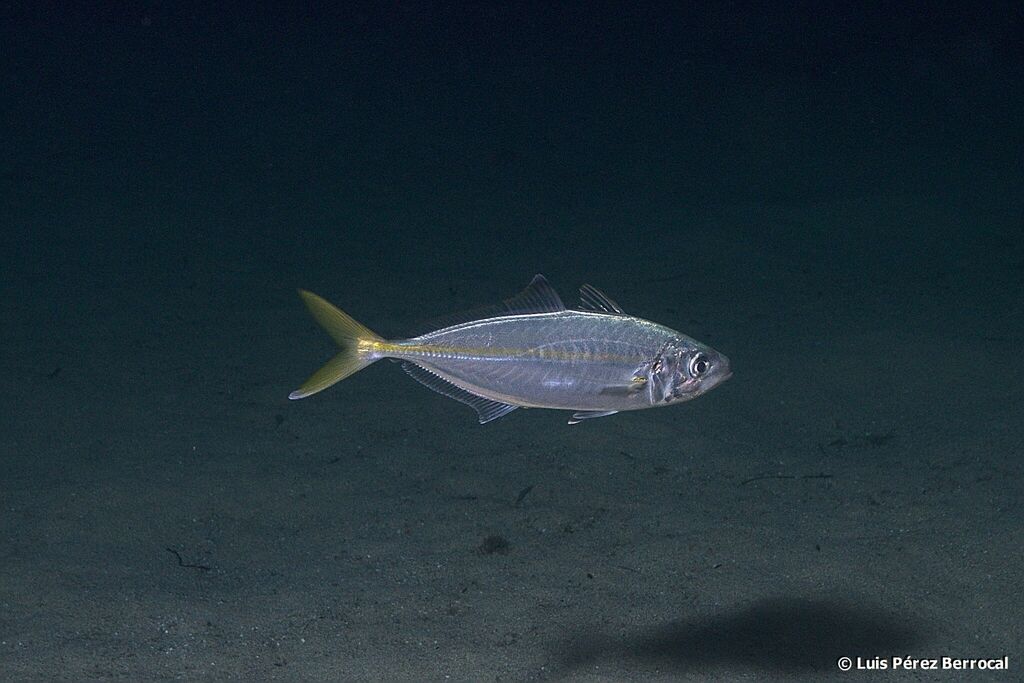
Spotfin Scad
Caranx rhonchus
The false scad (Caranx rhonchus), also known as the spotfin scad, ten-finned horse mackerel and yellow horse mackerel, is a species of medium-sized marine fish classified in the jack family Carangidae. The false scad is distributed throughout the tropical and temperate waters of the eastern Atlantic Ocean from Namibia in the south to Spain and throughout most of the Mediterranean in the north. The species has an atypical body form compared to other species of Caranx, and can be distinguished from these on its elongate 'scad-like' body shape alone. Distinguishing the species from members of Decapterus and Trachurus is more difficult, requiring detailed anatomical analysis. The false scad is known to grow to a length of 60 cm and a weight of 1 kg. The species lives both pelagically and demersally in continental shelf waters, ranging from depths of 15 to 200 m. It is a predatory fish, taking small fishes, crustaceans including euphausiids and shrimps, and cephalopods as its main prey, with significant dietary shifts as it ages. The false scad reaches sexual maturity at 2 years of age, with spawning occurring between April and July in shallow inshore waters, where the juveniles remain. The species is of major importance to fisheries throughout its range, but particularly from Morocco to Senegal, with annual catches ranging from 500 to 19000 t. The species is caught using trawls, seine nets and gill nets and sold fresh, frozen or salted.
From the article False scad on Wikipedia (CC BY-SA), quoted section by section
Description
The false scad is a moderately large species, growing to a known maximum length of 60 cm and a weight of 1 kg, although is more common at lengths of around 35 cm. The species has a much different body profile to most other species of Caranx, possessing an elongate, slightly compressed body in place of the deep, oblong shaped forms of its larger relatives. The species dorsal profile is approximately as equally convex as the ventral profile. The dorsal fin is in two distinct parts, the first consisting of 8 spines while the second has 1 spine and 28 to 32 soft rays. The anal fin consists of 2 detached spines anteriorly, followed by 1 spine and 25 to 28 soft rays. The soft rays located at the end of both the dorsal and anal fins are detached and only connected by a basal interradial membrane, forming a partially detached finlet. The pectoral and pelvic fins are both short. The species lateral line is weakly arched anteriorly, becoming straight after the end of the dorsal fin lobe. The curved section has 45 to 55 scales present and 0 to 3 scutes, while the straight section contains 0 to 8 scales and 24 to 32 scutes. The shoulder girdle is smooth, lacking papillae. The false scad has a well-developed adipose eyelid, particularly posteriorly, with both the jaws containing irregular narrow bands of fine teeth. …
Range & habitat
The false scad is distributed throughout the tropical and temperate waters of the eastern Atlantic Ocean, although the species is more abundant in certain regions of its range. The species has been reported from as far south as Namibia, but southern Angola appears to be the furthest south the species normally ventures. It is distributed north along the west African coastline, reaching as far north as Spain in Europe, with its range also extending well into the Mediterranean Sea. Here it is known as far east as Turkey, Egypt and Israel and as far north as Italy, Greece and Albania. The false scad lives both pelagically, free swimming high in the water column, as well as demersally, hugging the bottom strata. It prefers sandy or muddy substrates over continental shelf environments, ranging in depths from 15 m to 200 m. Juveniles tend to inhabit shallower inshore waters including estuaries, lagoons, beaches and marshes.
Wikipedia: “Distribution and habitat”
What it does
It is a predatory species, with several studies conducted to determine its diet and feeding habits. A study in the Cape Blanc region found Branchiostoma lanceolatum (a cephalochordate), euphausiids, small fish and other small crustaceans were the predominantly taken food items, with a surprising absence of copepods which other small species included in the study did take. This lack of copepods in the false scad's diet was also noticed in an earlier similar study, which looked at the diet of slightly smaller fish. A much later study in the same location found similar results, with fish being the most common prey followed by crustaceans including shrimps and mysids, molluscs and annelids. There is a change in the diet of the species as it grows, with one study finding 23 to 30 cm long fish took Branchiostoma lanceolatum predominantly, 30 to 35 cm fish took euphausiids and mysids, while 35 to 55 cm fish consumed small fishes of the families Maurolicidae and Carangidae predominantly. A similar pattern has been seen in other studies, with a general pattern of decreasing amounts of crustaceans and increasing amounts of small fish consumed as the fish grows. Seasonal variation in prey items is also known, with crustaceans dominating the diet during autumn and winter, while small fish are more frequently taken in summer. …
Wikipedia: “Diet and feeding”
Where it lives
Recorded sightings
—
geo-referenced records in GBIF, from museums, herbaria and field observers.
Drag the globe to turn it. Dots are where records exist, not a range map; darker means more records.
In the stacks
Searching the stacks…
Every page naming Caranx rhonchus in the Biodiversity Heritage Library →
This page is assembled live from iNaturalist, GBIF, Wikipedia, the Source Library and the Internet Archive. It is not yet part of the hand-edited codex. iNaturalist taxon 120693.