On eBird ↗
Splendid Fairywren
Live sightings near you, the range map, bar charts of when it is seen, and Macaulay Library photos and recordings.
Splendid Fairywren
Malurus splendens
The splendid fairywren (Malurus splendens) is a passerine bird in the Australasian wren family, Maluridae. It is also known simply as the splendid wren or more colloquially in Western Australia as the blue wren. The splendid fairywren is found across much of the Australian continent from central-western New South Wales and southwestern Queensland over to coastal Western Australia. It inhabits predominantly arid and semiarid regions. Exhibiting a high degree of sexual dimorphism, the male in breeding plumage is a small, long-tailed bird of predominantly bright blue and black colouration. Nonbreeding males, females, and juveniles are predominantly grey-brown in colour; this gave the early impression that males were polygamous, as all dull-coloured birds were taken for females. It comprises several similar all blue-and-black subspecies that were originally considered separate species.
Like other fairywrens, the splendid fairywren is notable for several peculiar behavioural characteristics; the birds are socially monogamous and sexually promiscuous, meaning that although they form pairs between one male and one female, each partner mates with other individuals and even assists in raising the young from such trysts. Male fairywrens pluck pink or purple petals and display them to females as part of a courtship display.
From the article Splendid fairywren on Wikipedia (CC BY-SA), quoted section by section
Description
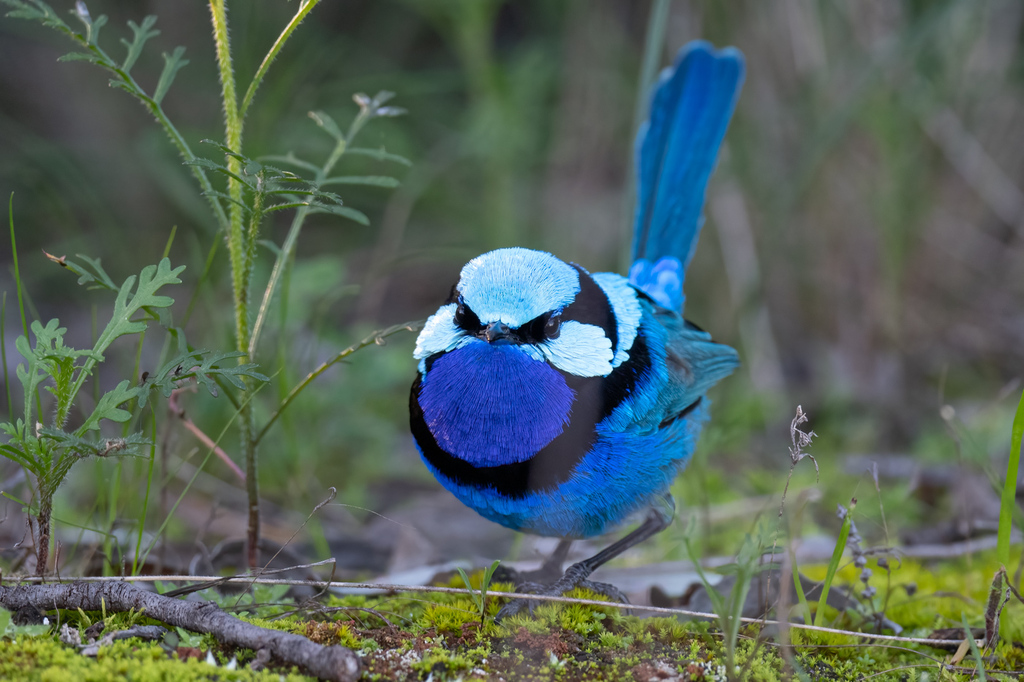
The splendid fairywren is a small, long-tailed bird 14 cm (5.5 in) long. Exhibiting a high degree of sexual dimorphism, the breeding male is distinctive with a bright blue forehead and ear coverts, a violet throat, and deeper rich blue back wings, chest, and tail with a black bill, eye band, and chest band. The blue breeding plumage of the male is often referred to as nuptial plumage. The non-breeding male is brown with blue in the wings and a bluish tail. The female resembles the non-breeding male but has a chestnut bill and eye-patch. Immature males moult into breeding plumage the first breeding season after hatching, though this may be incomplete with residual brownish plumage and may take another year or two to perfect. Both sexes moult in autumn after breeding, with males assuming an eclipse nonbreeding plumage. They moult again into nuptial plumage in winter or spring. Some older males have remained blue all year, moulting directly from one year's nuptial plumage to the next. Breeding males' blue plumage, particularly the ear coverts, is highly iridescent due to the flattened and twisted surface of the barbules. The blue plumage also reflects ultraviolet light strongly, so may be even more prominent to other fairywrens, whose colour vision extends into this part of the spectrum. …
Range & habitat
The splendid fairywren is widely distributed in the arid and semiarid zones of Australia. Its habitat is typically dry and shrubby, and includes mulga and mallee in drier parts of the country and forested areas in the southwest. The western subspecies M. s. splendens and eastern black-backed fairywren (subspecies M. s. melanotus) are largely sedentary, although the turquoise fairywren (subspecies musgravei) is thought to be partially nomadic. Unlike the eastern superb fairywren, the splendid fairywren has not adapted well to human occupation of the landscape and has disappeared from some urbanised areas. Forestry plantations of pine (Pinus spp.) and eucalypts are also unsuitable as they lack undergrowth.
Wikipedia: “Distribution and habitat”
What it does
Like all fairywrens, the splendid fairywren is an active and restless feeder, particularly on open ground near shelter, but also through the lower foliage. Movement is a series of jaunty hops and bounces, with its balance assisted by a proportionally large tail, which is usually held upright and rarely still. The short, rounded wings provide good initial lift and are useful for short flights, though not for extended jaunts. However, splendid fairywrens are stronger fliers than most other fairywrens. During spring and summer, birds are active in bursts through the day and accompany their foraging with song. Insects are numerous and easy to catch, which allows the birds to rest between forays. The group often shelters and rests together during the heat of the day. Food is harder to find during winter and they are required to spend the day foraging continuously. Groups of two to eight splendid fairywrens remain in their territory and defend it year-round. Territories average 4.4 ha (11 acres) in woodland-heath areas; size decreases with increasing density of vegetation and increases with the number of males in the group. The group consists of a socially monogamous pair along with one or more male or female helper birds that were hatched in the territory, though they may not necessarily be the offspring of the main pair. …
Wikipedia: “Behaviour and ecology”
In human culture
In his 1982 monograph, ornithologist Richard Schodde proposed a southern origin for the common ancestor of the superb and splendid fairywrens. At some time in the past, it was split into south-western (splendid) and south-eastern (superb) enclaves. As the southwest was drier than the southeast, once conditions were more favourable, the splendid forms were more able to spread into inland areas. These split into at least three enclaves, which subsequently evolved in isolation in the following drier glacial periods until the current more favourable climate saw them expand once again and interbreed where they overlap. This suggests the original split was only very recent, as the forms had insufficient time to speciate. Further molecular studies may result in this hypothesis being modified. A 2017 genetic study using both mitochondrial and nuclear DNA found the ancestors of the superb and splendid fairywrens diverged from each other around 4 million years ago, and their common ancestor diverged around 7 million years ago from a lineage that gave rise to the white-shouldered, white-winged, and red-backed fairywrens.
Wikipedia: “Evolutionary history”
Listen
Looking for field recordings…
Where it lives
Recorded sightings
—
geo-referenced records in GBIF, from museums, herbaria and field observers.
Drag the globe to turn it. Dots are where records exist, not a range map; darker means more records.
In the stacks
Searching the stacks…
Every page naming Malurus splendens in the Biodiversity Heritage Library →
This page is assembled live from iNaturalist, GBIF, Wikipedia, the Source Library and the Internet Archive. It is not yet part of the hand-edited codex. iNaturalist taxon 12083.