On eBird ↗
Red-backed Fairywren
Live sightings near you, the range map, bar charts of when it is seen, and Macaulay Library photos and recordings.
Red-backed Fairywren
Malurus melanocephalus
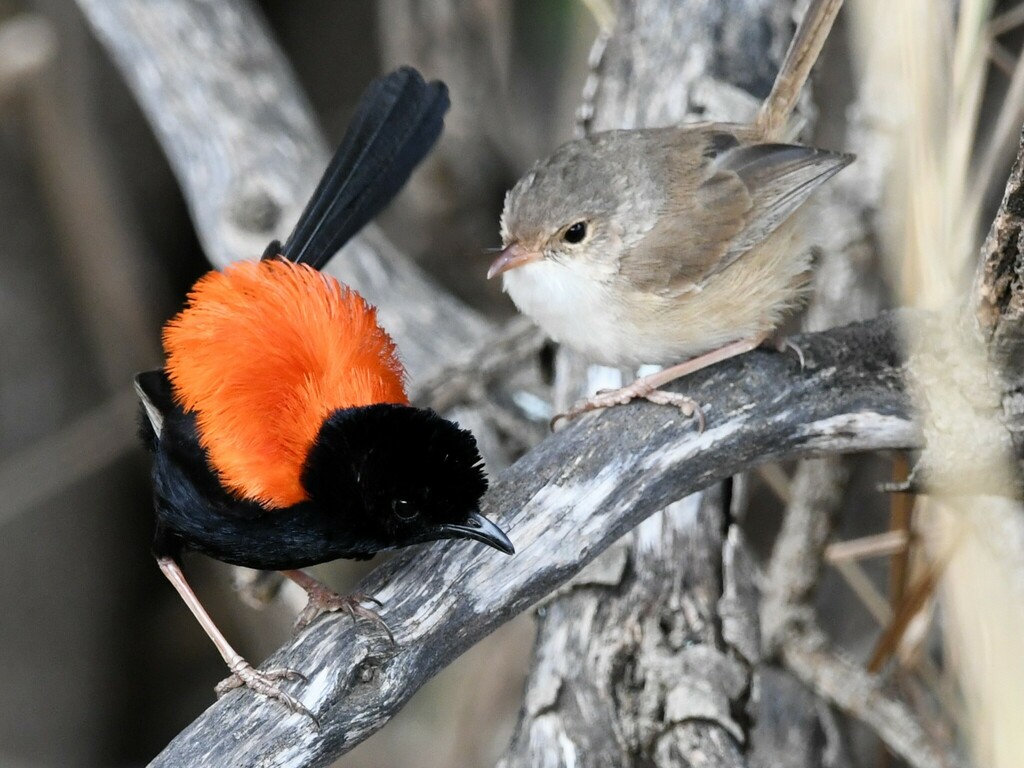
The red-backed fairywren (Malurus melanocephalus) is a species of passerine bird in the Australasian wren family, Maluridae. It is endemic to Australia and can be found near rivers and coastal areas along the northern and eastern coastlines from the Kimberley in the northwest to the Hunter Region in New South Wales. The male adopts a striking breeding plumage, with a black head, upperparts and tail, and a brightly coloured red back and brown wings. The female has brownish upperparts and paler underparts. The male in eclipse plumage and the juvenile resemble the female. Some males remain in non-breeding plumage while breeding. Two subspecies are recognised; the nominate M. m. melanocephalus of eastern Australia has a longer tail and orange back, and the short-tailed M. m. cruentatus from northern Australia has a redder back.
The red-backed fairywren mainly eats insects, and supplements its diet with seed and small fruit. The preferred habitat is heathland and savannah, particularly where low shrubs and tall grasses provide cover. It can be nomadic in areas where there are frequent bushfires, although pairs or small groups of birds maintain and defend territories year-round in other parts of its range. Groups consist of a socially monogamous pair with one or more helper birds who assist in raising the young. These helpers are progeny that have attained sexual maturity yet remain with the family group for one or more years after fledging.
From the article Red-backed fairywren on Wikipedia (CC BY-SA), quoted section by section
Description
The smallest member of the genus Malurus, the red-backed fairywren measures 11.5 centimetres (4.5 in) and weighs 5–10 g (0.18–0.35 oz), averaging around 8 g (0.28 oz). The tail is approximately 6 centimetres (2.4 in) long and is black in the breeding male, and brown in eclipse males, females, and juvenile birds. Averaging 8.6 mm (0.3 in), the bill is relatively long, narrow, pointed, and wider at the base. Wider than it is deep, the bill is similar in shape to those of other birds that feed by probing or picking insects off of their environs. Like other fairywrens, the red-backed fairywren is notable for its marked sexual dimorphism; the male adopts full breeding plumage by the fourth year, later than all other fairywrens apart from the closely related white-winged fairywren. The male in breeding plumage has a black head and body with striking red back and brown wings. At other times it has a brown upper body and white underparts. Some males, mainly younger, remain in eclipse plumage while breeding. The female looks remarkably similar with a buff brown body and a yellowish spot under the eye. The female of this species differs from those of other fairywren species in that it lacks a blue tint in the tail. Geographically, it follows Gloger's rule; female birds have whiter bellies and paler brown upperparts inland in sunnier climates. …
Range & habitat
The red-backed fairywren is endemic to Australia and can be seen along rivers and the coast from Cape Keraudren in northern Western Australia through the Kimberleys, Arnhem Land and the Gulf Country and into Cape York, with the Selwyn Range and upper reaches of the Flinders River as a southern limit. It is also found on the nearby offshore islands Groote Eylandt, Sir Edmund Pellew, Fraser, Melville and Bathurst Islands. Its range extends all the way down the east coast east of the Great Dividing Range to the Hunter River in New South Wales, preferring wet, grassy tropical or sub-tropical areas, with tall grasses such as blady grass (Imperata cylindrica), species of Sorghum, and Eulalia. It is not a true migrant, although it may be locally nomadic due to changes in vegetation, and may leave its territory after the breeding season. The species will retreat to fire-resistant cover at times of fire. The red-backed fairywren avoids arid habitats, and is replaced to the south of its range by the white-winged fairywren.
Wikipedia: “Distribution and habitat”
What it does
The red-backed fairywren is diurnal, and becomes active at dawn, and again in bursts throughout the day. When not foraging, birds often shelter together. They roost side-by-side in dense cover and engage in mutual preening. The usual form of locomotion is hopping, with both feet leaving the ground and landing simultaneously. However, a bird may run when performing the rodent-run display. Its balance is assisted by a relatively long tail, which is usually held upright and is rarely still. The short, rounded wings provide good initial lift and are useful for short flights, though not for extended jaunts. Birds generally fly in a series of undulations for a maximum of 20 or 30 m (66 or 98 ft). In dry tall grasslands in monsoonal areas, the change in vegetation may be so great due to either fires or wet season growth that birds may be more nomadic and change territories more often than other fairywrens. They form more stable territories elsewhere, such as in coastal areas. Cooperative breeding is less common with this species than with other fairywrens; helper birds have been sporadically reported, but the red-backed fairywren has been little studied. Both the male and female adult red-backed fairywren may utilise the rodent-run display to distract predators from nests with young birds. …
Wikipedia: “Behaviour and ecology”
In human culture
Ornithologist Richard Schodde has proposed that the ancestors of the two subspecies were separated during the last glacial period in the Pleistocene around 12,000 years ago. Aridity had pushed the grasslands preferred by the wren to the north, and with subsequent wetter warmer conditions it once again spread southwards and met the eastern form in northern Queensland and intermediate forms arose. The distribution of the three bi-coloured fairywren species indicates their ancestors lived across New Guinea and northern Australia in a period when sea levels were lower and the two regions were joined by a land bridge. Populations then became separated as sea levels rose, and New Guinea birds evolved into the white-shouldered fairywren, while Australian forms evolved into the red-backed fairywren and the arid-adapted white-winged fairywren. A 2017 genetic study using both mitochondrial and nuclear DNA found the ancestors of the red-backed and white-shouldered fairywrens diverged from each other around 3 million years ago, and their common ancestor diverged around 5 million years ago from a lineage that gave rise to the white-winged fairywren.
Wikipedia: “Evolutionary history”
Listen
Looking for field recordings…
Where it lives
Recorded sightings
—
geo-referenced records in GBIF, from museums, herbaria and field observers.
Drag the globe to turn it. Dots are where records exist, not a range map; darker means more records.
In the stacks
Searching the stacks…
Every page naming Malurus melanocephalus in the Biodiversity Heritage Library →
This page is assembled live from iNaturalist, GBIF, Wikipedia, the Source Library and the Internet Archive. It is not yet part of the hand-edited codex. iNaturalist taxon 12104.