- Animals
- ›Chordates
- ›Vertebrates
- ›Reptiles
- ›Snakes and Lizards
- ›Lizards
- ›Iguanas and Allies
- ›Iguanas, Anoles, and Allies
- ›Iguanas and Chuckwallas
- ›Cyclura
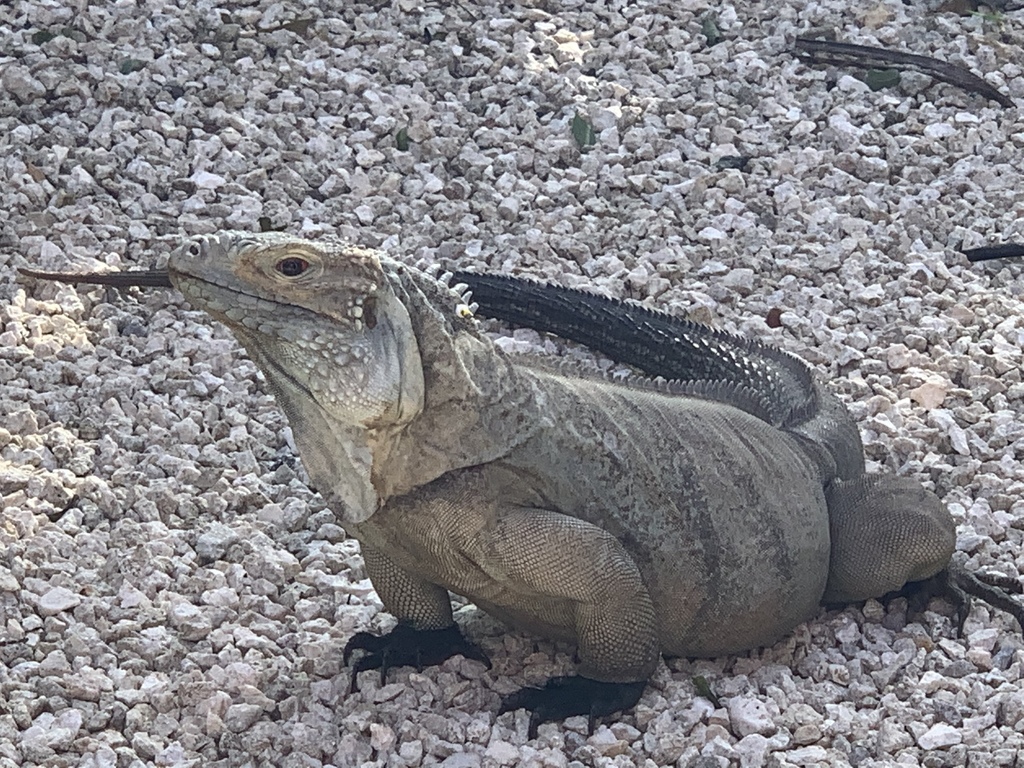
Grand Cayman Blue Iguana
Cyclura lewisi
The blue iguana (Cyclura lewisi), also known commonly as the Grand Cayman ground iguana, the Grand Cayman blue iguana, and the Cayman Island rock iguana, is an endangered species of lizard in the family Iguanidae. The species is endemic to the island of Grand Cayman. It was previously considered to be a subspecies of the Cuban iguana, Cyclura nubila, but in a 2004 article Frederic J. Burton reclassified it as a separate species because, according to him, the genetic differences discovered four years earlier between the different C. nubila populations warranted this interpretation. The blue iguana is one of the longest-living species of lizard (possibly up to 69 years).
The preferred habitat for the blue iguana is rocky, sunlit, open areas in dry forests or near the shore, as the females must dig holes in the sand to lay eggs in June and July. A possible second clutch is laid in September. The blue iguana's herbivorous diet includes plants, fruits, and flowers. Its color is tan to gray with a bluish cast that is more pronounced during the breeding season and more so in males. It is large and heavy-bodied with a dorsal crest of short spines running from the base of the neck to the end of the tail.
From the article Blue iguana on Wikipedia (CC BY-SA), quoted section by section
Description
An example of island gigantism, the blue iguana is the largest native land animal on Grand Cayman with a total nose-to-tail length of 5 ft (1.5 m) and weighing as much as 30 lb (14 kg). This is among the largest species of lizards in the Western Hemisphere. The largest of the Cyclura, its body length is 20–30 in (510–760 mm) with a tail equal in length. The blue iguana's toes are articulated to be efficient in digging and climbing trees. The mature male's skin color ranges from dark grey to turquoise blue, whereas the female is more olive green to pale blue. Young animals tend to be uniformly dark brown or green with faint darker banding. When they first emerge from the nest, the neonates have an intricate pattern of eight dark dorsal chevrons from the crest of their necks to their pelvic area. These markings fade by the time the animal is one year old, changing to mottled gray and cream and eventually giving way to blue as adults. The adult blue iguana is typically dark gray, matching the karst rock of its landscape. The animal changes its color to blue when it is in the presence of other iguanas to signal and establish territory. The blue color is more pronounced in males of the species. Its distinctive black feet contrast with its lighter overall body color. …
Range & habitat
The blue iguana is endemic to the island of Grand Cayman. As of 2012, the population can be found throughout the island Grand Cayman excluding the urban areas of Bodden Town, Gun Bay, Seven Mile Beach and West Bay. One theory for how the taxon ended up on the island is that a single female Cuban iguana, C. nubila nubila, with eggs inside her drifted across the sea, perhaps during a storm. Sometimes the Lesser Caymans iguana, C. nubila caymanensis, has been found on Grand Cayman.
Wikipedia: “Distribution”
What it does
Like all Cyclura species, the blue iguana is primarily herbivorous, consuming leaves, stems, flowers, nuts, and fruits from over 45 species of plants. The diet is very rarely supplemented with insects, crabs, slugs, and fungi. Blue iguanas have also been observed ingesting small rocks, soil, feces, and bits of shedding.
Wikipedia: “Diet”
At the table
Habitat destruction is the main factor threatening extinction for this iguana. Land clearance within remnant habitat is occurring for agriculture, road construction, and real estate development and speculation. The conversion of traditional crop lands to cattle pasture is eliminating secondary blue iguana habitat. Predation and injury to hatchlings by rats, to hatchlings and sub-adults by feral cats, and killing of adults by pet dogs are all placing severe pressure on the remaining wild population. Automobiles and motorscooters are an increasing cause of mortality as the iguanas rarely survive the collisions. Trapping and shooting is a comparatively minor concern, and has stopped according to the IUCN in 2012; however, before 1995, occasional trapping may have occurred. The common green iguana (Iguana iguana) has been introduced from Honduras and is well-established on Grand Cayman as an invasive species. It far outnumbers the native blue iguana. No direct negative consequences on the blue iguana due to this introduction are known, but the mere presence of the green iguana confuses public attitudes and understanding. …
Wikipedia: “Causes of decline”
Toxicity
The blue iguana is listed as endangered on the IUCN Red List. In 1988 the British researcher Roger Avery spent two weeks on the island and only observed three animals. Surveys in 2003 indicated a total population in the range of 5–15 individuals. In 2006 the iguana was one of the most endangered lizards on Earth. Restored free-roaming subpopulations in the Queen Elizabeth II Botanic Park and the Salina Reserve numbered approximately 125 individuals in total after an initial release in December 2005. The restored subpopulation in the Queen Elizabeth II Botanic Park has been breeding since 2001, and the subpopulation in the Salina Reserve was deemed to be breeding in 2006 after a nest of three hatched eggs was discovered in the wild. In April 2007, after another large-scale release, there were 299 blue iguanas living in the wild, with hundreds more being raised in captivity on Grand Cayman. In late 2012, the blue iguana recovery program estimated that the wild population had risen to approximately 750 individuals, and the IUCN subsequently downlisted the species from critically endangered to endangered. International trade in the species is regulated due to its listing on Appendix I of the Convention on International Trade in Endangered Species.
Wikipedia: “Endangered status”
In human culture
The specific name, lewisi, commemorates the surname of the scientist who collected the holotype of this species, Charles Bernard Lewis. The closest relatives of the blue iguana are the Cuban iguana (Cyclura nubila) and the Northern Bahamian rock iguana (C. cychlura). The blue iguana can be genetically distinguished from the subspecies found on Little Cayman and Cayman Brac known as C. nubila caymanensis, although it can interbreed with this subspecies and produce fertile offspring. In 1938, Lewis of the Institute of Jamaica joined an Oxford University biological expedition to the Cayman Islands. Lewis obtained two blue iguanas, a male and a female, which were later lodged with the Natural History Museum, London. Chapman Grant, in an article published in 1940, formally described the blue iguana as a separate taxon for the first time, classifying it as the trinomial C. macleayi lewisi. Albert Schwartz and Richard Thomas reclassified it as C. nubila lewisi in 1975, making it a subspecies of the Cuban iguana. In his 2004 article Frederick Burton repeatedly states Schwartz and Carey reclassified it in a 1977 publication, but he is mistaken. Burton, who runs the captive breeding program on the island, reclassified the blue iguana as a distinct species in 2004. Although it has almost identical head scale counts and patterns as C. …
Wikipedia: “Etymology and taxonomy”
Where it lives
Recorded sightings
—
geo-referenced records in GBIF, from museums, herbaria and field observers.
Drag the globe to turn it. Dots are where records exist, not a range map; darker means more records.
In the stacks
Searching the stacks…
Every page naming Cyclura lewisi in the Biodiversity Heritage Library →
This page is assembled live from iNaturalist, GBIF, Wikipedia, the Source Library and the Internet Archive. It is not yet part of the hand-edited codex. iNaturalist taxon 121111.