On eBird ↗
Dusky Grasswren
Live sightings near you, the range map, bar charts of when it is seen, and Macaulay Library photos and recordings.
Dusky Grasswren
Amytornis purnelli
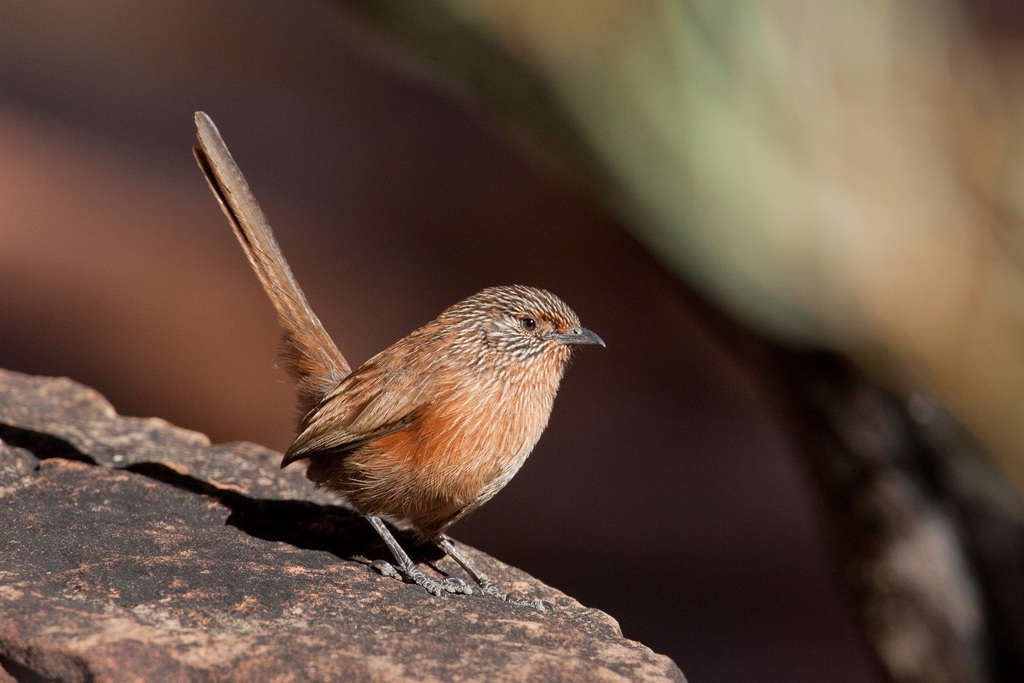
The dusky grasswren (Amytornis purnelli) is a species of small passerine bird in the family Maluridae. The species is endemic to Australia but is limited to inland areas of the Northern Territory, Western Australia and South Australia.
From the article Dusky grasswren on Wikipedia (CC BY-SA), quoted section by section
Description
The dusky grasswren is superficially similar in appearance to a number of the other grasswrens in the genus Amytornis, but is the only member of this genus to exclusively inhabit rocky ranges across Central Australia. It has a predominantly brown base colour to its plumage with fine pale streaking over the head breast and mantle. The brown of the plumage is a richer chestnut on the back and pale to almost buff on the belly and vent. The most obvious difference between sexes is the bright rusty-brown spot on the fore-flanks of the adult female and all birds exhibit the characteristic cocked tail posture common to all malurids.
Field identification. The species is easily identified within its core range by its distinctive vocalisations (see further information below). The mouse-like, strongly terrestrial, habits of the species can make it difficult to observe clearly within its preferred habitat of boulder-strewn rocky hillsides covered with spinifex grasses. But when observed well, the cocked tail, overall brown colouration and strongly terrestrial habits should be sufficient to achieve a positive identification.
Similar species. The dusky grasswren is similar in shape and form to most of the other species in Amytornis, but is relatively unmistakable if seen well in the field. …
Range & habitat
Across their entire range, dusky grasswrens adhere to the same habitat type: rocky ranges and outcrops, often preferring tumbled talus or scree, and with areas of thick, long-unburnt spinifex grasses in the genus Triodia. They are not known to use sandplain habitat adjacent to rocky areas which may be one factor giving rise to the patchiness of their occurrence across Central Australia.
Wikipedia: “Habitat”
What it does
In the wild dusky grasswrens have been observed feeding on a range of small arthropods and other invertebrates; seeds; and small desert fruits but there are few published accounts of wild feeding observations. In captivity the species has been observed to subsist on a typical aviary feed-out of meat mix, greens and vegetables enriched with a variety of live invertebrate prey including cockroaches and mealworms.
Wikipedia: “Diet”
Listen
Looking for field recordings…
Where it lives
Recorded sightings
—
geo-referenced records in GBIF, from museums, herbaria and field observers.
Drag the globe to turn it. Dots are where records exist, not a range map; darker means more records.
In the stacks
Searching the stacks…
Every page naming Amytornis purnelli in the Biodiversity Heritage Library →
This page is assembled live from iNaturalist, GBIF, Wikipedia, the Source Library and the Internet Archive. It is not yet part of the hand-edited codex. iNaturalist taxon 12119.