On eBird ↗
Mallee Emuwren
Live sightings near you, the range map, bar charts of when it is seen, and Macaulay Library photos and recordings.
Mallee Emuwren
Stipiturus mallee
The mallee emu-wren (Stipiturus mallee) is a species of bird in the Australasian wren family, Maluridae. It is endemic to Australia.
Its natural habitat is temperate grassland. It is threatened because of habitat loss.
From the article Mallee emu-wren on Wikipedia (CC BY-SA), quoted section by section
Description
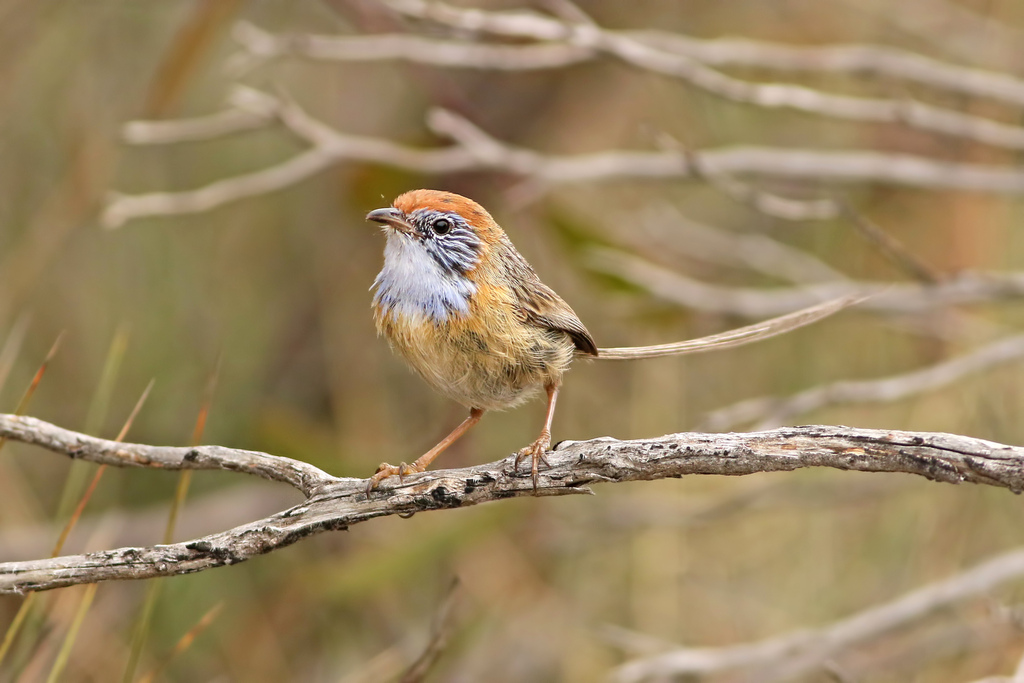
The mallee emu-wren is an average 16.5 centimetres (6.5 inches) from head to tail. The adult male mallee emu-wren has olive-brown upperparts with dark streaks, and a pale rufous unstreaked crown, and grey-brown wings. It has a sky blue throat, upper chest, lores, and ear coverts. The lores and ear coverts are streaked with black, and there is white streaking under the eye. Though still long, the tail is not as long as in other emu-wrens, and is composed of six filamentous feathers, the central two of which are longer than the lateral ones. The underparts are pale brown. The bill is black, and the feet and eyes are brown. The female resembles the male but lacks blue plumage. Its crown is paler red and it has white lores. Its bill is dark brown. The mallee emu-wren moults yearly after breeding, and birds have only the one plumage. The most recognizable and identifiable feature is the six emu-like feathers on its tail. This feature is highly distinguishable from other species found in its home range.
Range & habitat
The mallee emu-wren is restricted to open mallee woodland with spinifex understory in north-western Victoria and south-eastern South Australia. This region is rich in Triodia or as it is commonly known spinifex. The spinifex grass often grows to 1 metre (3 feet 3 inches) in height and provides the optimal habitat for the mallee emu-wren. Formerly classified as a vulnerable species by the IUCN, recent research shows that its numbers are decreasing more and more rapidly. It is consequently uplisted to endangered status in 2008. The mallee emu-wren is listed as nationally endangered under the Australian Environment Protection and Biodiversity Conservation Act 1999. The current estimated total population size is approximately 4,000 birds. Although this species is widely dispersed throughout the Murray Sunset Reserve its home ranges are patchy throughout the 488 square kilometres (188 square miles) reserve. Recent studies have concluded that the species is more widespread than previously thought. However, the species is much rarer in the southern regions of the preserve. Their dispersion is heavily connected to the prevalence of hummocks formed by grass-like plants of the genus Triodia. This biotic factor is of the most influence in the dispersion of mallee emu-wren.
Wikipedia: “Distribution and habitat”
What it does
Like all emu-wrens, the mallee emu-wren is difficult to observe in clumps of spinifex. It is not a proficient flier. Its diet consists mainly of insects including beetles, seeds, and some vegetation.
Breeding. Breeding is little known, but has been recorded between September and November. The nest is a dome-shaped structure built of grasses generally located deep within a clump of spinifex. Two or three oval eggs are laid which measure 13.5 to 16 mm (0.53–0.63 in) by 10 to 12 mm (0.39–0.47 in). They are white with reddish-brown freckles, more concentrated over the larger end.
Threats. Too frequent burning The vegetation varies in composition from year to year post controlled burn. As the vegetation reaches 30 years from the last burn it is no longer suitable for the mallee emu-wren. The strongest population numbers occur in regions that are less than 16 years old since their last burn. Although the periodic burning is good for the mallee emu-wren the frequent wildfires or excessive controlled burns are detrimental. Climate fluctuations The two main climate aspects that relate to the mallee emu-wren's mating success are temperature and rainfall. …
Wikipedia: “Behaviour and ecology”
Listen
Looking for field recordings…
Where it lives
Recorded sightings
—
geo-referenced records in GBIF, from museums, herbaria and field observers.
Drag the globe to turn it. Dots are where records exist, not a range map; darker means more records.
In the stacks
Searching the stacks…
Every page naming Stipiturus mallee in the Biodiversity Heritage Library →
This page is assembled live from iNaturalist, GBIF, Wikipedia, the Source Library and the Internet Archive. It is not yet part of the hand-edited codex. iNaturalist taxon 12131.