- Animals
- ›Chordates
- ›Vertebrates
- ›Ray-finned Fishes
- ›Spiny-rayed fishes
- ›Blennies, Damselfishes and Allies
- ›Damselfishes
- ›Chromis and Humbugs
- ›Dascyllus
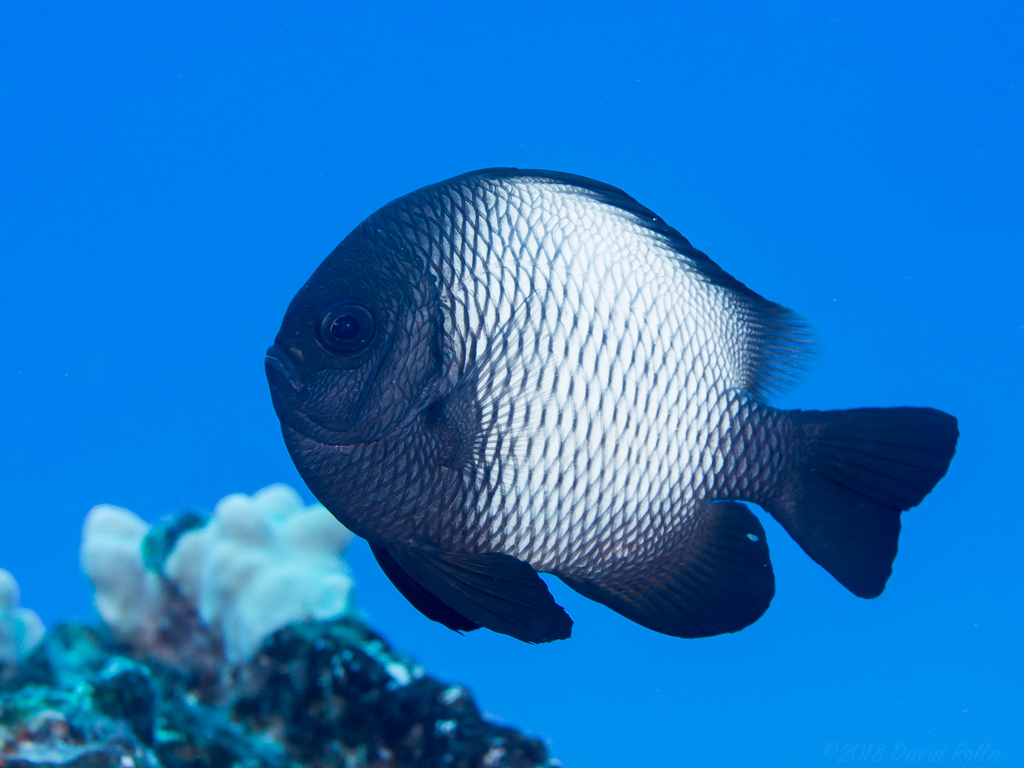
Hawaiian Dascyllus
Dascyllus albisella
Dascyllus albisella commonly known as the Hawaiian dascyllus, Hawaiian domino, Domino damselfish, or white-spotted damsel is a marine fish found in the Eastern Central Pacific.
From the article Dascyllus albisella on Wikipedia (CC BY-SA), quoted section by section
Description
Length up to 12.5 cm, dark gray to black, but centers of scales on body are whitish.
Range & habitat
Associated with coral reefs, most usually in shallow, protected waters. swim in shallow water surface to 20 feet below in small openings.
Wikipedia: “Habitat”
What it does
Dascyllus albisella are a relatively passive species that spends most of their time foraging. Normally, males are the more aggressive of the two genders as they are the ones that usually exhibit parental care. While male aggressiveness is expected, males exhibit sole care of the offspring unlike most animals. This is due to the uniparental nature of Dascyllus albisella. This does not indicate that the females are not present whatsoever. Nor does this show that the females only have a duty to lay the eggs. In cases where the male is not present, females may develop more aggressiveness depending on the situation. As we can see, females do not desert the nest after mating. Females that are larger are more likely to defend the nest in the absence of the male than smaller females. That being said, the nest is defended most frequently by females that were born at that nest. This does not apply to all the females. Some females, even when raised at the nest will not defend the nest regardless. This increased aggressiveness is more favored towards the larger females, however the correlation isn't terribly strong between size and nest defense. There is only a tendency for larger fish to defend. In another case when both parents are present, the female will display increased aggressiveness when predation levels increase. …
Wikipedia: “Behavior”
Where it lives
Recorded sightings
—
geo-referenced records in GBIF, from museums, herbaria and field observers.
Drag the globe to turn it. Dots are where records exist, not a range map; darker means more records.
In the stacks
Searching the stacks…
Every page naming Dascyllus albisella in the Biodiversity Heritage Library →
This page is assembled live from iNaturalist, GBIF, Wikipedia, the Source Library and the Internet Archive. It is not yet part of the hand-edited codex. iNaturalist taxon 121392.