- Animals
- ›Chordates
- ›Vertebrates
- ›Ray-finned Fishes
- ›Spiny-rayed fishes
- ›Butterflyfishes, Angelfishes, and Allies
- ›Surgeonfishes, Tangs, and Unicornfishes
- ›Naso
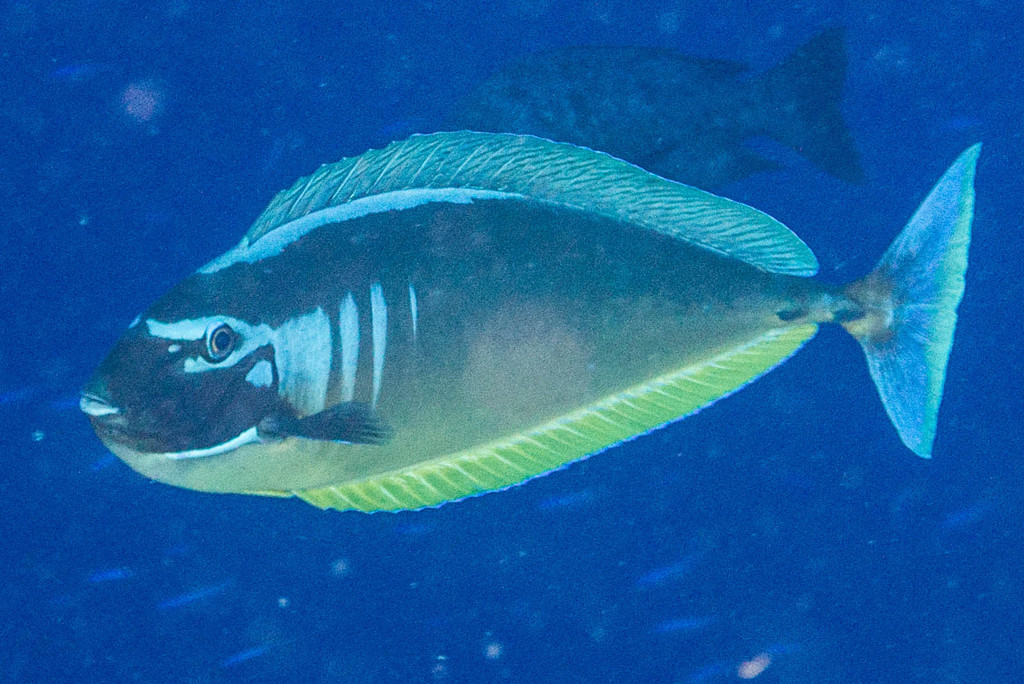
Sleek Unicornfish
Naso hexacanthus
The sleek unicornfish (Naso hexacanthus), also known as the blue-tail unicorn, Thorpe's unicornfish, blacktongue unicornfish or ʻopelu kala, is a species of marine ray-finned fish belonging to the family Acanthuridae, the surgeonfishes, unicornfishes and tangs. This species is found in coral reefs in the Pacific and Indian Oceans. It is of value in commercial fisheries and as a game fish, and is also seen in aquaria.
From the article Sleek unicornfish on Wikipedia (CC BY-SA), quoted section by section
Description
The sleek unicornfish does not have a protuberance extending from its forehead, unlike some of its congeners. Its colors range from a dark brown to yellow, on occasion changing to blue or silver. Adults measure 75 centimeters in length. The teeth are angled backwards; the tongue is black.
Range & habitat
The sleek unicornfish is distributed in the Indo-Pacific, from the Hawaiian islands to Africa and India. It inhabits lagoons and seaward reef slopes. As the sleek unicornfish has a wide Indo-Pacific distribution the IUCN has classified its conservation status as Least Concern.
Wikipedia: “Distribution and habitat”
What it does
The species consumes plankton and small crustaceans, as well as filamentous algae. It is the subject of moderate fisheries.
Wikipedia: “Ecology”
In human culture
The sleek unicornfish's specific name, hexacanthis means "six spines" and is an allusion to the six dorsal fin spines.
Wikipedia: “Etymology”
Where it lives
Recorded sightings
—
geo-referenced records in GBIF, from museums, herbaria and field observers.
Drag the globe to turn it. Dots are where records exist, not a range map; darker means more records.
In the stacks
Searching the stacks…
Every page naming Naso hexacanthus in the Biodiversity Heritage Library →
This page is assembled live from iNaturalist, GBIF, Wikipedia, the Source Library and the Internet Archive. It is not yet part of the hand-edited codex. iNaturalist taxon 121458.