- Animals
- ›Chordates
- ›Vertebrates
- ›Ray-finned Fishes
- ›Spiny-rayed fishes
- ›Butterflyfishes, Angelfishes, and Allies
- ›Surgeonfishes, Tangs, and Unicornfishes
- ›Acanthurus
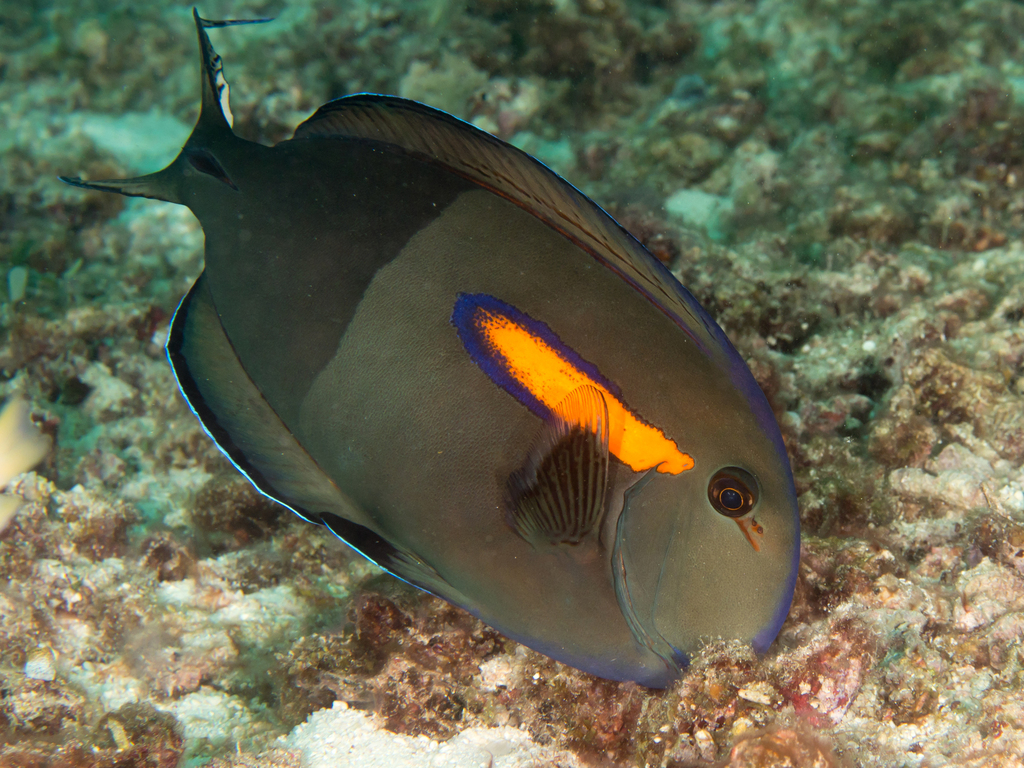
Orangeblotch Surgeonfish
Acanthurus olivaceus
Acanthurus olivaceus, the orange-band surgeonfish, orange-shoulder surgeonfish or orangebar tang, is a species of marine ray-finned fish in the family Acanthuridae, the surgeonfishes, unicornfishes and tangs. It lives in the tropical waters of the Indo-Pacific.
From the article Acanthurus olivaceus on Wikipedia (CC BY-SA), quoted section by section
Description
Like most other surgeonfish species, the orange-band surgeonfish is a deep-bodied, laterally-compressed oval fish. It is over twice as long as it is deep, with a maximum length of 35 cm (14 in), although a more typical length is 25 cm (10 in). Both the dorsal and the anal fins are long and low, extending as far as the caudal peduncle. The dorsal fin has 9 spines and 23 to 25 soft rays while the anal fin has 3 spines and 22 to 24 soft rays. The tail fin is strongly lunate, with the tips growing longer as the fish gets older. The adult fish is greyish-brown, and the paler front half of the fish very abruptly changes to the darker hind portion. There is a distinctive orange bar with a purplish-black margin immediately behind the top of the operculum, and there are blue and orange lines at certain fin bases. Like all other surgeonfishes, this species has a pair of scalpel-like scales that project upward from the caudal peduncle. Larger males develop a convex snout which clearly differentiates them from females. Juvenile fish are yellow.
Range & habitat
The orange-band surgeonfish is found in the tropical eastern Indian Ocean and the western Pacific Ocean. Its range extends from Christmas Island and the Cocos Islands to southern Japan, Australia (except the southern coast), Indonesia, the Philippines and Hawaii. It is associated with reefs, often found on outer slopes and in more exposed locations. As adult, it is a solitary fish, but sometimes joins schools. The adult depth range is between about 9–46 m (30–151 ft), but juveniles are found in shallower water in sheltered locations in small groups.
Wikipedia: “Distribution and habitat”
What it does
The orange-band surgeonfish feeds on detritus and on algae growing on the seabed, as well as the film of diatoms and filamentous algae that grows on sand and other substrates. It often forms schools with parrotfish, tangs and other surgeonfishes with similar diets; their grazing is important in maintaining coral reef habitats, since it keeps rocks free from excessive growth of algae, so that coral larvae can find suitable place to settle.
Wikipedia: “Ecology”
Where it lives
Recorded sightings
—
geo-referenced records in GBIF, from museums, herbaria and field observers.
Drag the globe to turn it. Dots are where records exist, not a range map; darker means more records.
In the stacks
Searching the stacks…
Every page naming Acanthurus olivaceus in the Biodiversity Heritage Library →
This page is assembled live from iNaturalist, GBIF, Wikipedia, the Source Library and the Internet Archive. It is not yet part of the hand-edited codex. iNaturalist taxon 121704.