On eBird ↗
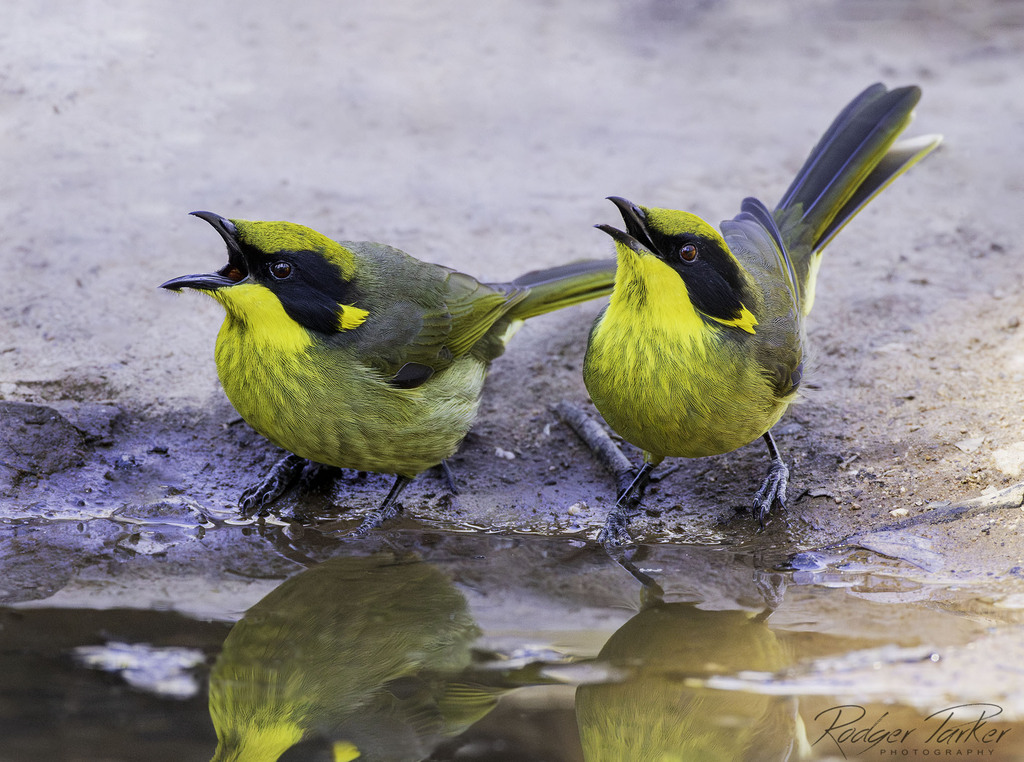
Yellow-tufted Honeyeater
Live sightings near you, the range map, bar charts of when it is seen, and Macaulay Library photos and recordings.
Yellow-tufted Honeyeater
Lichenostomus melanops
The yellow-tufted honeyeater (Lichenostomus melanops) is a passerine bird found in the south-east ranges of Australia from south-east Queensland through eastern New South Wales and across Victoria into the tip of Southeastern South Australia. A predominantly black and yellow honeyeater, it is split into three subspecies.
From the article Yellow-tufted honeyeater on Wikipedia (CC BY-SA), quoted section by section
Description
The yellow-tufted honeyeater is 17–23 cm (6.7–9.1 in) long, with females usually smaller. It has a bright yellow forehead, crown and throat, a glossy black mask and bright golden ear-tufts. The back is olive-green to olive-brown on wings and tail, and the underparts are more olive-yellow. The bill and gape are black, eyes brown, and legs grey-brown.
Range & habitat
The yellow-tufted honeyeater occurs from south-east Queensland through eastern New South Wales and across Victoria. Its preferred habitats are dry open sclerophyll forests and woodlands dominated by eucalypts with shrubby undergrowth, as well as mallee, brigalow and cypress-pine (Callitris). The helmeted honeyeater subspecies is largely restricted to dense vegetation along riverbanks, dominated by the mountain swamp gum (Eucalyptus camphora) with a dense understorey of woolly tea-tree (Leptospermum lanigerum), scented paperbark (Melaleuca squarrosa), saw-sedge (Gahnia), ferns and tussock grasses.
Wikipedia: “Distribution and habitat”
What it does
Yellow-tufted honeyeaters are a noisy, active species in colonies from a few up to a hundred. It aggressively defends territories around flowering trees. It has a great variety of calls from a warbled "tui-t-tui-t-tui", a whistled "wheit-wheit", a sharp "querk" to a harsh contact-call "yip" or "chop-chop".
Diet and Foraging. The diet of the yellow-tufted honeyeater is primarily arthropods, such as a variety of insects and spiders, and occasionally snails. It also feeds on lerps and honeydew, nectar and sap flows from eucalypts, occasionally fruit and flowers. It takes insects in flight and by probing the bark of tree-trunks and limbs.
Breeding. Breeding takes place between July and March (mostly from September to January), with one or two broods each season. The nest is a cup-shaped structure of dried grasses, bits of bark and other plant material, bound with spider webs and lined with fur and feathers, hung by its rim in dense shrubbery or regrowth. Two or three eggs, each measuring 23 mm × 17 mm (0.91 in × 0.67 in), are laid, pinkish in colour, blotched with pale reddish- or buff-brown. The eggs are incubated mostly by the female for 14–16 days. The nestlings are brooded by the female and fed by both sexes and any helpers, fledging at 13–15 days post-hatch and usually becoming independent by 6 weeks. …
Wikipedia: “Behaviour”
Listen
Looking for field recordings…
Where it lives
Recorded sightings
—
geo-referenced records in GBIF, from museums, herbaria and field observers.
Drag the globe to turn it. Dots are where records exist, not a range map; darker means more records.
In the stacks
Searching the stacks…
Every page naming Lichenostomus melanops in the Biodiversity Heritage Library →
This page is assembled live from iNaturalist, GBIF, Wikipedia, the Source Library and the Internet Archive. It is not yet part of the hand-edited codex. iNaturalist taxon 12204.