- Animals
- ›Echinoderms
- ›sea urchins and sea cucumbers
- ›Sea Urchins, Sand Dollars, and Heart Urchins
- ›sea urchins
- ›Aulodonta
- ›Diadematacea
- ›Diadematoida
- ›Diadematidae
- ›Echinothrix
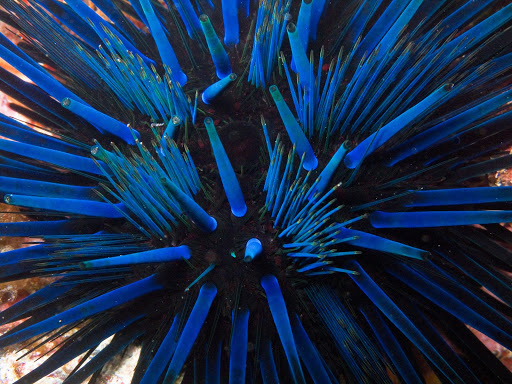
Blue-black Urchin
Echinothrix diadema
The diadema urchin or blue-black urchin (Echinothrix diadema) is a species of tropical sea urchin, member of the Diadematidae family.
From the article Echinothrix diadema on Wikipedia (CC BY-SA), quoted section by section
Description
Echinothrix diadema is a long spined urchin. With its spines, the typical diameter is 10–20 cm (3.9–7.9 in). The internal organs are enclosed in the test, covered by a thin dermis and epidermis. It is generally black or blue-black in colour, and always dark (the spines show a blue sheen in the light). The spines are closed at the tip; the anal sac is small and dark. It differs from Echinothrix calamaris in that the spines are not banded, except in juveniles, and that its anal sac is small and hardly visible, and the spines show a blue sheen (whereas dark morphs of E. calamaris show a greenish tinge). Another similar species is Diadema setosum, which has longer spines and smaller test, the distinguishing feature being an orange ring around anal sac.
Wikipedia: “Description and characteristics”
Range & habitat
This species can be found throughout all the Indo-Pacific coral reefs, from the Red Sea to Hawaii. It is a shallow waters species, living between the surface and 10m deep, but can eventually be found down to 70m.
Wikipedia: “Distribution and habitat”
What it does
The grazing preferences of Echinothrix diadema in Fiji were found to correlate with its preferred algae/seagrass species, Codium geppiorum. The grazing activity contributes to echinoid bioerosion.
Wikipedia: “Feeding habits”
Where it lives
Recorded sightings
—
geo-referenced records in GBIF, from museums, herbaria and field observers.
Drag the globe to turn it. Dots are where records exist, not a range map; darker means more records.
In the stacks
Searching the stacks…
Every page naming Echinothrix diadema in the Biodiversity Heritage Library →
This page is assembled live from iNaturalist, GBIF, Wikipedia, the Source Library and the Internet Archive. It is not yet part of the hand-edited codex. iNaturalist taxon 122164.