On eBird ↗
Eastern Spinebill
Live sightings near you, the range map, bar charts of when it is seen, and Macaulay Library photos and recordings.
Eastern Spinebill
Acanthorhynchus tenuirostris
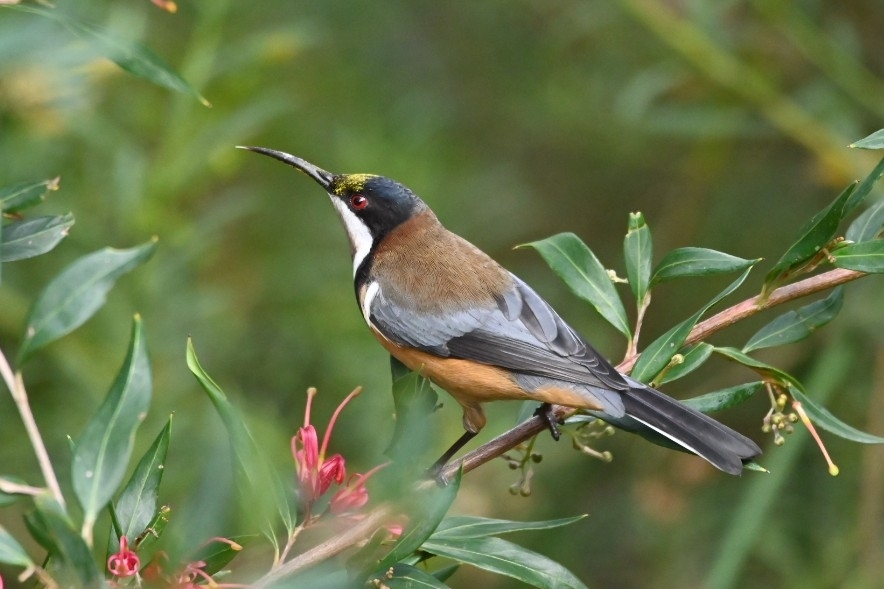
The eastern spinebill (Acanthorhynchus tenuirostris) is a species of honeyeater found in south-eastern Australia in forest and woodland areas, as well as gardens in urban areas of Canberra, Sydney and Melbourne. It is around 15 cm long, and has a distinctive black, white and chestnut plumage, a red eye, and a long downcurved bill.
From the article Eastern spinebill on Wikipedia (CC BY-SA), quoted section by section
Description
The male eastern spinebill is 13–16 cm (5–6.5 in) long, and has a long thin downcurved black bill with a black head, white throat with a chestnut patch and red iris. It has a brownish-red nape, a grey-brown back and pale cinnamon underparts. The dark tail is tipped with white laterally. Females are smaller with olive-grey crown, similar in colouring to male but slightly duller; and juveniles are pale warm cinnamon below with grey to olive-brown upperparts, a brown-red eye and orange base to the bill. The call is a clear, high-pitched, staccato piping "chip-chip-chip", sometimes repeated for lengthy periods.
Range & habitat
Eastern spinebills are found in dry sclerophyll forest, scrub and heathland from the Cooktown area in North Queensland south through New South Wales east of the Great Dividing Range, through Victoria and into the Flinders Ranges in eastern South Australia as well as throughout Tasmania. Adaptable, they can be found in urban gardens with sufficient vegetation to act as cover and a food source.
Wikipedia: “Distribution and habitat”
What it does
The eastern spinebill feeds on nectar from many plants, including the blooms of gum trees, mistletoes Amyema spp., Epacris longiflora, Epacris impressa (common heath), Correa reflexa, and various members of the Proteaceae such as Banksia ericifolia, Banksia integrifolia, Lambertia formosa and Grevillea speciosa, as well as small insects and other invertebrates. A 1982 study in the New England National Park in north-eastern New South Wales found that there was a large influx of birds coinciding with the start of flowering of Banksia spinulosa there. They have been known to feed from exotic plants such as fuchsias. During periods of abundant flowering there may be periods of low nectar production, and it appears that the eastern spinebill responds to these periodic shortages by storing fat during periods of high nectar production, increasing the amount of time spent feeding, or dropping its day-time metabolic rate to night-time levels.
Wikipedia: “Diet”
Listen
Looking for field recordings…
Where it lives
Recorded sightings
—
geo-referenced records in GBIF, from museums, herbaria and field observers.
Drag the globe to turn it. Dots are where records exist, not a range map; darker means more records.
In the stacks
This page is assembled live from iNaturalist, GBIF, Wikipedia, the Source Library and the Internet Archive. It is not yet part of the hand-edited codex. iNaturalist taxon 12238.