On eBird ↗
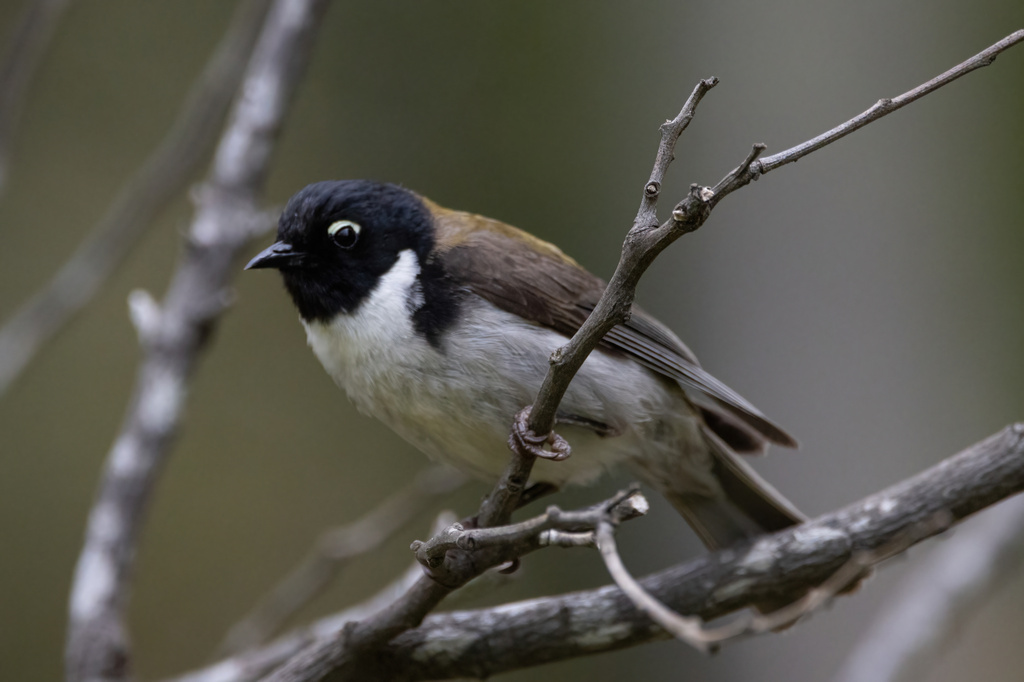
Black-headed Honeyeater
Live sightings near you, the range map, bar charts of when it is seen, and Macaulay Library photos and recordings.
Black-headed Honeyeater
Melithreptus affinis
The black-headed honeyeater (Melithreptus affinis) is a species of bird in the family Meliphagidae. It is one of two members of the genus Melithreptus endemic to Tasmania. Its natural habitats are temperate forests and Mediterranean-type shrubby vegetation. Despite its name, the black-headed honeyeater eats predominantly insects.
From the article Black-headed honeyeater on Wikipedia (CC BY-SA), quoted section by section
Description
A mid-sized honeyeater, it is olive-green above and white below, with a wholly black head that lacks the white nape of its relatives. It has a blue-white patch of bare skin around the eye. Its beak is small.
Range & habitat
The black-headed honeyeater is endemic to Tasmania as well as King Island and the Furneaux Group, where it inhabits wet and dry sclerophyll forests, as well as scrub and heathland, and subalpine habitats to an altitude of 1200 m (4000 ft).
Wikipedia: “Distribution and habitat”
What it does
Insects and spiders form the bulk of the diet along with flower nectar. The black-headed honeyeater specialises in foraging among the foliage of trees, as opposed to probing the trunk for prey, which is practised by its relative the strong-billed honeyeater, and consequently the two species rarely overlap. Birds often hang upside down from branches while foraging.
== References ==
Wikipedia: “Feeding”
Listen
Looking for field recordings…
Where it lives
Recorded sightings
—
geo-referenced records in GBIF, from museums, herbaria and field observers.
Drag the globe to turn it. Dots are where records exist, not a range map; darker means more records.
In the stacks
Searching the stacks…
Every page naming Melithreptus affinis in the Biodiversity Heritage Library →
This page is assembled live from iNaturalist, GBIF, Wikipedia, the Source Library and the Internet Archive. It is not yet part of the hand-edited codex. iNaturalist taxon 12253.