- Animals
- ›Chordates
- ›Vertebrates
- ›Ray-finned Fishes
- ›Tarpons, Eels, and Allies
- ›True Eels
- ›Muraenoidei
- ›Morays
- ›Typical Morays
- ›Gymnothorax
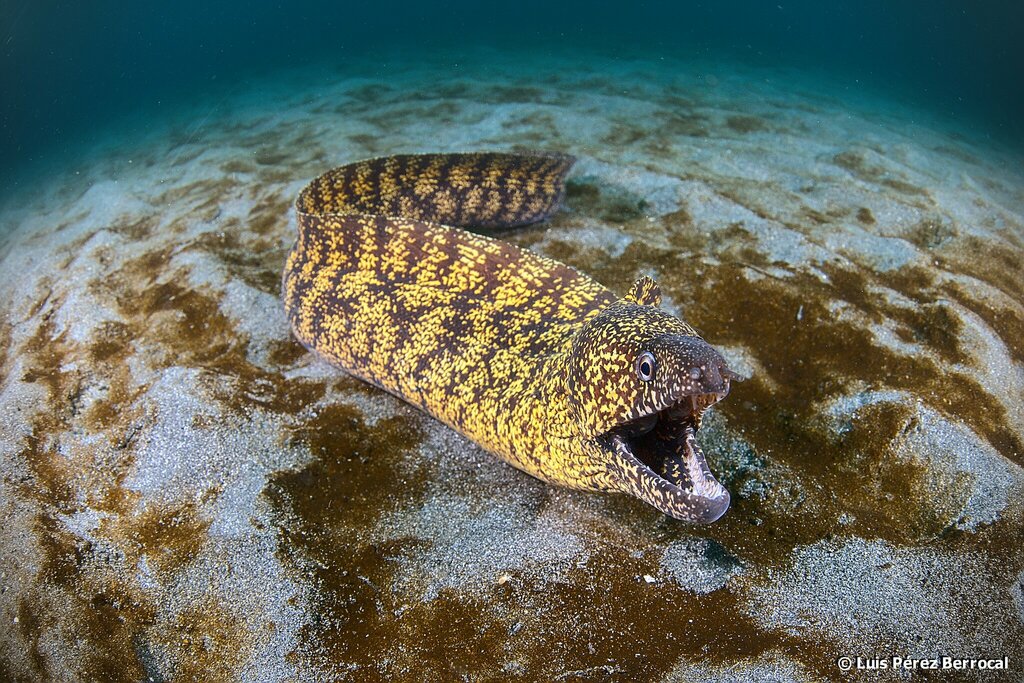
Kidako Moray
Gymnothorax kidako
The Kidako moray (Gymnothorax kidako) is a species of marine fish in the family Muraenidae. It inhabits coral reefs or lagoons and can be found in tropical and subtropical seas near Taiwan and Japan. The species is diurnal, which means it is more active in the daytime than the nighttime. It is also piscivorous: it consumes fish, octopus, and squid. Other than the Kidako moray, there are about 200 species of moray eels in the Muraenidae family. The Kidako moray doesn't attack humans unless they are provoked. However, due to the menacing looks of the Kidako moray and moray eels in general, they are feared by divers and snorkelers.
From the article Kidako moray on Wikipedia (CC BY-SA), quoted section by section
Description
The Kidako moray is a medium size fish that can reach a maximum length of 91cm. It has a brownish color with white spots (snowflake-like) on its head, body and fins. It also has a pattern of blotches all over its body. They continue onto its tail. However, some of the patterns disappear as they get closer to the tail. The snout and chin are brown with yellow streaks.
Range & habitat
Morays are commonly found in warm-temperature areas like tropical and subtropical seas. Specifically, the Kidako moray is found throughout the western Pacific area from Taiwan to Japan. The Kidako moray usually inhabits coral reefs or lagoons. They hide in rocky bottoms, but they expose their heads occasionally. Some of them also reside in waters up to 400 meters deep, where there is a lower temperature compared to the shallower areas where most of the moray eels inhabit. In addition, morays are usually known to be nocturnal; however, observation has discovered that many of them are also diurnal. Sometimes, the Kidako moray, which is quite common in some areas in Japan, is used for food. It is harvested in some minor commercial fisheries.
Wikipedia: “Distribution and habitat”
What it does
The Kidako moray is piscivorous. It consumes fish and cephalopods such as octopuses and squids to survive. The dietary habits of morays could be divided into two types, piscivory and durophagy. Feeding types differ depending on the sharpness of the teeth as well as the shape or size of the jaws. The species that have long caniniform teeth are more likely to consume octopus, fish, and crustaceans occasionally. On the other hand, species with molariform or short caniniform teeth tend to consume more on crustaceans.
Wikipedia: “Dietary habits”
At the table
Kidako moray is eaten in Japan, where it is called utsubo, although this name is also used for other moray eels. Few death cases were reported from consuming moray eels. As moray eels are being used as food in some places, fish poisoning has the chance to happen. On Saipan island, 57 people were reportedly poisoned by consuming moray 12 inches thick. This caused 2 deaths and 14 of them became comatose. Later in the investigation, it was found to be a typical ciguatera poisoning. The poison has a highly toxic compound that could show its highest levels in a large moray.
Wikipedia: “As food”
Where it lives
Recorded sightings
—
geo-referenced records in GBIF, from museums, herbaria and field observers.
Drag the globe to turn it. Dots are where records exist, not a range map; darker means more records.
In the stacks
Searching the stacks…
Every page naming Gymnothorax kidako in the Biodiversity Heritage Library →
This page is assembled live from iNaturalist, GBIF, Wikipedia, the Source Library and the Internet Archive. It is not yet part of the hand-edited codex. iNaturalist taxon 123526.