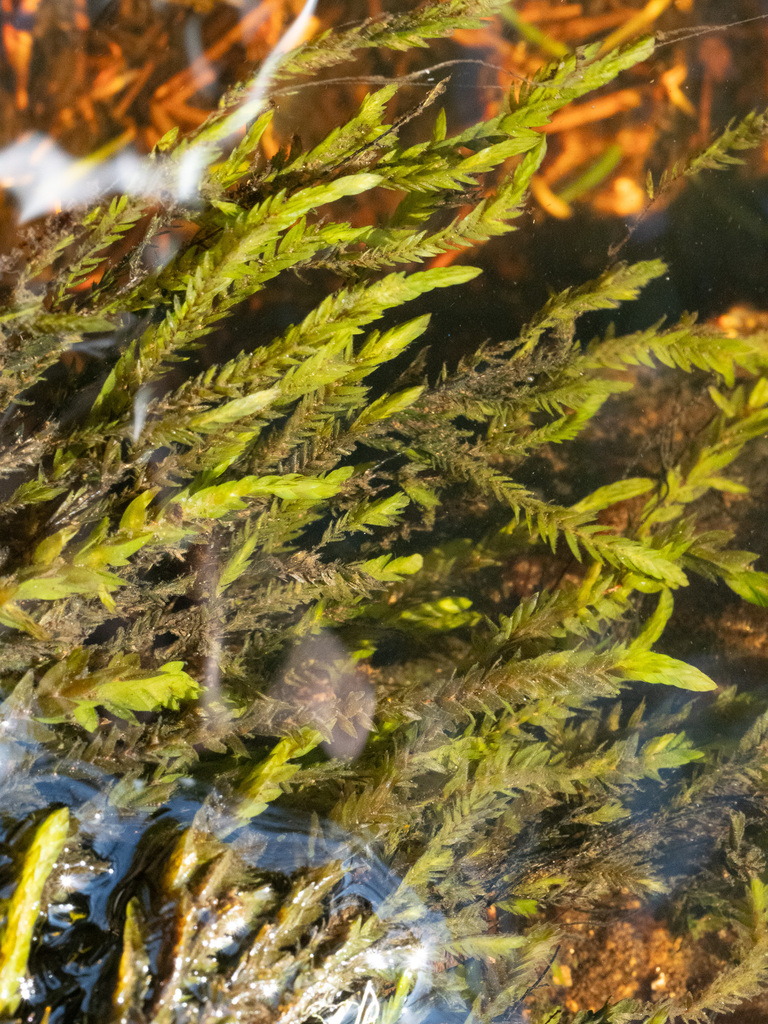
Willow Moss
Fontinalis antipyretica
Fontinalis antipyretica, greater water-moss, or common water moss, is a species of submerged aquatic moss belonging to the subclass Bryidae. It is found in both still and flowing freshwater in Europe, Asia, Greenland and Africa. In North America it is found in most Canadian provinces with a seaboard and most US states except the most southern.
From the article Fontinalis antipyretica on Wikipedia (CC BY-SA), quoted section by section
Description
F. antipyretica has branched, trailing stems that are triangular in cross-section and may be as long as 60 cm (24 in). The leaves are quite stiff and are arranged in three overlapping rows. Each leaf is lance-shaped or egg-shaped, with a keel and a sharp point, some 4 to 9 mm (0.16 to 0.35 in) long. There are no flowers but minute spores are sometimes produced in smooth sporangia (capsules) between 2 and 2.6 mm (0.08 and 0.10 in) long.
Range & habitat
F. antipyretica is found in Europe, Asia and parts of Africa. It grows attached to submerged rocks in fast-flowing water. It also occurs attached to the substrate in lakes and as floating masses in still water, and may be cast up on beaches at the waterside. It thrives in shady positions and prefers acidic water, with a pH of around 8.4 being the maximum tolerated. It is replaced in highly acid mountain and moorland streams in the UK by Fontinalis squamosa.
Wikipedia: “Distribution and habitat”
What it does
F. antipyretica grows in large clumps and mats and provides refuge for fish eggs and fry. Numerous invertebrates shelter among the fronds; Chironomid larvae hide in the bases of the leaves and mayfly, caddisfly and stonefly larvae cling to the fronds, and in fast-flowing water black fly larvae are often present. Diatoms and other microscopic algae grow epiphytically on the fronds.
Wikipedia: “Ecology”
At the table
F. antipyretica was traditionally used in cool-water aquaria, but in tropical aquaria the similarly structured "Java moss" ( a Vesicularia species) takes its place.
Wikipedia: “Aquarium uses”
Where it lives
Recorded sightings
—
geo-referenced records in GBIF, from museums, herbaria and field observers.
Drag the globe to turn it. Dots are where records exist, not a range map; darker means more records.
In the stacks
Searching the stacks…
Every page naming Fontinalis antipyretica in the Biodiversity Heritage Library →
This page is assembled live from iNaturalist, GBIF, Wikipedia, the Source Library and the Internet Archive. It is not yet part of the hand-edited codex. iNaturalist taxon 123790.