- Animals
- ›Chordates
- ›Vertebrates
- ›Reptiles
- ›Snakes and Lizards
- ›Lizards
- ›Iguanas and Allies
- ›Dragons and Chameleons
- ›Chameleons
- ›Trioceros
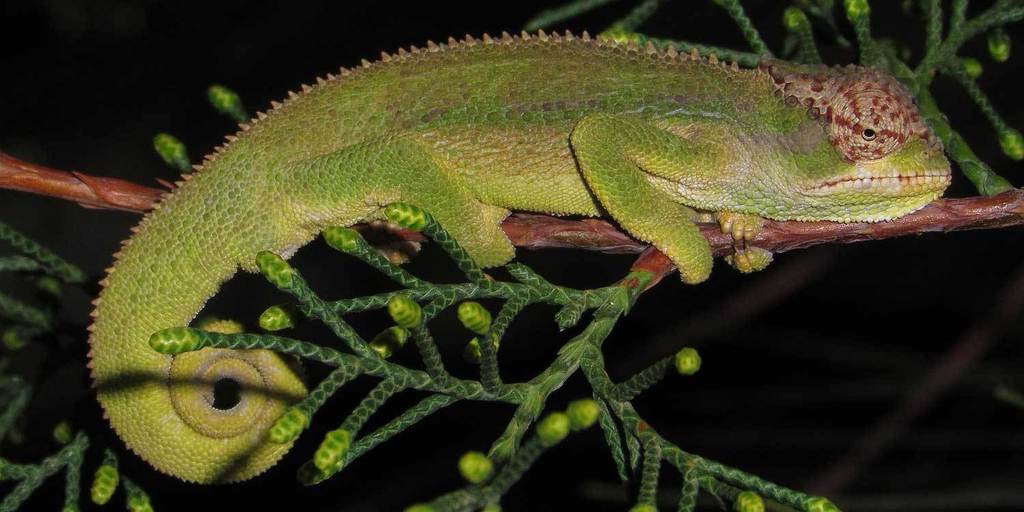
Dinsho Mountain Chameleon
Trioceros wolfgangboehmei
Wolfgang Böhme's Ethiopian chameleon (Trioceros wolfgangboehmei) is a species of chameleon found in the northern slopes of the Bale Mountains in Ethiopia. It is a small-sized chameleon of the Trioceros affinis species complex. The chameleon is approximately 6 inches (15 centimeters) in length, and are known for their distinctive crest of large, spiny scales along its back. The species is named after Wolfgang Böhme, senior herpetologist at the Zoological Research Museum Alexander Koenig, to honor his contributions to chameleon research.
From the article Trioceros wolfgangboehmei on Wikipedia (CC BY-SA), quoted section by section
Description
Wolfgang Böhme's Ethiopian chameleon can be distinguished from other species in the Trioceros affinis species complex though the following characteristics:
Prominent and well-developed dorsal crest with a low number of pointed and enlarged cone-shaped scales in a single row reaching to the lower half the tail; Top of the casque posteriorly raised above the dorsal crest; Heterogeneous body scalation containing both small standard scales and enlarged plate-like scales; Canthus parietalis formed from 9–12 enlarged scales; Area between lateral and temporal crest and the posterior rim of the orbit consists of wrinkled enlarged scales; 53-59 flank scales at midbody; Short snout-vent length, only up to 66 millimeters; Unique hemipenis morphology: smooth shaft, with four pairs of thick, pointed papillae and two pairs of non-serrated rotulae. Female and male T. wolfgangboehmei are similar morphologically. Females have slightly shorter snout-vent lengths on average, lower relative tail lengths, and lower head width/length ratios.
Male and female adult T. wolfgangboehmei are most commonly yellowish, brownish, or bright green. This color extends generally throughout the body, including on the dorsal crest. Most individuals have a bright white temporal spot posterior to the orbit. A dorso-lateral longitudinal stripe of enlarged, flattened scales may be present as well. …
Range & habitat
Population density has been estimated to be 20-40 individuals/hectare in natural forest edges, and 80-110 individuals/hectare in local gardens and farm areas. Trioceros wolfgangboehmei is native to the Bale Mountains in Dinsho and Goba. T. wolfgangboehmei resides on the northern and north-eastern slopes of the mountains, unlike other Trioceros species (T. harennae and T. balebicornutus) that are confined to the southern slopes. They primarily reside at altitudes around 2,000 to 3,000 meters above sea level. They prefer forest-edge zones, but may also live in the city centers of Goba and Robe in small fields and gardens. Adult chameleons prefer to live on small trees and bushes, whereas juveniles prefer grass adjacent to trees.
Wikipedia: “Habitat and Distribution”
Where it lives
Recorded sightings
—
geo-referenced records in GBIF, from museums, herbaria and field observers.
Drag the globe to turn it. Dots are where records exist, not a range map; darker means more records.
In the stacks
Searching the stacks…
Every page naming Trioceros wolfgangboehmei in the Biodiversity Heritage Library →
This page is assembled live from iNaturalist, GBIF, Wikipedia, the Source Library and the Internet Archive. It is not yet part of the hand-edited codex. iNaturalist taxon 1250147.