On eBird ↗
Crescent Honeyeater
Live sightings near you, the range map, bar charts of when it is seen, and Macaulay Library photos and recordings.
Crescent Honeyeater
Phylidonyris pyrrhopterus
The crescent honeyeater (Phylidonyris pyrrhopterus) is a passerine bird of the honeyeater family Meliphagidae native to southeastern Australia. A member of the genus Phylidonyris, it is most closely related to the common New Holland honeyeater (P. novaehollandiae) and the white-cheeked honeyeater (P. niger). Two subspecies are recognized, with P. p. halmaturinus restricted in range to Kangaroo Island and the Mount Lofty Ranges in South Australia.
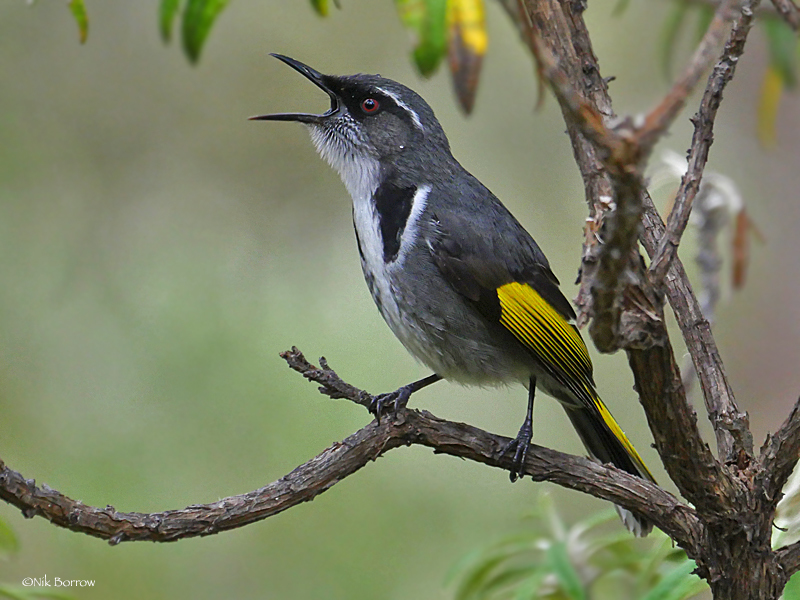
It has dark grey plumage and paler underparts, highlighted by yellow wing-patches and a broad, black crescent, outlined in white, down the sides of its breast. The species exhibits slight sexual dimorphism, with the female being duller in colour than the male. Juvenile birds are similar to the female, though the yellow wing-patches of male nestlings can be easily distinguished.
From the article Crescent honeyeater on Wikipedia (CC BY-SA), quoted section by section
Description
The crescent honeyeater measures 14–17 centimetres (5.5–6.7 in) in length with a wingspan of 16–23 centimetres (6.3–9.1 in), and it weighs about 16 grams (0.56 oz). It is sexually dimorphic with the female a paler version of the male. The male is mostly dark grey, with clear yellow wing-patches; a broad black crescent, outlined in white, down the sides of the breast; and a white streak above the eye. The top of the tail is black with yellow edges to the feathers forming distinctive yellow panels on the sides of the tail. White tips on the undertail are usually only visible in flight. The underparts are pale brownish-grey fading to white. The female is duller, more olive-brown than grey, with duller yellow wing-patches and faded crescent-shaped markings. Both sexes have dark grey legs and feet, deep ruby eyes and a long, downcurved black bill. The gape is also black. Young birds are similar to the adults, though not as strongly marked, and have dark grey bills, duller brown eyes, and yellow gapes. Male nestlings can be distinguished by their more extensive yellow wing-patches from seven days old. …
Wikipedia: “Appearance”
Range & habitat
There are records of scattered populations of the crescent honeyeater on the Central Tablelands, the Mid North Coast, and in the Hunter Region of New South Wales, and it is widespread in the areas of New South Wales south of Dharug National Park and east of Bathurst. In Victoria it is widespread across an area from the NSW border south west to Wallan with scattered populations recorded further west. It is widespread in Tasmania, except in the northeastern part of the state where it is more sparsely distributed. It is restricted to sclerophyll forest in eastern South Australia, where isolated populations have been recorded in the Mount Lofty Ranges and on Kangaroo Island. Local influxes have occurred outside its normal range in response to changes in habitat. Recorded population densities range from 0.3 birds per hectare (0.12/acre) near Orbost, to 8.7 pairs per hectare (3.5/acre) in Boola Boola State Forest, also in Victoria. While the crescent honeyeater occupies a wide variety of habitats including coastal heath, rainforest, wet sclerophyll forest, mountain forest, alpine woodland, damp gullies and thick tea-tree scrub, they all demonstrate its preference for dense vegetation. It has been frequently recorded in wet sclerophyll forest dominated by eucalypts and with a thick mid-story and understory of shrubs such as blackwood, silver wattle, Cassinia, Prostanthera, and Correa. …
Wikipedia: “Distribution and habitat”
What it does
The crescent honeyeater is arboreal, foraging mainly among the foliage and flowers in the understory and tree canopy on nectar, fruits and small insects. It has been recorded eating the honeydew of psyllids, soft scale and felt scale insects. It feeds primarily by probing flowers for nectar, and gleaning foliage and bark and sallying for insects. While regularly observed feeding singly or in pairs, the crescent honeyeater has also been recorded moving in loose feeding flocks, and gathering in large groups at productive food sources. A study in forest near Hobart in Tasmania found that the crescent honeyeater's diet was wholly composed of insects during the breeding season, while nectar was a significant component during winter. Insects consumed included moths and flies. Tree-trunks were the site of foraging around two-thirds of the time, and foliage a third. It fed on nectar as plants came into flower in the autumn and winter, and then foraged in Tasmanian blue gum (Eucalyptus globulus) during the breeding season in spring. The flowering of royal grevillea (Grevillea victoriae) over summer in subalpine areas in the Snowy Mountains attracted large numbers of crescent honeyeaters. It feeds intensively when sources are plentiful and, when feeding on flame heath (Astroloma conostephioides), it was recorded visiting an average of 34 flowers per minute. …
Wikipedia: “Feeding”
Listen
Looking for field recordings…
Where it lives
Recorded sightings
—
geo-referenced records in GBIF, from museums, herbaria and field observers.
Drag the globe to turn it. Dots are where records exist, not a range map; darker means more records.
In the stacks
Searching the stacks…
Every page naming Phylidonyris pyrrhopterus in the Biodiversity Heritage Library →
This page is assembled live from iNaturalist, GBIF, Wikipedia, the Source Library and the Internet Archive. It is not yet part of the hand-edited codex. iNaturalist taxon 12641.