- Animals
- ›Chordates
- ›Vertebrates
- ›Mammals
- ›Therians
- ›Placental Mammals
- ›Ungulates, Carnivorans, and Allies
- ›Carnivorans
- ›Mustelids
- ›Weasels
- ›Mustela
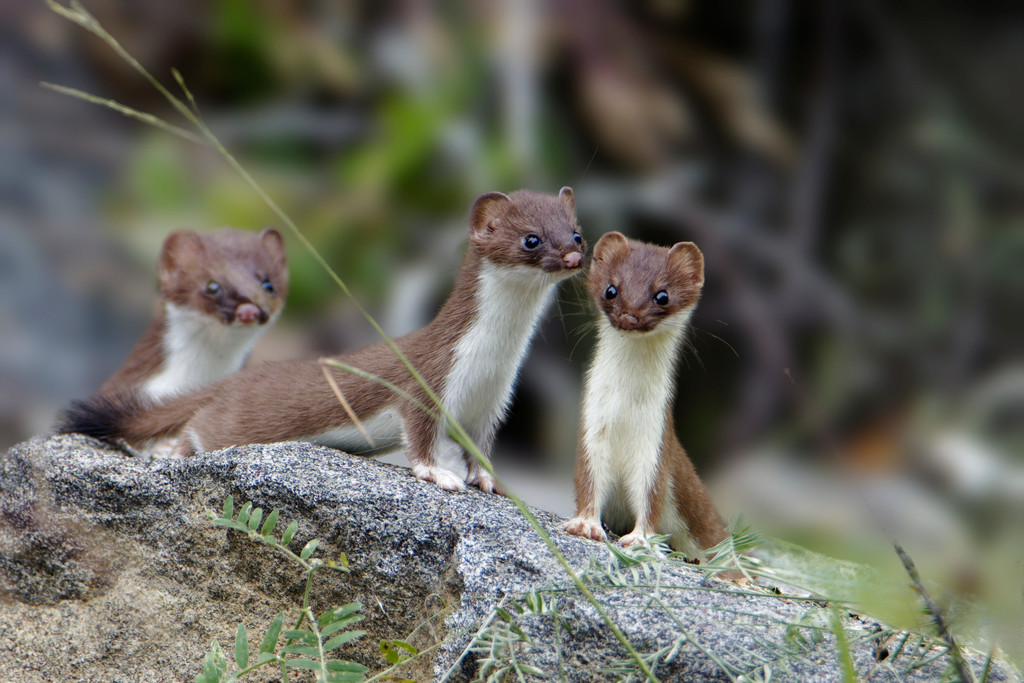
American Ermine
Mustela richardsonii
The American ermine or American stoat (Mustela richardsonii) is a member of the family Mustelidae and of the genus mustelid. Previously thought of as conspecific with the stoat (M. erminea), they have a body plan typical of weasels and are native to most of North America. There are currently 13 recognized subspecies. American ermines are small carnivorous mammals that live in a variety of terrestrial habitats, such as forests and wetlands.
From the article American ermine on Wikipedia (CC BY-SA), quoted section by section
Description
The American ermine has a body plan typical of weasels. It has short legs, a long body and neck, and a small triangular head with short round ears. It has a brown dorsum with a white venter (except during winter when the coat is fully white) and a short, black-tipped tail. The black coloring of the tail may serve to distract predators and divert attacks away from the body, which blends in more with its surroundings. American ermines are sexually dimorphic and males are 30% larger than females.
Range & habitat
The species is found throughout most of North America aside from most of Alaska (although it is found on some islands in southeastern Alaska), eastern Yukon, most of Arctic Canada, and Greenland, where it is replaced by M. erminea. It reaches the northern extent of its range in Ellesmere Island and a portion of eastern mainland Nunavut and ranges from here to cover almost all of western North America south to northern New Mexico, and eastern North America south to northern Virginia. It is absent from most of the Southeastern United States and the Great Plains.
Wikipedia: “Distribution”
What it does
Ermines are primarily nocturnal hunters, although they can also be seen frequently during the day. In North America, where the ecological niche for rat- and rabbit-sized prey is taken by the larger long-tailed weasel (Neogale frenata), the carnivorous American ermine preys mainly on mice and voles. Shrews, young cottontails, chipmunks, deer mice, jumping mice, and house mice are also preyed on. Occasionally, small birds, frogs, small fish, and earthworms are eaten. Usually the ermine kills by biting at base of skull.
Wikipedia: “Diet”
Listen
Looking for field recordings…
Where it lives
Recorded sightings
—
geo-referenced records in GBIF, from museums, herbaria and field observers.
Drag the globe to turn it. Dots are where records exist, not a range map; darker means more records.
In the stacks
Searching the stacks…
Every page naming Mustela richardsonii in the Biodiversity Heritage Library →
This page is assembled live from iNaturalist, GBIF, Wikipedia, the Source Library and the Internet Archive. It is not yet part of the hand-edited codex. iNaturalist taxon 1264427.