On eBird ↗
Gray Honeyeater
Live sightings near you, the range map, bar charts of when it is seen, and Macaulay Library photos and recordings.
Grey Honeyeater
Conopophila whitei
The grey honeyeater (Conopophila whitei) is a species of bird in the honeyeater family.
It is an uncommon and little-known bird, an often overlooked endemic of remote areas in central Australia.
From the article Grey honeyeater on Wikipedia (CC BY-SA), quoted section by section
Description
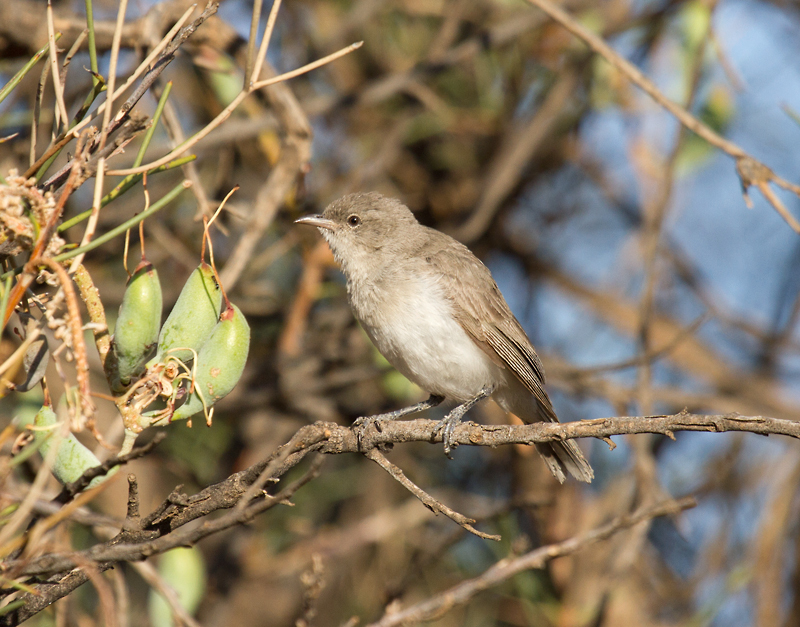
A tiny honeyeater, grey and discreet, with a nondescript colouration that is only faintly marked. The length is 10.5–12 cm (4.1–4.7 in). The plumage of the upper body is generally cold grey, the lower parts paler, becoming browner until a moult. Tail and flight feathers are a blackish brown, and a slightly darker marking extends across the eye to the bill. The tips of the tail feathers are white, aging to buffish. The bill is relatively short for a honeyeater, slightly down-curved and grey, becoming black toward the tip. There is a pale and indistinct ring of feathers, tinted buff, around the eye. The colour of the iris is brown, the legs are steel grey. Juveniles have a faintly yellowish cast to the thin eye-ring, that almost disappears as they mature, and on the pale grey feathers of the throat. The grey flight feathers of the immature birds have a yellow-green wash. The grey honeyeater is similar in appearance to the Western gerygone (Gerygone fusca), yellow-rumped thornbill (Acanthiza chrysorrhoa) and others of the genus Acanthiza, all of which it often accompanies in mixed species flocks. Care should be taken to distinguish the grey honeyeater from the female redthroat (Pyrrholaemus brunneus)
Voice. …
Range & habitat
The grey honeyeater is found in a range extending across the mid-west to the centre of the Australian continent, especially in the Pilbara and Murchison regions of Western Australia, and southern and central Northern Territory. It is rare to uncommon and probably sedentary with some nomadic movement. The species is found in semi-arid mulga (Acacia aneura) and similar acacia scrublands. The occurrence of mistletoe may be an important factor in determining its distribution. Some good locations for finding the grey honeyeater are the Olive Pink Botanic Garden, Alice Springs, in the Northern Territory, and Wanjarri Nature Reserve, south of Wiluna, and Tom Price, in Western Australia.
Wikipedia: “Distribution and habitat”
What it does
The grey honeyeater is primarily insectivorous, busily gleaning the surface of foliage for lerp and similar insects or hovering to capture flying insects. It also feeds on nectar by piercing the deep, tubular flowers of species such as Eremophila, and on the nectar and berries of mistletoe.
Wikipedia: “Feeding”
Listen
Looking for field recordings…
Where it lives
Recorded sightings
—
geo-referenced records in GBIF, from museums, herbaria and field observers.
Drag the globe to turn it. Dots are where records exist, not a range map; darker means more records.
In the stacks
Searching the stacks…
Every page naming Conopophila whitei in the Biodiversity Heritage Library →
This page is assembled live from iNaturalist, GBIF, Wikipedia, the Source Library and the Internet Archive. It is not yet part of the hand-edited codex. iNaturalist taxon 12670.