On eBird ↗
Oahu Oo
Live sightings near you, the range map, bar charts of when it is seen, and Macaulay Library photos and recordings.
Oahu 'O'o
Moho apicalis
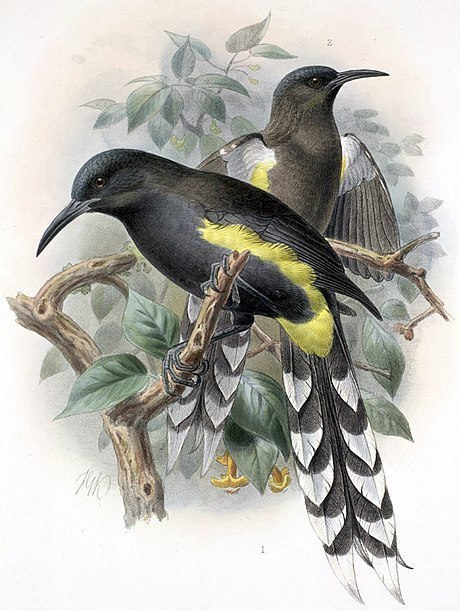
The Oʻahu ʻōʻō (Moho apicalis) is an extinct species of Hawaiian honeyeater in the genus Moho. It was previously regarded as member of the Australo-Pacific honeyeaters (Meliphagidae), and was endemic to Oʻahu.
From the article Oʻahu ʻōʻō on Wikipedia (CC BY-SA), quoted section by section
Description
The males reached a length of 30.5 centimeters. The wing length was 10.5 to 11.4 centimeters, the culmen was between 3.5 and 3.8 centimeters and the tarsus was between 3.4 and 3.8 centimeters. The females were smaller. The plumage was predominantly sooty black. The tail feathers were brown and had, with the exception of the two central tail feathers, white tips. Further characteristics were the white feather tufts under the axillaries and the two narrow central tail feathers which changed into fine hair-like or fibrous tips. The flanks and the undertail coverts were colored deeply yellow. The bill and the tarsus were black. It possessed a specialized tongue that was used for extracting various floral nectars from different flower species and had a thin, black bill that gently bent downward. Its biology was not well-studied.
Range & habitat
Its habitat was the wet mountain forests on Oʻahu. When specimens of Oʻahu ʻōʻō were found, they were collected scattered throughout the Koʻolau Range, until two zoologists, Olson and James, found subfossils of the birds at Barber's Point, which could point to the fact that these species' historical range may have extended across Oʻahu entirely.
Wikipedia: “Distribution and habitat”
What it does
Due to being the first Moho species to go extinct so early, historical documents towards the bird are limited. However, it is believed that its traits are similar to the other three species in the Moho genus. Its behavior was believed to also have been similar to another extinct relative, the kioea.
Wikipedia: “Behavior”
In human culture
During the pre-contact days, early Hawaiians used feathers from birds such as the Oʻahu ʻōʻō for clothing, especially for royal capes and headdresses. The common people also gathered feathers loosely into small tied bunches for tax payments to the ruling class.
Wikipedia: “Cultural significance”
Listen
Looking for field recordings…
Where it lives
Recorded sightings
—
geo-referenced records in GBIF, from museums, herbaria and field observers.
Drag the globe to turn it. Dots are where records exist, not a range map; darker means more records.
In the stacks
Searching the stacks…
Every page naming Moho apicalis in the Biodiversity Heritage Library →
This page is assembled live from iNaturalist, GBIF, Wikipedia, the Source Library and the Internet Archive. It is not yet part of the hand-edited codex. iNaturalist taxon 12673.