On eBird ↗
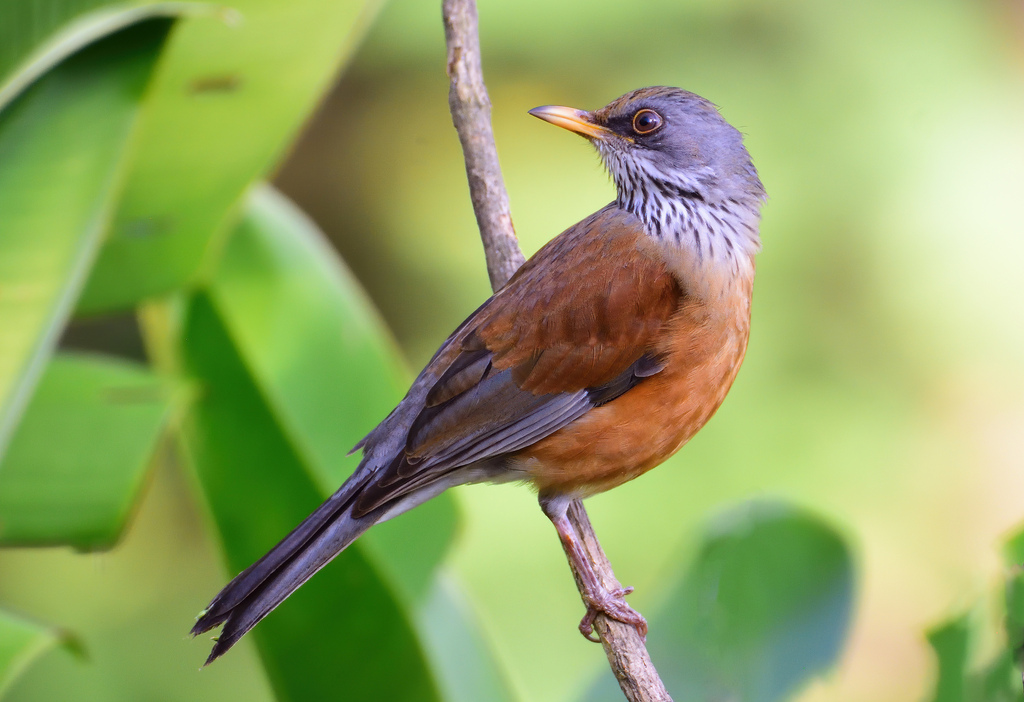
Rufous-backed Robin
Live sightings near you, the range map, bar charts of when it is seen, and Macaulay Library photos and recordings.
Rufous-backed Robin
Turdus rufopalliatus
The rufous-backed thrush (Turdus rufopalliatus) is a species of bird in the family Turdidae. It is endemic to Mexico but is also a casual visitor to the southwestern United States. It is also known as the rufous-backed robin.
From the article Rufous-backed thrush on Wikipedia (CC BY-SA), quoted section by section
Description
The rufous-backed thrush is similar in size and shape to the American robin (T. migratorius). It is 21.5 to 25.5 cm (8.5 to 10 in) long and weighs 72 to 85 g (2.5 to 3.0 oz). It has a wingspan of about 40 cm (16 in). The sexes have similar plumage though females are overall duller than males. Adults of the nominate subspecies T. r. rufopalliatus have a pale gray head with black lores and a yellow eye-ring. Their mantle, wings, and tail are pale gray. Their back and scapulars are dull chestnut with a gray wash. Their throat and the sides of their neck are white with dark streaks. Their breast and flanks are orange-chestnut and their belly and vent are white. They have a yellow bill. Juveniles are similar to adults with the addition of buffy stipples and streaks on their upperparts and dark mottling and barring on their underparts. Subspecies T. r. interior is very like the nominate but with a duller, more maroon, back. T. r. graysoni is larger than the nominate. Its scapulars are grayish buff and its breast and flanks mostly dull buff.
Range & habitat
The nominate subspecies of the rufous-backed thrush is found in western Mexico from Sonora south to about Jalisco. It also is an occasional visitor to southeastern California, southern Arizona, south-central New Mexico, and far western Texas. Subspecies T. r. interior is found in south-central Mexico from Jalisco south to western Puebla and Oaxaca. T. r. graysoni is found on the Tres Marías Islands off western Mexico and as a non-breeding visitor to the mainland in Nayarit. There are isolated populations of the species in Mexico City and Oaxaca City that are probably descended from escaped cage birds. The rufous-backed thrush inhabits a variety of arid to semi-humid landscapes in the tropical and subtropical zones. These include deciduous and semi-deciduous forest, gallery forest, thorn forest, plantations, and gardens. Sources differ on its maximum elevation; one says it is 2,500 m (8,200 ft) and another says 1,500 m (4,900 ft). On the Tres Marias Islands it reaches 600 m (2,000 ft).
Wikipedia: “Distribution and habitat”
What it does
The rufous-backed thrush primarily feeds on fruit, at least in the non-breeding season. It forages on the ground and in trees and bushes. In winter it is often in flocks.
Wikipedia: “Feeding”
Listen
Looking for field recordings…
Where it lives
Recorded sightings
—
geo-referenced records in GBIF, from museums, herbaria and field observers.
Drag the globe to turn it. Dots are where records exist, not a range map; darker means more records.
In the stacks
Searching the stacks…
Every page naming Turdus rufopalliatus in the Biodiversity Heritage Library →
This page is assembled live from iNaturalist, GBIF, Wikipedia, the Source Library and the Internet Archive. It is not yet part of the hand-edited codex. iNaturalist taxon 12714.