On eBird ↗
Cocoa Thrush
Live sightings near you, the range map, bar charts of when it is seen, and Macaulay Library photos and recordings.
Cocoa Thrush
Turdus fumigatus
The cocoa thrush (Turdus fumigatus) is a species of bird in the family Turdidae. It is found on St. Vincent, Grenada, and Trinidad and in Argentina, Brazil, Colombia, French Guiana, Guyana, Suriname, and Venezuela.
From the article Cocoa thrush on Wikipedia (CC BY-SA), quoted section by section
Description
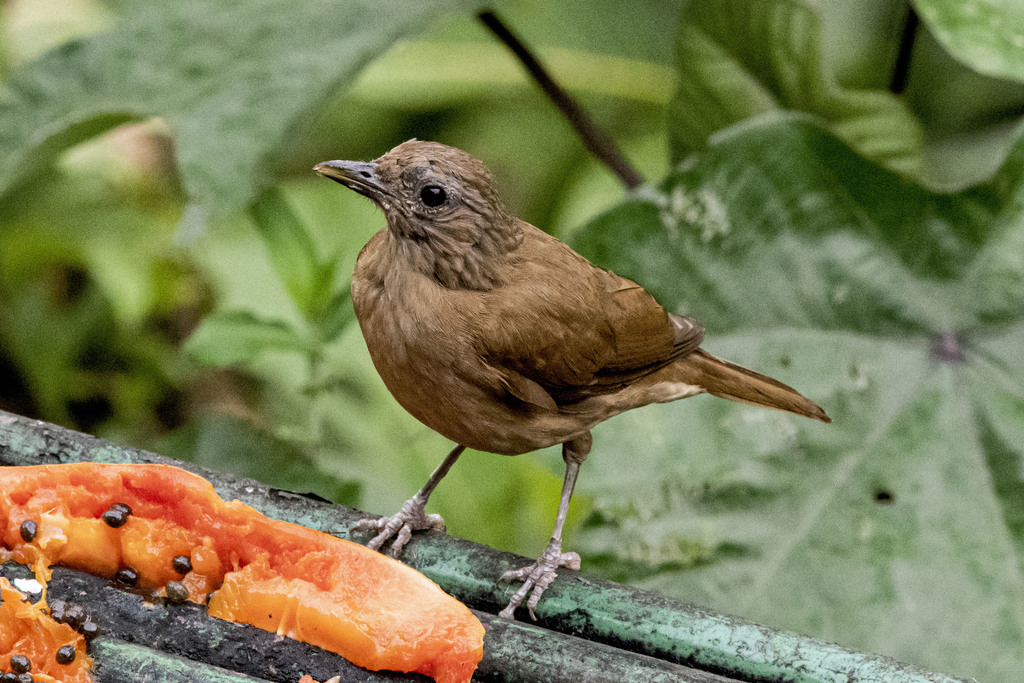
The cocoa thrush is 21.5 to 24 cm (8.5 to 9.4 in) long and weighs 55 to 83 g (1.9 to 2.9 oz). The sexes have the same plumage. Adults of the nominate subspecies T. f. fumigatus have a foxy-brown head, upperparts, wings, and tail. Their throat is whitish buff with dark streaks, their breast and flanks pale orange-brown, and their belly to vent whitish with brown feather tips on the latter. Juveniles resemble adults with the addition of buff streaks and spots on their upperparts, wing bars made of orangey spots, and dark brown mottling on buffy orange underparts. All subspecies have a dark iris and brownish gray bill, legs, and feet. The other subspecies differ from the nominate and each other thus:
T. f. aquilonalis: less rufous on upper- and underparts than nominate T. f. orinocensis: slightly darker upperparts and less white underparts than nominate T. f. bondi: less rufous upperparts than nominate and grayish brown underparts T. f. personus: buffish brown underparts
Range & habitat
The subspecies of the cocoa thrush are found thus:
T. f. aquilonalis: Trinidad; Serranía del Perijá on the Venezuela-Colombia border; western base of Venezuelan Andes in Táchira; east of Venezuelan Andes from Lara east to Sucre and Monagas T. f. orinocensis: eastern base of Venezuelan Andes from Barinas south and western Amazonas; west into central and eastern Colombia T. f. fumigatus: from Delta Amacuro and eastern Bolívar in Venezuela east through the Guianas and much of Amazonian Brazil; separately in southeastern Brazil between Alagoas and São Paulo states T. f. bondi: St. Vincent T. f. personus: Grenada The southern and eastern edges of the species' range in Amazonian Brazil roughly follow a line from southern Rondônia east to southern Tocantins and then northeast to the Atlantic in Maranhão. In addition to the above, the SACC and eBird have records in Argentina. Some sources include eastern Bolivia in the range of T. f. fumigatus. The IOC does not and the South American Classification Committee (SACC) has no records in that country. BirdLife International places the species on many other islands in the Lesser Antilles in addition to St. Vincent and Grenada; no other source does so. The cocoa thrush inhabits a variety of landscapes, many of which are somewhat open. They include the interior, clearings, and edges of humid forest, somewhat open woodlands, and gallery forest. …
Wikipedia: “Distribution and habitat”
What it does
The cocoa thrush feeds on fruit, larval and adult insects, and other invertebrates such as worms and millipedes. It takes fruit from trees and other diet items primarily on the ground.
Wikipedia: “Feeding”
Listen
Looking for field recordings…
Where it lives
Recorded sightings
—
geo-referenced records in GBIF, from museums, herbaria and field observers.
Drag the globe to turn it. Dots are where records exist, not a range map; darker means more records.
In the stacks
Searching the stacks…
Every page naming Turdus fumigatus in the Biodiversity Heritage Library →
This page is assembled live from iNaturalist, GBIF, Wikipedia, the Source Library and the Internet Archive. It is not yet part of the hand-edited codex. iNaturalist taxon 12715.