On eBird ↗
Izu Thrush
Live sightings near you, the range map, bar charts of when it is seen, and Macaulay Library photos and recordings.
Izu Thrush
Turdus celaenops
The Izu thrush or Izu Islands thrush (Turdus celaenops) is a thrush native to the Izu and Ryukyu Islands of Japan, in particular, Hachijojima, Mikurajima, and Miyakejima in the former chain, and Yakushima and the Tokara Islands in the latter. This species is absent from the main islands of Japan, and due to its limited range, is listed in the IUCN Red List as Vulnerable.
From the article Izu thrush on Wikipedia (CC BY-SA), quoted section by section
Description
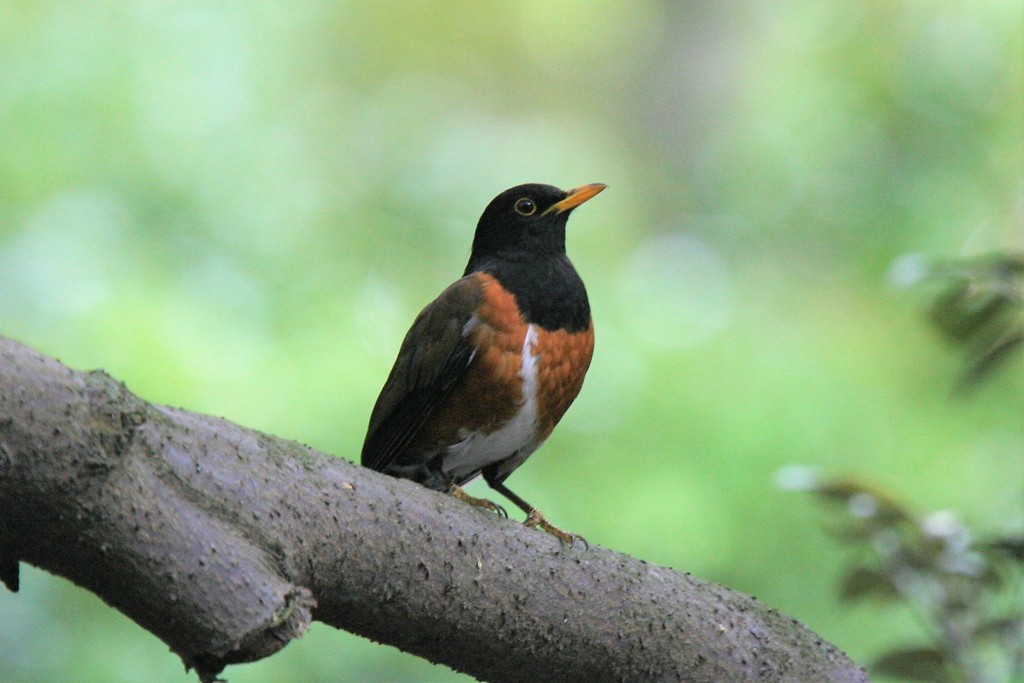
The Izu thrush is about 23 cm (9.1 in) long. Their back and tails are black and they have a yellow eye-ring and bill, brown wings, and a rust-red chest. The males have darker plumage than that of the females.
Range & habitat
The Izu thrush is an endemic bird of Japan. Most are on the Izu Islands. On Izu Ōshima, Miyakejima and Mikurajima they sing two syllables. The song of the population of Hachijojima 90 km (56 mi) south sounds entirely different with one syllable. On their last island of the chain Aogashima they have more syllables. Some less densely populated are on the Tokara Islands Yakushima, Kuchinoshima, Nakanoshima, Tairajima, Akusekijima and Takarajima. On Nakanoshima the song is composed of more syllables. In addition, there are wintering records from Shizuoka, Chiba, Mie and Wakayama Prefectures.
Wikipedia: “Distribution”
What it does
Izu thrushes eat small animals, such as earthworms and insects, and fruits, like cherries or mullberries.
Wikipedia: “Feeding”
Listen
Looking for field recordings…
Where it lives
Recorded sightings
—
geo-referenced records in GBIF, from museums, herbaria and field observers.
Drag the globe to turn it. Dots are where records exist, not a range map; darker means more records.
In the stacks
Searching the stacks…
Every page naming Turdus celaenops in the Biodiversity Heritage Library →
This page is assembled live from iNaturalist, GBIF, Wikipedia, the Source Library and the Internet Archive. It is not yet part of the hand-edited codex. iNaturalist taxon 12723.