- Animals
- ›Chordates
- ›Vertebrates
- ›Mammals
- ›Therians
- ›Placental Mammals
- ›Primates, Rodents, and Allies
- ›Primates
- ›Monkeys, Apes, and Tarsiers
- ›Monkeys and Apes
- ›Apes and Old World Monkeys
- ›Apes
- ›Great Apes
- ›African Hominids
- ›Australopithecus
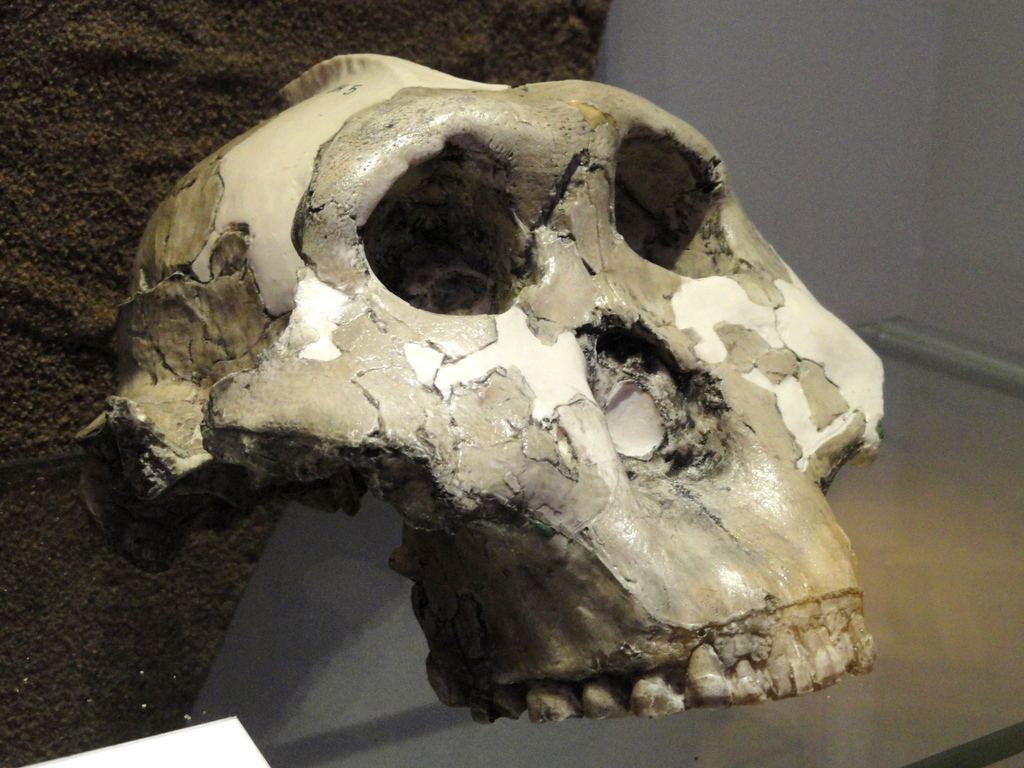
Australopithecus robustus
Paranthropus robustus is an extinct species of robust australopithecine from the Early and possibly Middle Pleistocene of the Cradle of Humankind, South Africa, about 2.27 to 0.87 (or, more conservatively, 2 to 1) million years ago. It has been identified in Kromdraai, Swartkrans, Sterkfontein, Gondolin, Cooper's, and Drimolen Caves. Discovered in 1938, it was among the first early hominins described, and became the type species for the genus Paranthropus. However, it has been argued by some that Paranthropus is an invalid grouping and synonymous with Australopithecus, so the species is also often classified as Australopithecus robustus.
Robust australopithecines—as opposed to gracile australopithecines—are characterised by heavily built skulls capable of producing high stresses and bite forces, as well as inflated cheek teeth (molars and premolars). Males had more heavily built skulls than females. P. robustus may have had a genetic susceptibility for pitting enamel hypoplasia on the teeth, and seems to have had a dental cavity rate similar to non-agricultural modern humans. The species is thought to have exhibited marked sexual dimorphism, with males substantially larger and more robust than females. Based on 3 specimens, males may have been 132 cm (4 ft 4 in) tall and females 110 cm (3 ft 7 in). Based on 4 specimens, males averaged 40 kg (88 lb) in weight and females 30 kg (66 lb). The brain volume of the specimen SK 1585 is estimated to have been 476 cc, and of DNH 155 about 450 cc (for comparison, the brain volume of contemporary Homo varied from 500 to 900 cc). P.
From the article Paranthropus robustus on Wikipedia (CC BY-SA), quoted section by section
What it does
In 1954, Robinson suggested that the heavily built skull of P. robustus and resultantly exorbitant bite force was indicative of a specialist diet adapted for frequently cracking hard foods such as nuts. Because of this, the predominant model of Paranthropus extinction for the latter half of the 20th century was that they were unable to adapt to the volatile climate of the Pleistocene, unlike the much more adaptable Homo. Subsequent researchers reinforced this model studying the musculature of the face, dental wearing patterns, and primate ecology. In 1981, English anthropologist Alan Walker, while studying the P. boisei skulls KNM-ER 406 and 729, pointed out that bite force is a measure of not only the total pressure exerted but also the surface area of the tooth over which the pressure is being exerted, and Paranthropus teeth are 4–5 times the size of modern human teeth. Because the chewing muscles are arranged the same way, Walker postulated that the heavy build was instead an adaptation to chew a large quantity of food at the same time. He also found that microwearing on 20 P. boisei molar specimens were indistinguishable from patterning recorded in mandrills, chimps, and orangutans. …
Wikipedia: “Diet”
In human culture
In 1968, American anthropologist Alan Mann, using dental maturity, stratified P. robustus specimens from Swartkrans into different ages, and found an average of 17.2 years at death (they did not necessarily die from old age), and the oldest specimen was 30–35 years old. He also reported an average of 22.2 years for A. africanus. Using these, he argued these hominins had a humanlike prolonged childhood. In response, in 1971, biologist Kelton McKinley repeated Mann's process with more specimens, and (including P. boisei) reported an average of 18 years. McKinley agreed with Mann that P. robustus may have had a prolonged childhood. McKinley also speculated that sexual maturity was reached at approximately 11 years because it is about halfway between the averages for chimps (9 years) and humans (13). Based on this, he concluded babies were birthed at intervals of 3 to 4 years using a statistical test to maximise the number of children born. In 1972, after estimating a foetal size of 1,230–1,390 g (2.7–3.1 lb) based on an adult female weight of 50 kg (110 lb), anthropologist Walter Leutenegger estimated foetal head size at about 110–160 cc (6.7–9.8 cu in), similar to a chimp. In 1973, using this and an equation between foetal head size and gestation (assuming foetal growth rate of 0.6 for all mammals), biologist John Frazer estimated a gestation of 300 days for P. robustus. …
Wikipedia: “Life history”
Listen
Looking for field recordings…
Where it lives
Recorded sightings
—
geo-referenced records in GBIF, from museums, herbaria and field observers.
Drag the globe to turn it. Dots are where records exist, not a range map; darker means more records.
In the stacks
Searching the stacks…
Every page naming Australopithecus robustus in the Biodiversity Heritage Library →
This page is assembled live from iNaturalist, GBIF, Wikipedia, the Source Library and the Internet Archive. It is not yet part of the hand-edited codex. iNaturalist taxon 127273.