- Animals
- ›Chordates
- ›Vertebrates
- ›Mammals
- ›Therians
- ›Placental Mammals
- ›Primates, Rodents, and Allies
- ›Primates
- ›Monkeys, Apes, and Tarsiers
- ›Monkeys and Apes
- ›Apes and Old World Monkeys
- ›Apes
- ›Great Apes
- ›African Hominids
- ›Australopithecus
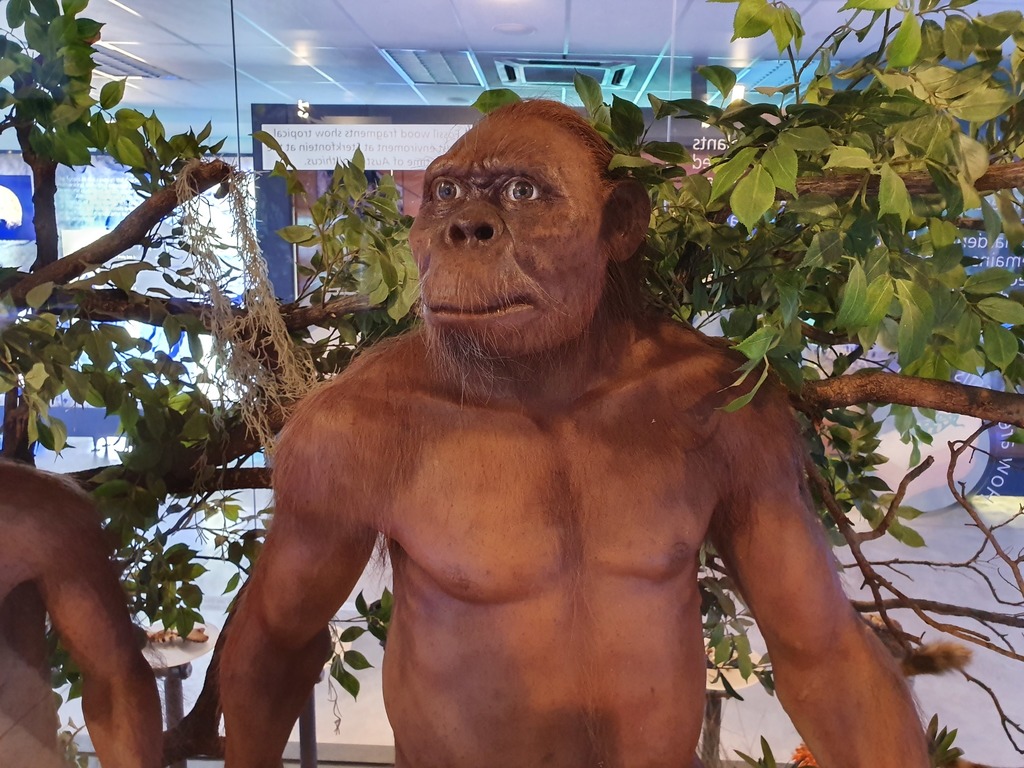
Australopithecus africanus
Australopithecus africanus is an extinct species of australopithecine which lived between about 3.3 and 2.1 million years ago in the Late Pliocene to Early Pleistocene of South Africa. The species has been recovered from Taung, Sterkfontein, Makapansgat, and Gladysvale. The first specimen, the Taung Child, was described by anatomist Raymond Dart in 1924, and was the first early hominin found. However, its closer relations to humans than to other apes would not become widely accepted until the middle of the century because most had believed humans evolved outside of Africa. It is unclear how A. africanus relates to other hominins, being variously placed as ancestral to Homo and Paranthropus, to just Paranthropus, or to just P. robustus. The oldest known South African australopith specimen "Little Foot", representing the most completely preserved early hominin with 90% of the skeleton intact, has been controversially suggested to represent A. africanus, its probable junior synonym A. prometheus, or neither of the two taxa.
A. africanus brain volume was about 420–510 cc (26–31 cu in). Like other early hominins, the cheek teeth were enlarged and had thick enamel. Male skulls may have been more robust than female skulls. Males may have been on average 140 cm (4 ft 7 in) in height and 40 kg (88 lb) in weight, and females 125 cm (4 ft 1 in) and 30 kg (66 lb). A. africanus was a competent biped, albeit less efficient at walking than humans. A. africanus also had several upper body traits in common with arboreal non-human apes.
From the article Australopithecus africanus on Wikipedia (CC BY-SA), quoted section by section
What it does
In 1954, Robinson proposed that A. africanus was a generalist omnivore whereas P. robustus was a specialised herbivore; and in 1981, American palaeoanthropologist Frederick E. Grine suggested that P. robustus specialised on hard foods such as nuts whereas A. africanus on softer foods such as fruits and leaves. Based on carbon isotope analyses, A. africanus had a highly variable diet which included a notable amount of C4 savanna plants such as grasses, seeds, rhizomes, underground storage organs, or perhaps grass-eating invertebrates (such as locusts or termites), grazing mammals, or insectivores or carnivores. Most primates do not eat C4 plants. More recent carbon and nitrogen isotope analysis of A. africanus specimens from Sterkfontein has suggested that mammal meat was not a significant component of their diet. A. africanus facial anatomy seems to suggest adaptations for producing high stress on the premolars, useful for eating small, hard objects such as seeds and nuts that need to be cracked open by the teeth, or for processing a large quantity of food at one time. However, like for P. robustus, microwear analysis on the cheek teeth indicate small, hard foods were infrequently eaten, probably as fall back foods during leaner times. Still, A. africanus, like chimps, may have required hammerstones to crack open nuts (such as marula nuts), though A. …
Wikipedia: “Diet”
Listen
Looking for field recordings…
Where it lives
Recorded sightings
—
geo-referenced records in GBIF, from museums, herbaria and field observers.
Drag the globe to turn it. Dots are where records exist, not a range map; darker means more records.
In the stacks
Searching the stacks…
Every page naming Australopithecus africanus in the Biodiversity Heritage Library →
This page is assembled live from iNaturalist, GBIF, Wikipedia, the Source Library and the Internet Archive. It is not yet part of the hand-edited codex. iNaturalist taxon 127276.